Free HVAC maintenance checklist templates: 7 printable checklists, an equipment log and a PM schedule
- Free. No signup and no email asked; every link goes straight to the file.
- Deepsel is our product. The checklists prove the work, Deepsel tracks the visit against the agreement, and the last section says so.
- The checklists don't replace the manufacturer's service instructions or safety training. Gas and electrical checks are for licensed techs.
Nine free maintenance checklist templates for HVAC shops, all on this page: seven printable checklists (the full spring-and-fall visit, AC, furnace, heat pump, inspection, tune-up report card, commercial rooftop units), an equipment maintenance log and a 12-month preventive maintenance schedule. Each checklist prints the target reading beside the task. One-click Google Docs or Sheets copy, Word or Excel, and PDF. No email asked.
I built these while writing the free HVAC maintenance agreement template. Section 3.3 of that agreement promises a list of tasks on every visit, and a shop needs a sheet that proves each task happened. The free checklists that already rank for these searches didn't do the job. Most are homeowner tip lists. The contractor-grade ones sit behind an email form, and none of them print the number the tech should see. A checkbox next to "check capacitor" proves nothing. "42.1 µF on a 45 µF rating" proves the capacitor was checked, and it tells the next tech what to expect.
Every file below is free, opens without a form, and copies into your own Google Drive in one click so you can put your logo on it. The seven checklists also download as Word and PDF. The two spreadsheets download as Excel.
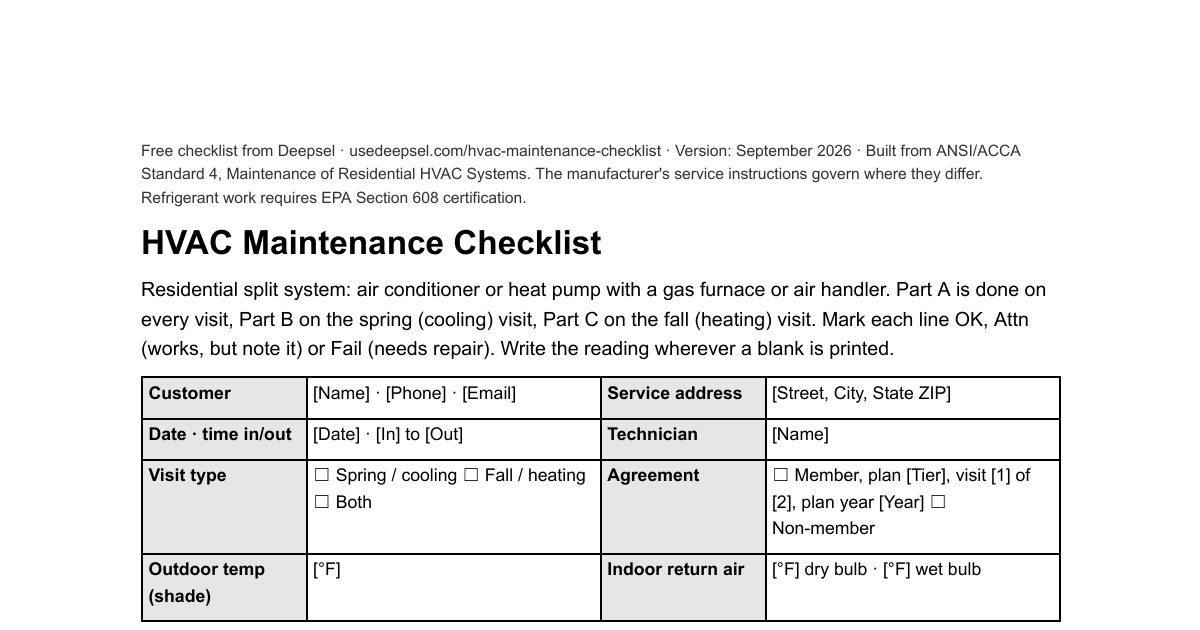
The nine templates
| Template | Use it for | What's inside | Format | Get it |
|---|---|---|---|---|
| HVAC maintenance checklist | The seasonal visit on a split system: spring cooling, fall heating | Every-visit tasks, a spring cooling page, a fall gas-furnace page, and a readings table with the target beside each number | 5-page PDF, Word, Google Docs | Google Docs copy · PDF · Word |
| AC maintenance checklist | The cooling visit on a split, packaged or ductless system | Eight sections with target ranges: temperature split, static pressure, capacitor tolerance, superheat or subcooling, plus the refrigerant leak rules | 4-page PDF, Word, Google Docs | Google Docs copy · PDF · Word |
| Furnace maintenance checklist | The fall heating visit on a gas, condensing, electric or oil furnace | CO action levels, heat exchanger, igniter ohms, flame sensor microamps, gas pressures, temperature rise, combustion analysis targets | 3-page PDF, Word, Google Docs | Google Docs copy · PDF · Word |
| Heat pump maintenance checklist | Both visits on a heat pump, including inverter and ductless units | A cooling-mode block for spring and a heating-mode block for fall: forced defrost, reversing valve, heat-strip amps by stage, aux-heat lockout | 3-page PDF, Word, Google Docs | Google Docs copy · PDF · Word |
| HVAC inspection checklist | A first visit on a new agreement, a home sale, a landlord walk-through | Nameplate capture for every unit, safety checks, readings against targets, a five-point condition grade, and a findings table that marks pre-existing problems | 3 pages per unit, PDF, Word, Google Docs | Google Docs copy · PDF · Word |
| HVAC tune-up checklist and report card | The customer-facing tune-up, sold by the point | 21 cooling points and 21 heating points, before-and-after readings, A/B/C condition grades, and a two-page report card the tech leaves behind | 2-page PDF, Word, Google Docs | Google Docs copy · PDF · Word |
| Commercial HVAC maintenance checklist | Quarterly PM on rooftop units, split systems and exhaust fans | A one-page roof sheet for six units plus a per-unit detail sheet on ASHRAE/ACCA Standard 180: belts, economizer, gas heat, VFD, controls | 5-page PDF, Word, Google Docs | Google Docs copy · PDF · Word |
| Equipment maintenance log template | The history of every unit you service | One row per unit (model, serial, refrigerant, filter size, warranty end) and one row per visit (readings, parts, refrigerant added), with last-serviced and next-due formulas | Google Sheets, Excel, 2-page printable PDF | Google Sheets copy · Excel · Printable PDF |
| Preventive maintenance schedule template | The year plan: who is due in which month | A 12-month grid that fills in the due months from frequency and start month, turns red when a month passes undone, and lists who is due this month on its own tab | Google Sheets, Excel, 3-page PDF | Google Sheets copy · Excel · PDF |
Which HVAC checklist do you need?
Pick by the visit, not by the word on the invoice. A seasonal visit on a customer's split system takes the full HVAC maintenance checklist. A cooling-only call takes the AC checklist, a heating-only call the furnace checklist, and a heat pump takes its own list in both seasons because the fall tasks are different. A new customer's first visit, a home sale or a landlord walk-through is an inspection. The tune-up checklist is the version the customer sees. Rooftop units take the Standard 180 sheet.
| If you are | Use | Because |
|---|---|---|
| Doing a member's spring or fall visit on a furnace-and-AC split system | HVAC maintenance checklist | One file covers the every-visit tasks plus a cooling page and a heating page, with the readings table on the back |
| Servicing an air conditioner, a packaged unit or a mini split in cooling season | AC maintenance checklist | Goes deeper on charge verification, capacitor tolerance and static pressure than the general list has room for |
| Servicing a gas, condensing, electric or oil furnace in fall | Furnace maintenance checklist | Carries the safety items and combustion targets (CO, gas pressure, temperature rise, flame sensor) that a cooling tech never sees |
| Servicing a heat pump in either season | Heat pump maintenance checklist | Adds the reversing valve, forced defrost, heat strips and aux-heat lockout that an AC or furnace list leaves out |
| Meeting a new customer, or asked to look at a system before a sale | HVAC inspection checklist | Records instead of adjusting: nameplates, condition grade, pre-existing problems, so the agreement starts from a written baseline |
| Selling a tune-up, or handing something to the customer at the door | HVAC tune-up checklist and report card | A numbered point list the customer can read, before-and-after readings, and a page that explains which advertised points are padding |
| Walking a roof with six rooftop units for a property manager | Commercial HVAC maintenance checklist | One line per unit on the roof sheet, a detail sheet per unit, frequencies from Standard 180, and the contract it delivers |
| Trying to remember what was found on a unit last time | Equipment maintenance log template | One row per unit and one row per visit, so filter sizes, refrigerant added and readings survive tech turnover |
| Planning the year so nobody's visit is missed | Preventive maintenance schedule template | A 12-month grid that marks due months and turns red when one passes, with a who's-due tab for the office |
What should be on an HVAC maintenance checklist?
An HVAC maintenance checklist should cover four groups: the every-visit tasks (filter, thermostat, electrical connections, capacitors, static pressure, condensate), the cooling tasks (both coils, refrigerant charge by superheat or subcooling), the heating tasks (heat exchanger, burners, flame sensor, gas pressure, temperature rise, flue CO), and the readings, each written against a target. That is the structure of ANSI/ACCA Standard 4, the residential maintenance standard, which lists the minimum inspection tasks for each equipment type and tells the tech to shut the equipment down and notify the owner in writing when a condition is unsafe.1, 2 Every residential checklist here follows that layout and cites the standard's task text on its own page.
The readings are what separate a checklist from a tip list. Here are the ones every page on this hub asks the tech to write down, with the target most sources agree on. Where two sources disagree, the page that owns the reading prints both and says so, and the equipment nameplate wins every time.
| Reading | Typical target | Explained on |
|---|---|---|
| Temperature split (return to supply, cooling) | 16 to 22 °F at design airflow, lower in humid air | AC checklist |
| Total external static pressure | At or below the blower's rating, usually 0.5 in. w.c. | HVAC maintenance checklist |
| Run capacitor | Within 6 percent of the rating on the label | AC checklist |
| Refrigerant charge | Superheat by chart on a fixed orifice; subcooling to the nameplate on a TXV | AC checklist |
| Flame sensor | Roughly 0.5 to 10 µA, compare to the board's spec | Furnace checklist |
| Temperature rise (heating) | Inside the range printed on the furnace nameplate | Furnace checklist |
| Manifold gas pressure | About 3.5 in. w.c. natural gas; propane per the plate | Furnace checklist |
| Flue CO, air free | Under 100 ppm target; the furnace page lists the shutdown levels | Furnace checklist |
| Ambient CO in the living space | Investigate above 9 ppm | Inspection checklist |
| Heat strip amp draw | About 20 A per 5 kW stage at 240 V | Heat pump checklist |
| Belt deflection (rooftop units) | 1/64 in. per inch of span | Commercial checklist |
Commercial equipment follows a different standard. ANSI/ASHRAE/ACCA Standard 180 sets the minimum inspection and maintenance tasks and frequencies for commercial building HVAC, and its scope excludes single-family houses.3, 4 The current edition is 180-2018.5 The commercial checklist maps the standard's tables onto a quarterly visit and shows the minimum frequency next to each task.
On timing, ENERGY STAR gives homeowners the same shape a shop sells: check the cooling system in the spring and the heating system in the fall, before contractors get busy, and look at the filter every month.6 Two visits a year is also the default in the agreement template, so the checklists are split the same way.
How the checklists, the log and the schedule fit together
Four documents, four questions. The schedule answers who is due this month. The checklist answers what the tech does at the visit. The log answers what was found on that unit, this time and every time before. The agreement tracker answers whether the customer got the visits they paid for.
| Document | Question it answers | One row per | Get it |
|---|---|---|---|
| Preventive maintenance schedule | Who is due this month? | Unit, across 12 month columns | Schedule template |
| Maintenance checklist | What does the tech do, and what did the readings say? | Visit, one sheet | HVAC maintenance checklist and the six others above |
| Equipment maintenance log | What has been done to this unit before? | Unit, and one row per visit on the second tab | Log template |
| Agreement tracker | Did this member get the visits they paid for, and when do they renew? | Agreement | Tracking spreadsheet |
Here is how it runs at a two-truck shop in September. The schedule's This month tab lists the fall heating visits due. The office books them. The tech prints the furnace checklist, or opens the Google Docs copy on a phone, writes down the readings, and leaves the report card. Back at the office, someone types the readings into the log and marks visit 2 delivered in the tracker. Skip that last step and a paid visit disappears. That's the failure I read about most often while researching maintenance programs: the customer paid for two visits, got one, and nobody at the shop can say which.
What makes these different from the other free checklists
- A target beside every task, and a blank for the reading. "Check capacitor" becomes "capacitor within 6 percent of rating: ____ µF on ____ µF." The furnace page prints CO action levels; the AC page prints the split and the static pressure limit; the heat pump page prints the defrost termination and heat-strip amps.
- Agreement fields on the sheet. Visit 1 of 2 or 2 of 2, plan tier, next visit due. The checklist feeds the tracker instead of living in a folder on the truck.
- The same equipment fields as the agreement. Type, make, model, serial, location, filter sizes and UV bulb match Section 1 of the agreement template and the columns of the tracking spreadsheet, so a nameplate captured once lands in all three.
- Sourced. Each page lists between 13 and 32 sources: the standard's task text, HVAC School's field ranges, manufacturer service literature, EPA refrigerant rules, and practitioner threads quoted verbatim.
- No form, no email, and a one-click copy. The Google Docs and Sheets copies land in your Drive with the tables intact. Word and Excel downloads are on every page.
Put your logo on them
Each checklist has a brand line at the top ("Free checklist from Deepsel"). Make a Google Docs copy, replace that line with your company name, license number and phone, and it's yours. Word works the same way. The two sheets have room for it in the header row. If you sell a numbered tune-up, the tune-up page explains which points count and which are padding, so the list you print on the invoice can survive a customer reading it.
After the visit: the checklist proves the work, the ledger proves the visit
A signed checklist proves the tech did the work. It doesn't prove the customer got what they paid for, because that question lives one level up, in the agreement: two visits owed, which ones delivered, when the plan renews, whether the card on file went through. Under about 80 agreements the free tracking spreadsheet holds that ledger, and how to track HVAC maintenance agreements walks through the columns and the two formulas.
Past that, the ledger stops fitting in one person's head. That's the job Deepsel does beside Jobber or Housecall Pro: it keeps visits owed against delivered per unit, sends the season booking texts so members book their own tune-ups, charges the card on file with retries, and warns you before a paid visit expires. The checklists above are the visit. Deepsel is the record that the visit counted.
14-day free trial. No credit card required.Frequently asked questions
What should be on an HVAC maintenance checklist?
Four groups of tasks: what happens on every visit (filter, thermostat, electrical connections, capacitors, static pressure, condensate drain), the cooling tasks (both coils, refrigerant charge by superheat or subcooling), the heating tasks (heat exchanger, burners, flame sensor, gas pressure, temperature rise, flue CO), and the readings, each written against a target. That is the shape of ANSI/ACCA Standard 4, and the HVAC maintenance checklist on this page follows it section by section.
Is there a free HVAC maintenance checklist PDF?
Yes. Every checklist on this page downloads as a PDF with no email form: the full spring-and-fall checklist, AC, furnace, heat pump, inspection, tune-up report card and the commercial rooftop sheet. Each one also opens as a Google Doc you can copy in one click and edit, and as a Word file. The equipment log and the PM schedule are Google Sheets with an Excel download.
What is the difference between a maintenance checklist, a tune-up checklist and an inspection checklist?
A maintenance checklist is the technical task list for a seasonal visit: clean, adjust, measure. A tune-up checklist is the customer-facing version of the same visit, usually sold by the point, with a report card. An inspection checklist records without adjusting: nameplates, readings, a condition grade and pre-existing problems, which is what you want on a new customer's first visit or a home sale.
How often should HVAC maintenance be done?
Twice a year on a residential system: the cooling side in spring and the heating side in fall, which is also ENERGY STAR's advice to homeowners. Filters get checked monthly and changed at least every three months. Commercial rooftop units follow ASHRAE/ACCA Standard 180, whose task tables run from monthly filter checks to annual coil cleaning; most shops fold that into a quarterly visit. The PM schedule template turns those intervals into a 12-month grid.
Do these templates work in Excel and Word?
Yes. The seven checklists download as .docx and open in Word with the tables intact. The two spreadsheets download as .xlsx from their pages. The lookup and next-due formulas survive the export; the log's last-serviced formula uses MAXIFS, which needs Excel 2019 or newer, and the schedule's who's-due tab exports as a snapshot because Excel has no live FILTER on older versions. Each page says exactly what to expect.
Can I put my company logo on the checklists?
Yes, and I'd rather you did. Make a Google Docs or Sheets copy, replace the brand line at the top with your company name, license number and phone, and drop your logo into the header. The Word and Excel files work the same way. Nothing on the files asks you to keep the Deepsel name.
Sources
- ANSI/ACCA 4 QM-2013, "Maintenance of Residential HVAC Systems," Air Conditioning Contractors of America - purpose ("minimum inspection requirements"), section 3.3.2 equipment inventory, 3.3.7 unsafe conditions ("shut off the equipment and advise the occupant and/or owner, in writing"), and the per-equipment checklists in section 5. Public copy of the 2013 edition: capitalhvac.com; ACCA's own listing: acca.org. Read September 5, 2026.
- ACCA, news release on ANSI approval of ACCA 4 QM (the 2019 edition, reaffirmed 2024). acca.org, read September 5, 2026. The reaffirmed text is paywalled; the task quotes on the checklist pages come from the 2013 public copy.
- ANSI/ASHRAE/ACCA Standard 180-2012, "Standard Practice for Inspection and Maintenance of Commercial Building HVAC Systems" - section 2.2.1 scope excludes "single-family houses or multi-family structures of three or fewer stories above grade"; section 5 task and frequency tables. Public copy of the 2012 edition: philcoaircontrol.com, read September 5, 2026.
- U.S. Department of Energy, Better Buildings Solution Center, "ANSI/ASHRAE/ACCA Standard 180" - the standard "establishes minimum HVAC inspection and maintenance requirements." betterbuildingssolutioncenter.energy.gov, read September 5, 2026.
- ASHRAE, "Standards 180 and 211" bookstore page - lists Standard 180-2018 as the current edition. ashrae.org, read September 5, 2026.
- ENERGY STAR, "Maintenance Checklist" - "Contractors get busy once summer and winter come, so it's best to check the cooling system in the spring and the heating system in the fall"; "Inspect, clean, or change air filters once a month in your central air conditioner, furnace, and/or heat pump." energystar.gov, read September 5, 2026.