Furnace maintenance checklist: the fall heating visit, with the readings that prove it (free PDF, Google Docs and Word)
- Free. No signup and no email asked; the links below go straight to the file.
- Deepsel is our product. It tracks the maintenance agreements these visits belong to, and the last section says so.
- Written for trained technicians. It does not replace the manufacturer's service instructions, the rating plate, or gas safety training. Target ranges are typical field values; the rating plate wins.
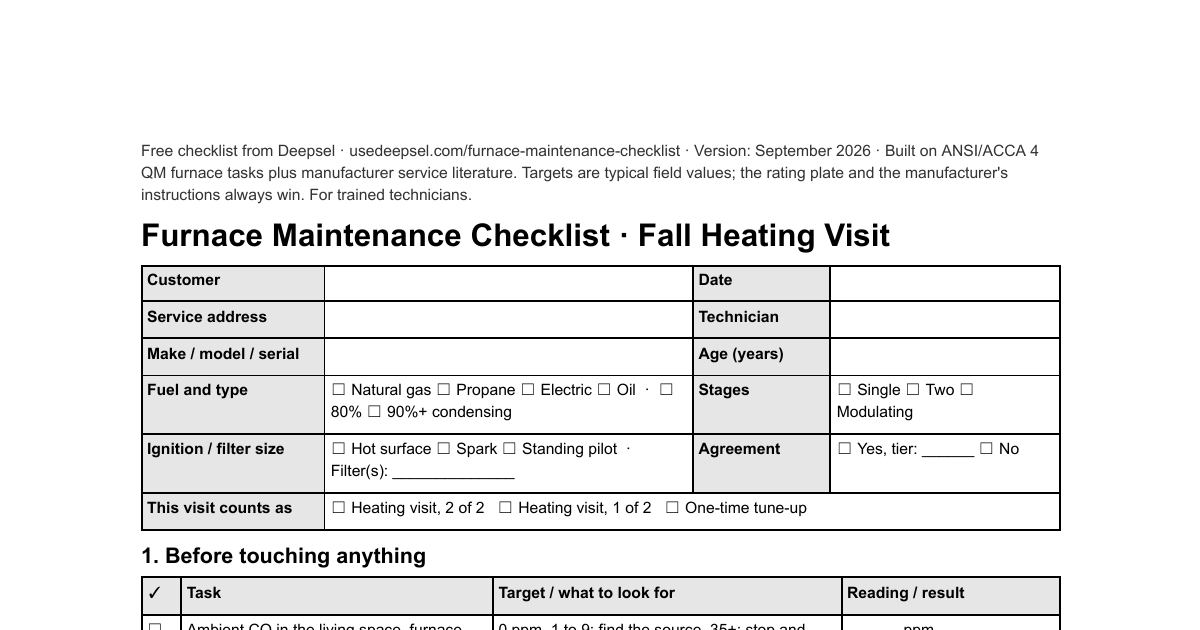
A furnace maintenance checklist covers the fall heating visit in four passes: safety first (ambient CO, gas leak check, clearances), the combustion side (heat exchanger, burners, igniter, flame sensor, gas pressures, safeties, combustion analysis, venting), the air side (filter, blower, temperature rise, static pressure), and a written record of every reading. This one prints on three pages and has a blank next to each number.
Get it three ways: make your own copy in Google Docs (one click, lands in your Drive, edit the targets to your equipment), download the Word version (.docx), or download the PDF for the truck. You can read it in Google Docs first without copying anything. It's one of the free HVAC checklists on the checklist hub; the year-round version with the cooling visit is the HVAC maintenance checklist.
I built it because the furnace checklists that rank for this search are homeowner lists from equipment brands, or contractor marketing pages that say "inspect the heat exchanger" and stop. None of them say what number the tech should get, or where to write it. This one starts from the task list in ACCA Standard 4, the manufacturer-endorsed minimum for residential maintenance,1 and adds target ranges from manufacturer literature and the combustion references below. Where two sources disagree, I print both.
What does a furnace tune-up include?
A furnace tune-up includes a carbon monoxide check of the living space, a gas leak check, an inspection of the heat exchanger, cleaning the burners and flame sensor, testing the igniter, measuring inlet and manifold gas pressure, testing the pressure switch, limit and rollout switches, a combustion analysis, a venting inspection, a filter change, blower cleaning with amp and capacitor readings, temperature rise, static pressure, and a written report. On a condensing furnace, add the condensate trap and drain.
That is the ACCA list in one paragraph. The standard's gas furnace checklist runs from the cabinet and clearances through electrical, blower, condensate, combustion and venting, with a corrective action printed next to every task.1 Goodman's manual asks for a yearly check of the flue system, the heat exchanger, the burners ("proper ignition, burner flame, and flame signal"), the wiring and the filters, at the beginning of the heating season.3 ENERGY STAR's version for homeowners is one line: gas connections, gas pressure, burner combustion and the heat exchanger.15
A service tech on r/HVAC said it faster: "Clean flame sensor. HSI resistance against spec. Blower cap μF. Blower wheel cleanliness... Visual inspection of hX, burners. Blower and IDM amps against spec. Temp rise, combustion analysis and TESP, checkout ductwork, gas connections, flue, fresh air, etc., while it's running. 45 minutes in and out."17 Every item in that sentence has a row below.
Before touching anything
| Task | Target, and what to look for | Record |
|---|---|---|
| Ambient CO in the living space, furnace running | 0 ppm. 1 to 9 ppm: find the source. 35 ppm and up: stop and ventilate. 100 ppm: evacuate and call 9119 | ppm |
| Combustibles and stored items clear of the cabinet and vent | Clearances per the rating plate; 24 inches of front service clearance3 | OK / corrected |
| Gas leak check at unions, drip leg, valve and flex connector | Chloride-free soap solution or an electronic detector. Never an open flame3 | No leaks / leak found |
| Watch the sequence of operation on a call for heat | Inducer starts, pressure switch closes, igniter warms up, gas valve opens, flame proves, blower starts after the delay4 | Normal / fault |
Combustion side (gas furnaces)
| Task | Target, and what to look for | Record |
|---|---|---|
| Heat exchanger: mirror or borescope, flame watch at blower start, then combustion analysis | No cracks, rust-through or bulges. The flame must not move when the blower starts. CO stays stable with the blower running12 | Pass / suspect / condemn |
| Burners and crossovers cleaned and aligned; flame check | Flames stable, quiet, soft and blue, straight off the burner. Orange tips from dust are fine; yellow is not. No impingement on the tubes3 | OK / cleaned / issue |
| Hot surface igniter: visual, then cold resistance | No cracks or white spots. Silicon carbide commonly 40 to 90 Ω cold; silicon nitride far lower, about 11 to 17 Ω on common models. OL means a crack: replace. Compare to the OEM spec7, 8 | Ω, type |
| Flame sensor cleaned and burner ground checked | 0.5 to 10 µA DC depending on the furnace; 2 to 6 µA is common. Under about 1 µA, check the rod, ground and wiring before condemning anything5, 6 | µA |
| Inlet gas pressure, furnace running | Per the rating plate. Natural gas typically 4.5 to 10.0 inches w.c.; propane about 11 to 133, 4 | in. w.c. |
| Manifold pressure, each stage | Per the rating plate. Natural gas 3.2 to 3.8 inches w.c., set at 3.5. Propane 9.7 to 10.3 (Goodman) or 10.5 to 11.5 (HVAC School's field range), set to the plate3, 4 | high / low, in. w.c. |
| Inducer motor: amps, bearings, wheel, collector box | Amps within the nameplate; no water, rust or debris in the housing1 | A |
| Pressure switch: tubing pulled and blown clear, port clear | Open with the inducer off, closed with it on; no water or kinks in the tubing3, 16 | OK, setpoint |
| Limit switch and flame rollout switches | Continuity, no jumpers, mounted tight. Rollouts are often manual reset; note the type4 | OK / replaced |
| Combustion analysis after 10 minutes of run, each stage separately | 80% induced draft, natural gas: O2 7 to 9%, CO2 6.5 to 8%, stack 325 to 400 °F, draft -0.02 to -0.04 inches w.c. CO air-free under 100 ppm; 100 to 400 means repair; over 400, shut it down13, 9 | O2, CO2, stack, draft, CO af |
| Venting and combustion air | Connector rises toward the vent, joints tight, no rust streaks or condensate marks, termination clear, clearance to combustibles. Louvers and intake unobstructed1 | OK / issue |
Condensing furnaces (90%+), add these
| Task | Target, and what to look for | Record |
|---|---|---|
| Condensate trap removed and flushed | Water flows from every port; hot water clears stubborn sludge. The trap is mandatory, and it gets cleaned at every maintenance14 | Cleaned |
| Drain line, condensate pump, float switch, neutralizer | Sloped, no double trap, vented after the trap. Pump moves water and the float shuts the furnace off. Condensate is acidic, pH about 3 to 5; replace spent neutralizer media14 | OK / issue / media replaced |
| PVC intake and exhaust | Joints sound, slope back toward the furnace about a quarter inch per foot, terminations clear and correctly spaced14 | OK / issue |
Air side and electrical (all furnaces)
| Task | Target, and what to look for | Record |
|---|---|---|
| Filter: size, fit, condition, airflow arrow | Replace if loaded. Write the size on the customer's record so the truck carries it next year3 | Size, replaced |
| Blower wheel and housing cleaned; motor amps; capacitor | Amps at or under the nameplate FLA. Capacitor within 6% of the rated µF, no bulging1, 11 | A of FLA; µF of rated |
| Temperature rise on high fire after 15 to 20 minutes | Within the rating plate range (35 to 65 °F or 45 to 75 °F are common plates). Supply probe a few feet downstream, out of sight of the heat exchanger2 | Return, supply, rise, plate range |
| Total external static pressure | Most furnaces are rated 0.5 inches w.c. Read the return between the filter and blower, the supply between the furnace and the coil10 | Return + supply = total |
| Line and low voltage, connections, wire routing, board | Within the nameplate; 24 V control circuit; tight, no heat discoloration, nothing rubbing on sheet metal1 | V / V, OK |
| Thermostat, blower door switch, panels, humidifier if fitted | Full heat cycle on and off; the door switch kills power; doors tight; pad, solenoid and drain15 | OK, pad replaced |
The PDF adds short sections for electric and oil furnaces, covered further down, and a findings table with a column for the price after the member discount. The tech who found the cracked igniter is the person the customer trusts to price the fix.
The readings that matter, and what the numbers mean
A checkbox says the tech looked. A number says what they found, and next year's number says which way it's heading. These six are the ones I'd want filled in before a furnace visit counts as delivered.
Temperature rise
Every gas furnace rating plate shows a rise range, something like 45 to 75 °F. Run the furnace on high fire for 15 to 20 minutes, read the return air, read the supply a few feet downstream so the probe can't see the heat exchanger, and subtract.2 Aim for the middle. A rise near or over the top of the range means too little air is moving across the heat exchanger, and the furnace will start cycling on its limit switch, a safety control that fails early when it gets used as a thermostat. A rise under the bottom of the range means too much air, and the flue gases can condense inside a heat exchanger that was never built to get wet.2 High rise on a maintenance visit almost always has a boring cause: a loaded filter or a dirty blower wheel, both of which are earlier rows on the same sheet.
Inlet and manifold gas pressure
Two readings with a manometer, furnace running. Inlet pressure has to clear the minimum on the rating plate; Goodman's 80% furnace wants 4.5 to 10.0 inches of water column on natural gas.3 Manifold pressure is what the burners see after the gas valve's regulator, and the plate gives a tight window: 3.2 to 3.8 inches w.c. on natural gas, set at 3.5, and 9.7 to 10.3 on propane, set at 10.0.3 HVAC School's field range for propane runs a little higher, 10.5 to 11.5.4 Follow the plate on the furnace in front of you.
The reason this reading earns its blank is what overfiring does. In CPSC's furnace emissions testing, a furnace fired at its rated 100,000 Btu per hour with a partly blocked vent produced 59 ppm of air-free CO. Pushed to 118,000 and 128,000 Btu, the same furnace produced 399 ppm to more than 3,400 ppm.19 A gas valve set half an inch high is an overfired furnace.
Flame sensor microamps
The flame sensor is a metal rod in a ceramic insulator. When the burner lights, a tiny DC current flows through the flame to ground and tells the board the fire is real. HVAC School's range is 0.5 to 10 microamps depending on the furnace, with 2 to 6 common.5 A tech on r/HVAC put it at "Above 2 microamps ideal. Typically 2-4," and added the reminder every apprentice needs: "Make sure the grounding wires make good contact, it's a part of the flame sensor circuit."6
Clean it, don't sell it. Bryan Orr looked for evidence of a special coating on flame rods and found none; his advice is very fine steel wool or an abrasive pad, then wipe the grit off.5 The top comment in that r/HVAC thread: "Some of y'all still on the fad of replacing them? Never understood, simply clean and put back is all that is needed 99% of the time. I've replaced one in the last 10 years, it was because of rust."6 A rod that keeps coating up points at the room: cleaners, laundry chemicals, combustion air from the wrong place.5
Hot surface igniter resistance
Igniters get ohmed cold, at the plug, without removing them. Silicon carbide igniters are brittle and crack from handling, so a visual inspection can cause the failure it was looking for.7 An OL reading is a crack: replace it. A reading climbing past the manufacturer's rated ohms, often around 90 for silicon carbide, is an igniter on its way out.7 Silicon nitride igniters read far lower. A supplier's tech sheet puts common silicon nitride models at 11 to 17 ohms and the older flat silicon carbide type at 50 to 75.8 Write down which type is in the furnace, so the truck carries the right spare next fall.
Carbon monoxide: three readings
Start in the living space with the furnace running. The target is zero. NCI's exposure chart calls 1 to 9 ppm the most a living area should ever see, puts 35 ppm at the OSHA eight-hour limit, and says at 100 ppm you stop testing and call 911.9 Then take a return air reading near the furnace and a supply reading downstream after five minutes of running; AHRI Guideline X says both should read no more than 9 ppm and, if the furnace is not leaking into the airstream, the same as each other.20
The flue is the third number, and it needs an analyzer that calculates air-free CO. Air-free corrects the raw reading for the excess air that dilutes it, so it is always higher than the raw number, and it is the number the standards are written in.18 ANSI Z21.47, the furnace standard, allows up to 400 ppm air-free.19 Nobody who does this for a living treats 400 as a passing grade. HVAC School's working target is under 100 ppm in the flue and zero in the structure.18, 20 NCI's test sequence is the one on the sheet: CO can spike at light-off but should settle to 10 to 100 ppm within five minutes and hold there; a reading that keeps climbing, even slowly, is a problem, and over 400 the furnace is shut off until it's repaired.9 Multi-stage furnaces get tested on each stage.13
The other combustion numbers give the CO reading context. Testo's applications guide lists typical readings for an induced-draft gas furnace as 7 to 9% oxygen, 6.5 to 8% CO2, a stack temperature of 325 to 400 °F, and a draft of -0.02 to -0.04 inches w.c., measured after ten minutes of running.13 A condensing furnace runs a much cooler stack and follows its own manufacturer table.
Static pressure
Total external static pressure is the airflow budget the furnace was designed for, usually 0.5 inches w.c. on the rating plate. On a furnace, read the return between the filter and the blower and the supply between the heat exchanger and the cased coil, because the coil is an accessory with its own pressure drop that the plate rating leaves out.10 Check that the filter, coil and blower wheel are clean before drilling a test port, or the reading measures the dirt. A return side reading of 0.4 or more on its own points at a loaded filter or an undersized return.10 Goodman's own startup sheet has blanks for return static, supply static, total, rise, inlet and manifold pressure,3 which is the record half of this checklist under another name.
How do you check a furnace heat exchanger?
Check a furnace heat exchanger four ways, in this order: measure ambient CO in the house with the heat running; watch the flames when the blower starts, because a flame that moves is being pushed by air that shouldn't reach it; run a combustion analysis and watch whether CO holds steady; then look, with a mirror or a borescope through the burner openings, pulling the blower if you need to.12 A crack means replacement. HVAC School's line is blunt: "If there are any cracks in an exchanger, it needs to be replaced," and when you find one, "quote it for repair and turn the furnace off."12
The argument in the trade is over shops that only look. A tech on r/HVAC posted his company's policy packet last December: "We only do visual inspections of heat exchangers. We do not use combustion analyzers." The replies: "Combustion analysis tells you the facts of how the unit is running. I have found high CO due to failed heat exchangers that had nothing to do with cracks at all. If my CO is above 100 ppm in the flue I know I need to find the problem."21 Another: "You won't see cracks on a secondary heat exchange, but it'll plug up something fierce and give the analyzer a stroke because of the high levels of CO... a visual inspection will not tell if the secondary is plugged."21
The opposite failure exists too, and the same thread named it: the tech who red-tags a furnace for a hairline mark on a face plate that has no effect on operation. Small cracks belong in the report because they become large cracks. Whether the furnace runs tonight is a CO question, which is why the condemn box on the sheet sits next to the ambient and flue CO readings that justify it.
Condensing, electric and oil furnaces: what changes
A 90%+ furnace pulls so much heat out of the flue gas that water condenses in the secondary heat exchanger, and that water is acidic, pH around 3 to 5.14 Everything downstream has to drain. The trap is mandatory, because the drain taps into the exhaust path, and it collects sludge, so it comes off and gets flushed at every maintenance until water runs from every port.14 The PVC vent slopes back toward the furnace about a quarter inch per foot so condensate drains instead of pooling in the inducer.14 Where code or a septic system requires it, neutralizer media gets replaced. The 2022 r/HVAC checklist thread added a step that applies to 80% furnaces too: "Pressure switch tubing check (mandatory to remove and blow clear)."16 Water in that tubing is a common reason a furnace won't light on the first cold morning.
An electric furnace, or an air handler with heat strips, gets a shorter list. Read the amps on each stage and compare them to the kW rating: watts divided by volts, so a 5 kW strip pulls about 20 amps at 240 volts and a 10 kW package about 40.22 Ohm the thermal limits (low ohms good, OL open), confirm the sequencer brings the stages in one at a time, check the lugs for heat discoloration, prove the blower interlock so the strips can't run without air, and take a temperature rise against the data tag.22
An oil furnace is the visit that takes longest and gets skimped most. ACCA Standard 4 has a separate oil furnace checklist,1 and the Maryland weatherization field guide spells out the readings: replace the oil filter and the nozzle, gap the electrodes, time the cad cell so the burner shuts off within 45 seconds of losing the flame, set pump pressure to the burner's spec (commonly 100 to 150 psi), smoke test to near zero on a modern burner, set overfire draft near -0.02 inches w.c., and treat a stack over 450 °F on a clean unit as an oversized nozzle.23 A tech on r/hvacadvice, to a homeowner whose burner was reset in ten minutes and declared fine: "That's the first ten minutes of the boiler or furnace maintenance. Was a combustion analysis performed? Did he test any components? An oil fired boiler maintenance usually takes me over two hours to do it right."24
What a homeowner can do, and what only a licensed tech should do
A homeowner should change the filter, keep the area around the furnace and the vent terminations clear, keep a CO alarm on every level, watch the flames through the sight glass (steady blue is right; yellow, flickering or lifting means call), and book the visit before the first cold week.15, 25 That's the whole list.
Everything on the combustion side stays with a licensed tech. Never open the burner compartment with the gas on. Never test for a gas leak with a flame; Goodman prints that warning in capitals.3 Don't touch a silicon carbide igniter with bare fingers; skin oil starts the fracture that kills it.8 Don't reset a tripped rollout switch and walk away; it tripped because flame left the burner box. And never jump a safety. A tech on r/HVAC posted the aftermath of a homeowner's father who had jumped out every safety on the furnace, under the title "Not everyday we get to save lives."26 The CDC counts more than 400 unintentional CO deaths a year in the United States, over 100,000 emergency visits and over 14,000 hospitalizations, and its first prevention line is a yearly service by a qualified technician.27
Why the tech writes the numbers down
The owner who started the 2022 r/HVAC thread on rewriting his company's checklists said the quiet part: "I personally think the checklists are for the technicians more then the homeowner for future reference and key information for diagnosing."16 He's right, and it's the reason a 28-point checklist with 28 checkboxes is worth less than a 20-point checklist with 12 blanks.
A furnace that read 3.4 microamps last fall and 1.6 this fall has a story. So does a blower capacitor drifting from 9.8 to 9.1 on a 10 µF rating, or a stack temperature 40 degrees higher than last year on the same rise. None of those are failures today. Each one is the repair the customer approves next year because the tech can show the trend, and the trend exists only if someone wrote the number down. The same sheet, filed with the customer, is the shop's defense when a heat exchanger fails in January and the question is what the tech found in October.
So the checklist ends with three lines that have nothing to do with the furnace: the filter size confirmed on the customer's record, the readings entered into the agreement record, and which agreement visit this one counts as.
The checklist proves the work. The ledger proves the visit happened.
A signed checklist proves what the tech did at one address on one day. It says nothing about the 140 other members who paid for a fall visit and haven't been booked, or the six whose visits from last year were never delivered. That list, visits owed versus delivered, per member, per unit, is the part of a maintenance program that quietly breaks. The customer paid in March, the shop got busy in July, and in December an emergency call reveals the tune-up never happened.
The fix is a ledger next to the checklist. If you run agreements out of a binder or a spreadsheet, start with the free maintenance agreement tracking spreadsheet: one row per agreement, both visits with owed, booked and done dates, filter sizes, and a saved view of who's due this season. The HVAC maintenance agreement template writes the visit promise into the contract, including what a visit includes, so this checklist becomes the proof that the promise was kept. The reasoning behind the ledger is in how to track HVAC maintenance agreements, and the year-round version of this page is the HVAC maintenance checklist, with the heat pump maintenance checklist covering dual-fuel and auxiliary heat.
Past about 80 agreements the spreadsheet stops being the problem and time does. That's the job Deepsel does: it keeps the visits-owed ledger per covered unit, sends members their fall booking link by text and email, charges the renewal to the card on file, and warns the office before a paid visit expires. It runs beside Jobber or Housecall Pro. The tech still fills in this checklist on the job; the office marks the visit delivered in one place, and the filter size from the header block lives on the unit record for next year.
14-day free trial. No credit card required.Frequently asked questions
How often should a furnace be serviced?
Once a year, before the heating season. Goodman's installation manual says the furnace should be inspected by a qualified service agency at least once per year, at the beginning of the heating season, and the CDC gives the same once-a-year advice for every fuel-burning appliance because of carbon monoxide. Filters are the exception: the manufacturer wants them inspected monthly, and most homes replace a one-inch filter every 30 to 90 days.
How much does a furnace tune-up cost?
Trane puts a yearly furnace tune-up at $70 to around $200 depending on where you live and the furnace's condition. On r/hvacadvice a contractor quoted $150 to $200 for a maintenance that includes cleaning the burners. The cheaper end usually buys a filter change and a look. A visit with a combustion analysis, cleaned burners and flame sensor, gas pressures and recorded readings takes about 45 minutes and sits at the top of that range, or inside a maintenance agreement.
Does a furnace tune-up need a combustion analysis?
Yes. ACCA Standard 4 lists a combustion analysis test among the gas furnace maintenance tasks, and the techs I read agree in stronger words. A plugged secondary heat exchanger on a condensing furnace shows no crack to the eye, but the analyzer catches the CO it produces. The analysis takes about 15 minutes once the furnace has run ten minutes. Without it, the heat exchanger line on the checklist is a guess.
What is a safe CO reading for a furnace?
Three numbers. In the living space, with the furnace running, zero. Nine parts per million is the most a living area should ever see. In the flue, measured air-free after five to ten minutes of running, under 100 ppm is the working target. The ANSI Z21.47 furnace standard allows up to 400 ppm air-free, and readings over 400 mean the furnace gets shut off until it is repaired. Between 100 and 400, something is wrong and needs fixing soon.
Should the flame sensor be replaced every year?
No. A flame sensor is a metal rod in a ceramic insulator with no coating to wear off. Clean it with fine steel wool or an abrasive pad, wipe it, check the burner ground, and read the microamps. Techs on r/HVAC report replacing one or two in ten years, for rust or a broken ceramic. Replace it when the reading stays under about 1 microamp after cleaning with the ground and wiring confirmed good, or when the ceramic is cracked.
What's the difference between a furnace tune-up, a maintenance visit and an inspection?
A tune-up and a maintenance visit are the same job: clean, test, measure, adjust, record. An inspection is the look without the cleaning and adjusting, the kind of check a home inspector or a warranty tech does. This page is the maintenance visit for a furnace. The full-year version with the cooling visit is the HVAC maintenance checklist, and the customer-facing summary of what a visit includes is the HVAC tune-up checklist.
Sources
- ACCA, ANSI/ACCA 4 QM, "Maintenance of Residential HVAC Systems," Checklist 5.4 Gas Furnace and Checklist 5.5 Oil Furnace (2013 edition, mirrored by Capital HVAC) - tasks include "Inspect heat exchanger for signs of corrosion, fouling, structural problems (e.g., cracks, perforations, and bulges), and erratic flame operation during blower operation," "Measure, record, and adjust manifold pressure," "Record micro-amps for comparison with OEM specifications," "Perform combustion analysis test," "Measure and record TD across the heat exchanger." capitalhvac.com, read September 5, 2026. The standard was reaffirmed as ACCA 4 QM-2019 (R2024), "a nationally recognized, manufacturer-endorsed set of minimum tasks," per ACCA's release of September 16, 2024, acca.org.
- HVAC School, "Furnace Air Temperature Rise" - "It is shown in a range like 50-80° or 45-75°"; run "at least 15 to 20 minutes"; supply reading "several feet away from the furnace so that it isn't affected by radiant heat"; near the high end "the furnace may begin cycling on the limit control"; below the low end "you could even start to form condensation in the heat exchanger." hvacrschool.com, read September 5, 2026.
- Goodman, Installation Instructions for *M9S80 and *C9S80 gas furnaces - inlet gas supply pressure "Natural Gas Minimum: 4.5" w.c. Maximum: 10.0" w.c."; manifold pressure natural gas "3.2 - 3.8" w.c." set at 3.5, propane "9.7 - 10.3" w.c." set at 10.0; "Never test for gas leaks with an open flame"; "Unobstructed front clearance of 24" for servicing"; annual inspection "at the beginning of the heating season"; flames "should be stable, quiet, soft, and blue (dust may cause orange tips but they must not be yellow)"; "Check for kinked pressure switch tubing"; startup sheet fields for static pressure, temperature rise and gas pressures. documents.alpinehomeair.com, read September 5, 2026.
- HVAC School, "Gas Furnaces - What a Tech Needs to Know" - manifold pressure "usually between 3.2 and 3.8" WC... If you're working on an LP system, that range is probably going to be 10.5-11.5" WC"; natural gas supply "5-7 inches of water column," LP "10-13" WC"; sequence of operation; "some parts, like a flame rollout switch, may need to be reset manually." hvacrschool.com, read September 5, 2026.
- HVAC School, "Flame Sensing - The Basics" - "you should read between 0.5 and 10 microamps (μA), depending on the furnace. Readings between 2 and 6 are common"; "I have found no evidence that typical flame-sensing rods have a special coating"; "I suggest using very fine steel wool or an abrasive pad"; "If flame rods are getting dirty/coated often, you will want to find out why." hvacrschool.com, read September 5, 2026.
- r/HVAC, "Flame Sensor micro amps." - "Above 2 microamps ideal. Typically 2-4... Make sure the grounding wires make good contact, it's a part of the flame sensor circuit"; top comment: "Some of y'all still on the fad of replacing them? Never understood, simply clean and put back is all that is needed 99% of the time. I've replaced one in the last 10 years, it was because of rust." reddit.com, October 1, 2024, read September 5, 2026.
- HVAC School, "Silicon Carbide vs. Silicon Nitride Hot Surface Ignitors (HSIs)" - "it's not the best idea to remove an ignitor for a visual inspection"; "An OL reading indicates that there is a crack"; "A high resistance can also indicate that a silicon carbide ignitor is on its last leg, particularly if it exceeds the manufacturer's rated ohms (often ~90 ohms)"; silicon nitride "will have lower resistance." hvacrschool.com, read September 5, 2026.
- Bradford Industrial Supply, "What are the different Hot Surface Igniters / Diagnosis" (tech sheet) - silicon carbide: "you should not touch with your bare fingers. Doing so will cause a micro fracture"; "A good cold igniter should be between 50 to 75 ohms"; "The resistance on the Silicon Nitride igniter should be 11 to 17 ohms and the Glowfly igniter should be 45 to 90 ohms." cdn.websites.hibu.com, read September 5, 2026.
- National Comfort Institute, Jim Davis, "Carbon Monoxide Test Numbers: What Do They Mean?" - "1-9 PPM - Maximum allowable short-term exposure in a living area"; "35 PPM - Is the maximum allowable concentration allowable for an 8-hour period per OSHA"; "At 100 PPM - Discontinue testing and Contact 911"; "Within 5 minutes, CO levels should drop and read from 10 -100 PPM"; "If CO readings begin to rise, even slowly, there's an indication of a problem"; "Readings over 400 PPM are an indication of severe combustion problems... the furnace must be shut off." nationalcomfortinstitute.com, read September 5, 2026.
- HVAC School, "Total External Static Pressure (TESP): A Basic Review" - "For furnaces, design TESP does not account for the cased cooling coil"; measure "between the filter and the blower and between the heat exchanger and the cased coil"; "A high return static reading (typically 0.4in w.c. and above) can be caused by dirty filters or undersized ductwork." hvacrschool.com, read September 5, 2026.
- HVAC School, "Testing Run Capacitors the Smart (and Easy) Way" - "Most capacitors allow for a 6%+/- tolerance. If it's outside of that range, then replacement of the capacitor may be necessary." hvacrschool.com, read September 5, 2026.
- HVAC School, "Heat Exchanger Crack Diagnosis" - "If there are any cracks in an exchanger, it needs to be replaced"; "measure ambient CO in the conditioned space while the heat is running"; flame displacement: "there should be no change in the flame when the blower starts"; visual inspection "using a mirror or borescope"; "When you do find a cracked exchanger, quote it for repair and turn the furnace off." hvacrschool.com, read September 5, 2026.
- Testo, "Combustion Applications Guide," Rev. 1.0 (2006), section 17.2, Typical Readings: Draft Induced Gas Fired Burners - "Oxygen: 7.0% - 9.0%; Carbon Dioxide: 6.5% - 8.0%; Stack Temp: 325º F to 400º F; Draft: -0.02"WC to -0.04"WC; Carbon Monoxide: < 100 ppm (undiluted)"; "Allow furnace to operate for ten minutes or until stack temperature stabilizes"; "If furnace is multi-stage or modulating, each stage must be checked independently." Hosted by HVAC School, hvacrschool.com, read September 5, 2026.
- HVAC School, "Condensate Drainage in a High Efficiency Gas Furnace" - "The condensate trap is absolutely mandatory"; "The trap needs to be cleaned out regularly, and that should be done during every maintenance"; "slope the venting down towards the furnace (typically a ¼'' slope per foot of length, minimum)"; "furnace condensate is acidic, and some states/provinces/countries may require the condensate to be neutralized." hvacrschool.com. The pH figure is from the HVAC School podcast "Condensing Furnace Drain Guidance w/ AC Service Tech": "This condensate is acidic (pH 3-5)." hvacrschool.com. Both read September 5, 2026.
- ENERGY STAR, "Maintenance Checklist" - heating specific: "Check all gas (or oil) connections, gas pressure, burner combustion and heat exchanger"; "Inspect, clean, or change air filters once a month"; pre-season check-ups, "the heating system in the fall." energystar.gov, read September 5, 2026.
- r/HVAC, "Question for Techs: What are some things on your maintenance 'checklists' for furnaces/heat pumps/AC?" - original post: "I personally think the checklists are for the technicians more then the homeowner for future reference and key information for diagnosing"; top reply: "Heat Exchanger Check (before anything else!)... Pressure switch tubing check (mandatory to remove and blow clear)... Flame Sense Test (if it has a flame rod, get a reading + make sure it's good)." reddit.com, September 6, 2022, read September 5, 2026.
- r/HVAC, "What should be done on every furnace and every AC maintenance?" - "Tstat batteries, wiring connections. Clean filter. SSU and high voltage wiring. Clean flame sensor. HSI resistance against spec. Blower cap μF. Blower wheel cleanliness (low air movement)... Visual inspection of hX, burners. Blower and IDM amps against spec. Temp rise, combustion analysis and TESP, checkout ductwork, gas connections, flue, fresh air, etc., while it's running. 45 minutes in and out"; another reply: "Combustion analysis is a beyond must." reddit.com, November 26, 2023, read September 5, 2026.
- HVAC School, "What Does 'Air Free CO' (Carbon Monoxide) Mean?" - "the CO Air Free number will always be higher than the uncorrected CO number"; "While it is widely recognized that 400 ppm CO is the allowable limit for flue CO levels, it is generally possible and recommended for flue CO levels to be below 100 ppm air free." hvacrschool.com, read September 5, 2026.
- U.S. Consumer Product Safety Commission, "Furnace CO Emissions Under Normal and Compromised Vent Conditions" - "The current ANSI Z21.47 standard (1998) requires that an air-free flue gas sample of CO not exceed a maximum of 400 ppm (0.04 percent) when a furnace vent is either partially or completely blocked"; "When the furnace was fired at 100,000 Btu/hr and 112,000 Btu/hr, the air-free CO concentrations in the flue gas ranged from 59 ppm to 545 ppm... 118,000 Btu/hr and 128,000 Btu/hr... from 399 ppm to more than 3,400 ppm." cpsc.gov, read September 5, 2026.
- HVAC School, "Practical Uses of Combustion Analysis" - return and supply air readings: "In both cases, you will want to measure no more than 9 PPM"; "The official threshold for CO in the flue per AHRI Guideline X is 200 PPM. (Other standards may accept readings up to 400 PPM COaf...)"; "the CO target should be <100 PPM in the flue and ZERO PPM inside the structure." hvacrschool.com, read September 5, 2026.
- r/HVAC, "How do we feel about combustion analyzers?" - original post quotes an employer packet: "We only do visual inspections of heat exchangers. We do not use combustion analyzers to determine if a crack is present"; replies: "Combustion analysis tells you the facts of how the unit is running. I have found high CO due to failed heat exchangers that had nothing to do with cracks at all. If my CO is above 100 ppm in the flue I know I need to find the problem" and "You won't see cracks on a secondary heat exchange, but it'll plug up something fierce and give the analyzer a stroke because of the high levels of CO... a visual inspection will not tell if the secondary is plugged... a furnace tune-up or hot water heater or boiler tune-up should always have a combustion analysis done." reddit.com, December 3, 2024, read September 5, 2026.
- HVAC School, "Electric Heat Troubleshooting, Service, and Math Class" - "In a 4.6-kilowatt (5kW) heater, you would divide 4,600 by the unit's rated voltage to get the amps"; "you can usually (but not always) expect 5kW heaters to draw 20 amps and 10kW to draw 40 amps"; thermal limits "If they are open, you'll measure OL or infinite ohms"; sequencers "have contacts that close at different times." hvacrschool.com, read September 5, 2026.
- Maryland Weatherization Field Guide, "Oil Burner Safety and Efficiency Service" - "Smoke number should be near zero on all modern oil-fired equipment"; "Adjust the barometric damper for a negative overfire draft of -0.020 IWC"; "A flue gas temperature more than 450° F is a sign that a clean heating unit is oversized"; "Time the flame sensor control or stack control to verify that the burner shuts off, within either 45 seconds or a time specified by the manufacturer"; "Replace oil filter(s) and nozzle"; oil pressure "≥ 100-150 psi." wxfieldguide.com, read September 5, 2026.
- r/hvacadvice, "Keep having to reset oil burner" - "That's the first ten minutes of the boiler or furnace maintenance. Was a combustion analysis performed? Did he test any components? An oil fired boiler maintenance usually takes me over two hours to do it right." reddit.com, November 14, 2024, read September 5, 2026. The $150 to $200 figure in the FAQ is from a contractor on r/hvacadvice: "My company charges $150-$200 for a furnace maintenance which includes cleaning the burners + a decent amount more," reddit.com, April 11, 2024.
- Trane, "Gas Furnace Maintenance Checklist" (Anne Fonda, reviewed by a Trane residential training manager) - dealer checklist including "Confirm the burner flames are in good adjustment without erratic flames," "check and clean the furnace burners and flame sensor," "Check and adjust the gas valve, check gas pressures"; filter every "30-90 days"; "A yearly furnace tune-up can cost anywhere from $70 to around $200"; "a gas furnace can last 15-20 years." trane.com, read September 5, 2026.
- r/HVAC, "Customer called wanting a maintenance. Her dad had previously worked on the furnace.. all he did was jump out all safeties. Not everyday we get to save lives." reddit.com, December 1, 2022, read September 5, 2026.
- Centers for Disease Control and Prevention, "About Carbon Monoxide Poisoning" - "Each year, more than 400 Americans die from unintentional CO poisoning not linked to fires, more than 100,000 visit an emergency department, and more than 14,000 are hospitalized"; "Have your heating system, water heater, and any other gas, oil, or coal burning appliances serviced by a qualified technician every year." cdc.gov, read September 5, 2026.