HVAC maintenance checklist: the full spring and fall service checklist, with the target readings
- Free. No signup and no email asked; the links below go straight to the file.
- Deepsel is our product. It tracks the maintenance agreements these visits are sold under, and the last section says so.
- The checklist is a minimum task list with typical target ranges. The manufacturer's service instructions and your safety training govern where they differ.
An HVAC maintenance checklist is the list of inspection tasks, cleaning steps and readings a technician completes on a seasonal visit: filter, static pressure, electrical connections and capacitors, both coils and the condensate drain in spring, then burners, heat exchanger, flame sensor, gas pressure, temperature rise and flue CO in fall. This one prints the target reading beside each task.
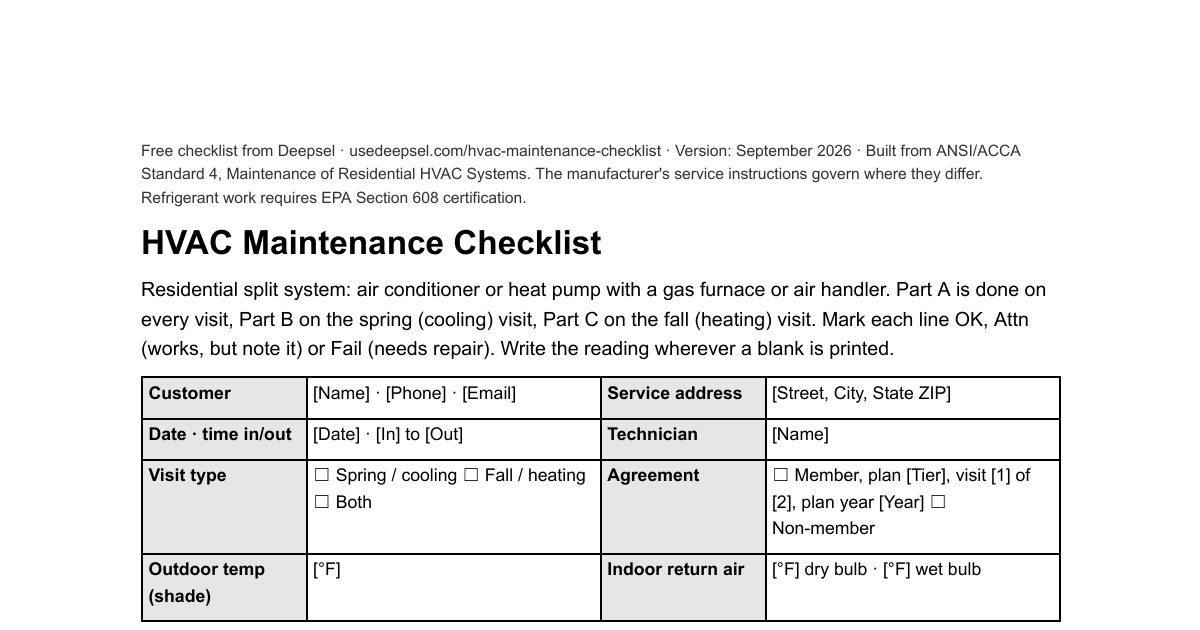
Get it three ways: make your own copy in Google Docs (one click, opens in your Drive, edit the tasks to match your shop), download the Word version (.docx), or download the PDF and print it. You can also read it in Google Docs first. The full checklist is on this page too, so nothing is hidden in the file. Single-system versions live on the free HVAC checklists page: AC, furnace, heat pump, tune-up, inspection and commercial.
No form, no follow-up email. I built this because the checklists that rank for this search share one flaw: they tell you what to check and never what the number should be. The top template asks for your name and email before you can see it.3 The Housecall Pro help doc gives you seventeen lines like "Check capacitor" and "Check sub-cool/super heat" with no values.4 A checklist without targets is a list of things a tech can tick without measuring anything. So this one is built from the trade's own minimum standard, ANSI/ACCA Standard 4, and every reading has a range printed beside it.
What is included in an HVAC maintenance checklist?
A complete residential HVAC maintenance checklist has three parts. An every-visit section covers the filter, thermostat, registers and accessible duct, static pressure, line voltage, connections, contactors, blower, condensate drain, cabinet, safeties and accessories. A cooling section adds both coils, the condenser fan, compressor amps, run capacitors under load, temperature split and refrigerant performance. A heating section adds burners, heat exchanger, igniter, flame sensor, gas pressures, inducer, combustion analysis, temperature rise, limits and venting.
That structure comes from ANSI/ACCA Standard 4, Maintenance of Residential HVAC Systems, whose stated purpose is "to establish minimum inspection requirements in the maintenance of HVAC equipment found in one-family and multi-family dwellings of three stories or less."1 The standard is organized by component: checklist 5.1 for the air distribution system, 5.3 for controls and safeties, 5.4 for the gas furnace, 5.7 for the evaporator coil, 5.8 for the condensing unit, with extra heat pump tasks. My checklist merges those into the three parts a tech works through on a real visit, and adds the target ranges the standard leaves to the manufacturer.
The names vary and the document doesn't. Maintenance checklist, service checklist, preventive maintenance (PM) checklist, tune-up sheet: same thing. One wrinkle is that some platforms use "service checklist" for the diagnostic call sheet, the one that starts with the customer's complaint and ends with an estimate. Housecall Pro publishes both kinds side by side.4 This page is the maintenance version, done in spring and fall whether or not anything is wrong.
Start with the equipment header, one checklist per system
ACCA 4 wants an inventory before any task: equipment type, make, model, serial number, year of manufacture and start-up date if known.1 I added filter sizes and MERV, refrigerant type, metering device and the thermostat model, because those are the things the next tech needs in the truck before the door opens. Fill the header once, at the first visit, and carry it forward.
One checklist per system, and the serial is the reason. A visit is delivered to a specific unit. When a home has two systems and a plan that covers one, the serial on the sheet is what settles which unit got the tune-up and which one is a paid call. That is the single most common argument in maintenance-plan complaints, and the free HVAC maintenance agreement template handles it the same way, with a covered-equipment table that the checklist header mirrors.
Every visit: the tasks that don't change with the season
A word about what is missing. In March 2026 a homeowner posted his new plan's task list on r/hvacadvice, with "Lubricate motors" and "Check fan belts" at the top of both seasons. The most-upvoted tech answered: "Most units within 40 years have direct drive sealed bearing motors, so there's no lubricating motors or belts. All their wording is redundant to make it seem like they are doing more. Checking refrigerant charge and operating pressures is the same thing."5 Padding a checklist with tasks that don't apply is how you lose a customer who reads it. Every row below is a real task on a modern split system, and the rows that apply only sometimes say so.
| Task | What to check | Target or pass condition |
|---|---|---|
| Talk to the customer | Comfort complaints, noises, smells, water, high bills, renovations since the last visit | Written in the notes before the tools come out |
| Filter | Size, direction, housing seal, air bypassing the filter | Replaced or cleaned; size recorded in the header |
| Thermostat | Heat, cool, fan, emergency heat on heat pumps; settings and schedule | Every mode responds; battery replaced yearly |
| Registers and accessible duct | Blocked registers, crushed flex, loose joints, torn insulation, moisture or growth | Open and intact; problems photographed for the findings table |
| Static pressure (TESP) | Return and supply static with a manometer, added together | Total at or under the rated TESP on the data tag, often 0.50 in. w.c.; return side at or above 0.4 means a dirty filter or a small return |
| Line voltage and disconnect | Voltage at the disconnect, fuse size, bypasses, grounding | Within nameplate range; disconnect intact |
| Connections and wiring | Low and high voltage terminals, heat discoloration, damaged insulation | Tight; discolored terminals replaced |
| Contactors and relays | Pitting, arcing, burned contacts | Replace on evidence of heavy arcing |
| Blower motor and wheel | Wheel tight on the shaft, free rotation, dirt on the blades, amps | Amps under nameplate FLA; wheel clean (a dirty wheel shows up as high static and a high split) |
| Condensate drain, trap and pan | Flush the line, clear the trap, check the pan and secondary pan, test the float switch | Drains freely; float switch shuts the unit down; tablets compatible with the coil metal |
| Cabinet and clearances | Panels, cabinet air leaks, service and combustion clearances | Tight and clear; nothing stored against the furnace |
| Safeties and control board | Pressure switch, limit, float switch; board jumpers and dip switches; scorched parts | Each safety trips and resets; settings match the application |
| Accessories | Humidifier pad and water line, UV bulb, media or electronic air cleaner, ERV/HRV filters and core, zone dampers | Serviced per the accessory's own schedule |
Static pressure is the one row on that list most shops skip, and it is the cheapest diagnostic on the sheet. Total external static pressure is the pressure change across the air handler from the return side to the supply side, measured with a dual-port manometer.7 Most residential equipment is rated to run at 0.50 inches of water column, with some rated higher and some lower, so the data tag is the target.8 HVAC School's rule of thumb for the return side alone is that 0.4 and above "can be caused by dirty filters or undersized ductwork," and that the blower "may even pick up condensate and sling it throughout the cabinet if the return static gets too high."7 Two probe readings tell you whether the airflow problem is the filter, the coil or the ducts before you touch a gauge.
Spring HVAC maintenance checklist (cooling)
Run the system in cooling for 15 to 20 minutes before taking any reading, at an outdoor temperature inside the manufacturer's operating range. ACCA 4 puts that timing rule in the standard itself.1 Then work outdoors to indoors, or the other way round, but finish where the disconnect is. The most-upvoted working tech in an r/HVAC thread on AC tune-up checklists ended his list with: "Finally verify the unit is running before walking away. You'd be surprised how many call backs we've had over disconnects being left out."6
| Task | What to check | Target or pass condition |
|---|---|---|
| Evaporator (indoor) coil | Fin condition, dirt, oil stains at joints, line insulation | Fins clean, straight and open; any oil stain bubble-tested for a leak |
| Condenser (outdoor) coil | Top off, clean from the inside out with coil cleaner and water, straighten fins, clear the base pan | Clean; two feet of clearance on every side |
| Condenser fan motor | Blade tight on the shaft, wobble, free rotation, amps | Amps under nameplate |
| Compressor | Running amps, hard-start kit if fitted | Amps under RLA on the nameplate |
| Run capacitors, under load | Measured microfarads against the rated value, on the compressor, fan and blower capacitors; bulging or leaking | Within plus or minus 6 percent of rated; outside that, recommend replacement |
| Air temperature split (delta T) | Return dry bulb minus supply dry bulb | Typically 16 to 22 °F at 400 CFM per ton; lower with humid return air, higher on 350 CFM per ton setups |
| Refrigerant performance | Suction and liquid pressures and line temperatures, with probes rather than hoses | Fixed orifice: superheat within about 3 °F of the manufacturer's target chart, usually 5 to 25 °F. TXV or EEV: subcooling at the nameplate target |
| Lines and joints | Oil stains, rubbing, missing suction-line insulation, service caps | Dry joints, insulated suction line, caps on |
| Heat pumps only | Reversing valve shifts in both directions, forced defrost, outdoor drain ports, unit height above the snow line | Valve shifts; defrost runs; ports open |
| Finish | Panels, disconnect, thermostat setting | System confirmed running before leaving |
Three of those rows carry most of the judgment, so here is the reasoning behind each target.
Capacitors: test under load, replace outside 6 percent
A capacitor tested with the power off can read fine and still fail at 3 p.m. in July. HVAC School's method is to read amps on the start wire under load, multiply by 2,652 and divide by the capacitor's measured volts to get the working microfarads. "Most capacitors allow for a 6%+/- tolerance. If it's outside of that range, then replacement of the capacitor may be necessary."9 The checklist has blanks for the rated and measured value on all three: compressor, condenser fan and blower. Write both numbers down. A capacitor at 5 percent under is a note for next spring; at 9 percent under it is a repair you can show the customer on paper.
Temperature split: a range, and a lazy rule if you use it alone
The number everyone knows is 20 degrees. HVAC School has an article titled "20° ΔT (Delta T), A Lazy Rule of Thumb," and it opens with the honest version: "depending on who you ask, the answer will range between 18-22 degrees Fahrenheit."11 Their diagnosis guide widens it: "The air temperature split during typical conditions will be between 16 and 22 degrees' difference from the return to the supply," and adds that the range only applies at 400 CFM per ton, while systems set to 350 CFM per ton "are more common today than ever, especially in humid climates," and run higher.10 The interpretation is the useful part: a high split means low airflow, a low split means low capacity.10 Write the split down every visit, on the same system, and the trend tells you more than any single reading.
Refrigerant: superheat for a piston, subcooling for a TXV, probes over hoses
The metering device decides the method, which is why the equipment header has a checkbox for it. On a fixed-orifice (piston) system you charge by superheat against the manufacturer's chart, which needs the outdoor dry bulb in the shade and the indoor return dry and wet bulb; the target comes out "generally somewhere between 5 and 25 degrees."12 On a TXV or EEV system "the superheat is controlled by the metering device itself, so you can't use superheat as the method," and you charge by subcooling instead.12 Superheat is a moving target, and "getting within 3° is about the best you can do."12
Two more rules. Use probes on the ports rather than a gauge manifold on a routine visit, because every hose connection bleeds refrigerant; an installer in the March 2026 thread put it plainly: "Everytime they hook up their gauges to check it you will loose some refridgerant."5 ACCA 4's own text only requires the temperature-difference check, with superheat or subcooling noted as "a good diagnostic field practice."1 And the person doing it has to hold EPA Section 608 certification. The EPA's definition of a technician includes anyone "attaching and detaching hoses and gauges to and from an appliance to measure pressure within the appliance."13 Apprentices can do it only under close, continual supervision.
Fall HVAC maintenance checklist (heating)
The fall visit is where the safety work lives. Fire the furnace on high stage for 15 to 20 minutes before measuring anything, wear a low-level personal CO monitor, and know the rule ACCA 4 puts on the contractor: if you find a condition that could result in unsafe operation, shut the equipment off and tell the occupant or owner in writing.1 The sign-off box on the PDF has a checkbox for exactly that.
| Task | What to check | Target or pass condition |
|---|---|---|
| Burners | Remove and clean; rust, debris, flame shape and color, flames lifting or wavering when the blower starts | Clean, even blue flames that hold steady at blower start |
| Heat exchanger | Cracks, rust, bulges, water marks; flame disturbance at blower start | No visible damage and clean combustion numbers; disturbance at blower start is a shutdown-and-test finding |
| Igniter | Hot surface: cracks, white spots, cold resistance. Spark: gap and insulator | Within the manufacturer's resistance spec; no cracks |
| Flame sensor | Clean the rod, then read microamps in series with the sensor lead | 0.5 to 10 µA depending on the furnace, 2 to 6 common; replace only for a cracked insulator or an open rod |
| Gas pressure | Inlet pressure at the inlet tap, manifold pressure at the valve, leak check on every joint touched | Manifold at the rating-plate value; low inlet pressure is a call to the utility |
| Inducer and pressure switch | Inducer noise and amps; pressure switch hose and port | Switch proves; hose clear of water |
| Combustion analysis | Flue CO air-free, O2, stack temperature; ambient, return and supply CO | Flue CO air-free under 100 ppm target, 200 ppm AHRI threshold; airstream CO 0 target, 9 ppm maximum |
| Temperature rise | Supply minus return after 15 to 20 minutes on high fire, supply probe several feet from the furnace | Inside the rating-plate range (for example 45 to 75 °F), ideally mid-range |
| Limits and safeties | High limit, rollout switches, door switch | Limit opens and resets; rollouts intact |
| Venting and combustion air | Flue or PVC condition, slope, support, rust streaks, terminations; combustion air supply; combustibles near the vent | Intact, clear and per the manufacturer and local code |
| Condensing furnace drain | Trap, drain line, neutralizer media | Cleaned and flowing |
| Heat pumps only | Charge by the heating chart, auxiliary heat stages and amps, defrost board, crankcase heater | Per the manufacturer's heating-mode data |
| Finish | Panels, thermostat setting, home CO alarm | System confirmed running; CO alarm present and tested |
Flame sensor: clean it, read it, leave it
Flame rods are the most over-replaced part on a fall visit. HVAC School's procedure is to clean the rod with very fine steel wool or an abrasive pad, wipe it, reinstall it, then read the current in series: "you should read between 0.5 and 10 microamps (μA), depending on the furnace. Readings between 2 and 6 are common."14 When an apprentice asked r/HVAC at what microamp reading to recommend replacement, the top answer, at 37 upvotes, was "simply clean and put back is all that is needed 99% of the time. I've replaced one in the last 10 years, it was because of rust."15 The second answer gave the working range: "Above 2 microamps ideal. Typically 2-4."15 Write the reading on the sheet, and replace the rod for a cracked insulator or an open circuit, not for a number that is a little low.
Combustion analysis: the test that finds the crack a flashlight can't
ACCA 4 lists the heat exchanger inspection as a visual task, looking for corrosion, cracks, bulges and "erratic flame operation during blower operation," and then separately requires a combustion analysis test with the results recorded.1 The two go together, because a visual check misses more than it finds. A tech on r/hvacadvice made the case in one sentence: "None of the tests you mentioned will tell you if your furnace is leaking CO. It is very possible for the furnace to leak enough CO to make you sick, but not enough to trigger most CO alarms."19
The numbers on the checklist come from HVAC School's summary of AHRI Guideline X: run the appliance at least five minutes, take an ambient reading, then return and supply readings, "in both cases, you will want to measure no more than 9 PPM"; the flue threshold "per AHRI Guideline X is 200 PPM," with other standards accepting up to 400 ppm air-free; and "regardless of which industry standard you use, the CO target should be <100 PPM in the flue and ZERO PPM inside the structure."16 Print the reading. A CO number on a signed sheet is worth more to the customer than any sentence about safety.
Temperature rise: the airflow check for heating
Every furnace rating plate lists a temperature rise range, "like 50-80° or 45-75°."17 The measurement is supply minus return after the furnace has run 15 to 20 minutes on high fire, with the supply probe several feet downstream so radiant heat from the exchanger doesn't skew it.17 Aim for the middle. Near or over the top of the range "the furnace may begin cycling on the limit control," and "when the rise is too high, you are not moving enough air over the heat exchanger," which points back to the filter, the blower wheel or the duct.17 The static pressure reading from Part A and the temperature rise from Part C are the same question asked in two seasons.
Heat pumps in heating mode
A heat pump gets the cooling checklist in spring plus three extra tasks from ACCA 4's heat pump supplement: test the reversing valve, test the defrost cycle controls, and confirm the outdoor drain ports are open and the unit sits high enough for condensate and snow to clear.1 In fall the charge is checked against the manufacturer's heating chart, the auxiliary heat stages are run and their amps recorded, and the defrost board gets a forced test. The heat pump maintenance checklist has the full dual-mode version, including the cold-climate and inverter caveats that don't fit here.
Seasonal HVAC maintenance checklists: spring, summer, fall and winter
ENERGY STAR's advice is two contractor visits a year, "the cooling system in the spring and the heating system in the fall," and it suggests planning them around the time changes so they don't slip.2 Summer and winter are the homeowner's seasons. Here is the whole year on one page.
Spring HVAC checklist
Part A plus Part B, between late February and early May depending on climate.18 This is the visit the agreement owes first, and the one that gets lost when the phones fill with breakdown calls in June.
Summer HVAC checklist (homeowner)
Check the filter monthly and change it when it's dirty; Trane's intervals are every 90 days with no pets, 30 to 60 days with pets, and 30 days for 1-inch filters in a home with allergies.18 Keep two feet clear around the outdoor unit and four feet above it, rinse the condenser coil with a hose on a gentle setting, never a pressure washer, and watch for water around the indoor unit, which means a blocked condensate drain.18
Fall HVAC checklist
Part A plus Part C, between late September and early November.18 If the home has a whole-house humidifier or dehumidifier, it gets serviced on the same visit.
Winter HVAC checklist (homeowner)
Filter changes continue. Clear heavy snow off a heat pump and away from its sides, keep drifting snow away from a condensing furnace's PVC intake and exhaust, test the CO alarm and change its batteries.18 A no-heat call in January that turns out to be a snow-blocked intake is a visit the shop eats.
HVAC maintenance readings: what to write down and the target ranges
These are the blanks on the printed checklist, gathered in one place. Every one is a number the customer can see and the next tech can compare against.
| Reading | Where and when | Typical target | Out of range points to |
|---|---|---|---|
| Total external static pressure | Return and supply ports, every visit | At or under the rated TESP on the data tag, often 0.50 in. w.c. | Dirty filter, coil or blower wheel; undersized return |
| Air temperature split | Return and supply dry bulb, cooling, after 15 to 20 minutes | 16 to 22 °F at 400 CFM per ton | High: low airflow. Low: low capacity or charge |
| Superheat | Suction line at the condenser, fixed-orifice systems | Manufacturer's chart target, usually 5 to 25 °F; within about 3 °F | High: undercharge or low load. Low: overcharge or low airflow |
| Subcooling | Liquid line at the condenser, TXV and EEV systems | Nameplate target | High: overcharge or restriction. Low: undercharge |
| Run capacitor microfarads | Under load, compressor, fan and blower | Within plus or minus 6 percent of rated | Replacement before the summer failure |
| Motor amps | Blower, condenser fan, compressor, inducer | Under nameplate FLA or RLA | Failing bearings, dirty wheel, wrong capacitor |
| Line voltage | At the disconnect | Within nameplate range | Utility or wiring problem; note and report |
| Furnace temperature rise | Supply minus return, high fire, 15 to 20 minutes in | Inside the rating-plate range, mid-range ideal | High: low airflow. Low: overfiring or oversized blower speed |
| Flame sensor current | In series with the sensor lead, burners lit | 0.5 to 10 µA, 2 to 6 common | Dirty rod, cracked insulator, poor ground, wrong polarity |
| Manifold gas pressure | At the gas valve outlet tap | Rating-plate value | Valve adjustment; low inlet pressure is the utility's problem |
| Flue CO air-free | Flue after five minutes of operation | Under 100 ppm target; 200 ppm AHRI threshold | Combustion problem or exchanger damage; troubleshoot before leaving |
| Ambient, return and supply CO | Near the furnace and in the airstream | 0 ppm target, 9 ppm maximum | Flue gas entering the airstream or the room; shut down |
Readings are what turn a checklist into a record. Here is what happens without them. In December 2023 an owner in Dallas asked r/hvacadvice whether to replace a 13-year-old system after his contractor said it was "showing its age." The entire written record of the visit, as he pasted it from the invoice, was: "Heating precision tune up checklist x1 completed. Changed customer supplied filter. Cleaned furnace and inspected drains. Checked all electrical components. Checked gas pressures and temps. Multiple worn parts on over 10 yr sys. Recommended full sys upgrade."21 Gas pressures and temps were checked and none were written down, so nobody could say what "worn" meant. A sheet with a manifold pressure, a temperature rise and a capacitor reading would have answered the question, or made the replacement case for him.
What a maintenance visit is, and what it isn't
The trade's own joke about tune-ups was the top comment, at 31 upvotes, in the r/HVAC thread I quoted earlier: "1. Talk to customer. 2. Condemn system. 3. Sell new system."6 Homeowners have heard it. In the March 2026 thread about the $14-a-month plan, one reply was: "This isn't a maintenance this is a visual inspection aka let me find anything in your house to try and sell you on."5 That reputation is the tax every honest shop pays, and the checklist is the receipt that lowers it.
ACCA 4 draws the line clearly. The inspection tasks are the visit. Corrective actions are separate, and "the HVAC contractor shall inform the homeowner of remedies included as part of the inspection and coordinate prior approval for remedies which are not part of the inspection process."1 That is why the findings table on the PDF has a column for the reading that justifies each recommendation and a box for the customer to mark it approved or declined. A recommendation with a number next to it is advice. A recommendation without one is a pitch.
How often should HVAC maintenance be done?
Twice a year for a system that both heats and cools: a cooling visit in spring and a heating visit in fall, which is ENERGY STAR's recommendation and the schedule every maintenance agreement is built on.2 Once a year for cooling-only or heating-only equipment. The filter is checked monthly by whoever lives there.2 ACCA 4 gives the contractor discretion "to increase inspection tasks or frequency of inspection to address deficiencies if unacceptable performance is found during successive inspections."1
For a shop the question is settled by the agreement, which owes two visits a year per covered system. Whether the second one happens is the subject of the next section.
The checklist proves the work. The ledger proves the visit happened.
Customers are starting to ask for the paper. When someone who had just inherited a house asked r/hvacadvice what to do first, the 111-upvote answer ended with: "Take pictures of everything and request a copy of the maintenance checklist. Put it all in a google drive folder, keep track of the maintenance. have it done at least once a year, ideally twice."20 Another homeowner, asked whether a plan was worth it: "If you can find a solid local company that runs a maintenance checklist and provides a report, that would be useful. I haven't come across that so far personally."22 That is a customer telling you what would make him sign.
Inside the shop, the sheet answers a different question. Every member is owed two visits a year on each covered unit, and the money for both was collected up front. The sign-off box on this checklist records the date, the serial and "visit 1 of 2 for the plan year," which is the fact the office needs when a member calls in October asking why nobody came in the spring. The checklist proves the work was done right. Something else has to prove it was done at all, on every unit, for every member, before the plan year ends.
Start with the free maintenance agreement tracking spreadsheet: one row per agreement, the same equipment and filter columns as the checklist header, and a done date for each visit that you fill in from the signed sheet. The reasoning behind every column is in how to track HVAC maintenance agreements. The contract that promises those visits, with a section that lists what each one includes in the same words as this checklist, is the HVAC maintenance agreement template. Run with discipline, the sheet holds to about 80 agreements.
Past that, the visits start slipping in the busy months, and that is the job Deepsel does. It keeps the ledger of visits owed versus delivered per covered unit, sends the season booking texts so members book their own tune-ups, charges the renewals to the card on file, and warns you before a paid visit expires. It works beside Jobber or Housecall Pro rather than replacing them, so the checklist stays on the job in the tool your techs already use and the completed visit gets logged against the agreement.
14-day free trial. No credit card required.Frequently asked questions
What does an HVAC tune-up include?
A tune-up is the same visit as seasonal maintenance, sold under a friendlier name. In spring it covers the filter, thermostat, electrical connections, capacitors under load, blower, condensate drain, both coils, temperature split and refrigerant performance. In fall it covers the burners, heat exchanger, igniter, flame sensor, gas pressure, combustion analysis, temperature rise, limits and venting. The task list on this page is the tune-up; the readings table tells you what the numbers should be.
What temperature split should an air conditioner have?
Return air minus supply air, both dry bulb, usually lands between 16 and 22 degrees Fahrenheit on a system moving 400 CFM per ton. Humid return air pulls it lower, and low-airflow setups at 350 CFM per ton push it higher. A high split points to low airflow (dirty filter, coil or blower wheel). A low split points to low capacity. Read it beside the superheat or subcooling numbers, never on its own.
What is the difference between an HVAC maintenance checklist and a service checklist?
In most shops they are the same document, along with preventive maintenance (PM) checklist and tune-up sheet. Some platforms split them: Housecall Pro publishes a maintenance checklist for the seasonal visit and a separate service call checklist for a diagnostic visit, which starts with the customer's complaint and ends with photos and a repair estimate. This page is the maintenance version, done twice a year whether or not anything is wrong.
Can a homeowner use this HVAC maintenance checklist?
Parts of it. A homeowner can change the filter, clear two feet around the outdoor unit, rinse the condenser coil with a garden hose, pour water down the condensate drain, test the thermostat and keep the CO alarm working. The rest needs a technician: capacitors and amps are live electrical work, refrigerant readings need EPA Section 608 certification by law, and combustion analysis needs an analyzer. Use the checklist to see what your contractor did and ask for the readings.
Is there a free HVAC maintenance checklist PDF?
Yes. The PDF on this page is five pages: an equipment header, the every-visit tasks, a spring cooling page, a fall heating page, and a findings and sign-off page with a line that records which agreement visit this was. It is free with no email asked, and the same file is available as a Word document and as a Google Doc you copy into your own Drive in one click.
Sources
- ANSI/ACCA 4 QM-2013, "Maintenance of Residential HVAC Systems," Air Conditioning Contractors of America - purpose ("minimum inspection requirements"), section 3.3.2 equipment inventory, 3.3.7 unsafe conditions ("shut off the equipment and advise the occupant and/or owner, in writing"), 5.2 corrective actions and prior approval, 5.4.1 operating-range timing, 5.4.2 frequency, and Checklists 5.1, 5.3, 5.4 (incl. task q, heat exchanger, and cc, combustion analysis), 5.7 (footnote: superheat or subcooling is "a good diagnostic field practice"), 5.8 and 5.8-HP. acca.org; copy read at transductiontechnologies.com, 2013, read September 5, 2026.
- ENERGY STAR, "Maintenance Checklist" - "it's best to check the cooling system in the spring and the heating system in the fall"; "Inspect, clean, or change air filters once a month"; "Airflow problems can reduce your system's efficiency by up to 15 percent." energystar.gov, read September 5, 2026.
- Velappity, "HVAC Maintenance Checklist" - the template is "available by submitting your name and email." velappity.com, read September 5, 2026.
- Housecall Pro Help Center, "Checklist Templates for HVAC" - separate Inspection, Service Call, Estimate and Maintenance checklists; the maintenance list includes "Check capacitor," "Check contactor OHM," "Check sub-cool/super heat." help.housecallpro.com, updated January 21, 2026, read September 5, 2026.
- r/hvacadvice, "Maintenance Plan worth it?" - the posted plan list ("Lubricate motors," "Check fan belts"); replies "Most units within 40 years have direct drive sealed bearing motors, so there's no lubricating motors or belts. All their wording is redundant to make it seem like they are doing more," "Everytime they hook up their gauges to check it you will loose some refridgerant," and "This isn't a maintenance this is a visual inspection aka let me find anything in your house to try and sell you on." reddit.com, March 20, 2026, read September 5, 2026.
- r/HVAC, "What is your AC tune up checklist?" - top comment "1. Talk to customer. 2. Condemn system. 3. Sell new system." (31 upvotes); working list ending "Finally verify the unit is running before walking away. You'd be surprised how many call backs we've had over disconnects being left out." reddit.com, April 13, 2023, read September 5, 2026.
- HVAC School, "Total External Static Pressure (TESP): A Basic Review" - "A high return static reading (typically 0.4in w.c. and above) can be caused by dirty filters or undersized ductwork"; "The blower may even pick up condensate and sling it throughout the cabinet if the return static gets too high." hvacrschool.com, July 22, 2021, read September 5, 2026.
- Energy Vanguard, "Duct Design 2 - Available Static Pressure" - "most systems are rated to operate at an total external static pressure of 0.50 inches of water column (iwc)"; "Some air handlers are rated higher. Some are rated lower." energyvanguard.com, read September 5, 2026.
- HVAC School, "Testing Run Capacitors the Smart (and Easy) Way" - the amps-times-2,652 method; "Most capacitors allow for a 6%+/- tolerance. If it's outside of that range, then replacement of the capacitor may be necessary." hvacrschool.com, March 4, 2017, updated July 25, 2026, read September 5, 2026.
- HVAC School, "The '5 Pillars' of Residential A/C Refrigerant Circuit Diagnosis" - "The air temperature split during typical conditions will be between 16 and 22 degrees"; "If the leaving temperature/delta T split is high, it is an indication of low airflow. If it is low, it is an indication of poor system performance/capacity"; 350 CFM per ton systems "are more common today than ever, especially in humid climates." hvacrschool.com, July 24, 2019, read September 5, 2026.
- HVAC School, "20° ΔT (Delta T), A Lazy Rule of Thumb" - "depending on who you ask, the answer will range between 18-22 degrees Fahrenheit." hvacrschool.com, April 5, 2019, read September 5, 2026.
- HVAC School, "How to Set a Charge by Superheat" - "With a TXV or EEV metering device, the superheat is controlled by the metering device itself, so you can't use superheat as the method"; target superheat "generally somewhere between 5 and 25 degrees"; "getting within 3° is about the best you can do." hvacrschool.com, July 10, 2023, read September 5, 2026.
- U.S. EPA, "Section 608 Technician Certification Requirements" - a technician is anyone "attaching and detaching hoses and gauges to and from an appliance to measure pressure within the appliance"; apprentices exempt only when "closely and continually supervised by a certified technician." epa.gov, read September 5, 2026.
- HVAC School, "Flame Sensing - The Basics" - "When the flame lights, you should read between 0.5 and 10 microamps (μA), depending on the furnace. Readings between 2 and 6 are common"; cleaning with "very fine steel wool or an abrasive pad." hvacrschool.com, December 17, 2021, read September 5, 2026.
- r/HVAC, "Flame Sensor micro amps." - "simply clean and put back is all that is needed 99% of the time. I've replaced one in the last 10 years, it was because of rust" (37 upvotes); "Above 2 microamps ideal. Typically 2-4." reddit.com, October 1, 2024, read September 5, 2026.
- HVAC School, "Practical Uses of Combustion Analysis" - airstream readings "no more than 9 PPM"; "The official threshold for CO in the flue per AHRI Guideline X is 200 PPM. (Other standards may accept readings up to 400 PPM COaf...)"; "the CO target should be <100 PPM in the flue and ZERO PPM inside the structure." hvacrschool.com, November 10, 2023, read September 5, 2026.
- HVAC School, "Furnace Air Temperature Rise" - rating plate ranges "like 50-80° or 45-75°"; run "at least 15 to 20 minutes"; supply probe "several feet away from the furnace"; "the furnace may begin cycling on the limit control"; "When the rise is too high, you are not moving enough air over the heat exchanger." hvacrschool.com, December 26, 2022, read September 5, 2026.
- Trane, "HVAC Maintenance Tips & Checklist - Seasonal Guide" - spring visit "late February to early May," fall visit "late September to early November"; filter intervals by household; "at least two feet on all sides and four feet above"; "don't use a pressure washer"; snow around heat pumps and PVC vents; seasonal visits "$100-$350." trane.com, updated August 3, 2026, read September 5, 2026.
- r/hvacadvice, "Annual Maintenance Checklist?" - "None of the tests you mentioned will tell you if your furnace is leaking CO. It is very possible for the furnace to leak enough CO to make you sick, but not enough to trigger most CO alarms." reddit.com, September 29, 2022, read September 5, 2026.
- r/hvacadvice, thread by a new homeowner (original post since deleted), comment with 111 upvotes - "Take pictures of everything and request a copy of the maintenance checklist. Put it all in a google drive folder, keep track of the maintenance. have it done at least once a year, ideally twice." reddit.com, May 14, 2025, read September 5, 2026.
- r/hvacadvice, "13 year old system. Natural Gas furnace in Dallas, TX. Time to replace?" - invoice text "Heating precision tune up checklist x1 completed. Changed customer supplied filter. Cleaned furnace and inspected drains. Checked all electrical components. Checked gas pressures and temps. Multiple worn parts on over 10 yr sys. Recommended full sys upgrade." reddit.com, December 18, 2023, read September 5, 2026.
- r/hvacadvice, "Is it worth it?" - "If you can find a solid local company that runs a maintenance checklist and provides a report, that would be useful. I haven't come across that so far personally." reddit.com, October 22, 2025, read September 5, 2026.