Heat pump maintenance checklist: cooling visit, heating visit, and the readings to write down
- Free. No signup and no email asked; the links below go straight to the file.
- Deepsel is our product. It tracks whether the visits on this checklist got delivered against a maintenance agreement, and the last section says so.
- The checklist doesn't replace the manufacturer's service instructions or your own safety training. Refrigerant work needs an EPA Section 608 card.
A heat pump maintenance checklist covers two different visits. The spring visit is an air conditioner tune-up: coils, capacitor, contactor, drain, static pressure, charge by the chart. The fall visit adds the parts an air conditioner doesn't have: reversing valve shift, a forced defrost cycle, heat-strip amps by stage, and the thermostat's auxiliary-heat settings. Both visits write down readings, with targets, so the next visit has something to compare.
Get it three ways: make your own copy in Google Docs (one click, opens in your Drive), download the Word version (.docx), or download the PDF. You can also read it in Google Docs first without copying anything. It's three printed pages, one sheet per outdoor unit. The whole checklist is also on this page below, with the reasoning and the sources for every target number.
I wrote it because the heat pump checklists that rank for this search are either homeowner tips (change the filter, trim the shrubs) or a 21-to-30-line PDF with no numbers on it, and the one with the most lines wants your email before you can print it.31, 32 A tech at a two-truck shop needs the targets on the sheet. The office needs the sheet back, filled in, so the visit counts.
What does heat pump maintenance include?
Heat pump maintenance includes everything on an air conditioner checklist plus four heating-side tests: reversing valve operation, defrost cycle controls, the outdoor unit's condensate drain ports, and the electric auxiliary heater's capacity and sequence of operation. That's the list in ACCA Standard 4, the residential maintenance standard, which adds a separate "additional heat pump tasks" checklist on top of the condensing unit and fan coil tasks.1 The standard was reaffirmed in 2024, so those tasks are still the industry's written minimum.2
Manufacturers say the same thing in plainer words. Trane's dealer list includes "Inspect the reversing valve" and "Check the defrost control operation (in the fall only)," and tells homeowners to book "twice a year," fall before winter and spring before AC season.15 The EPA's floor is lower, a professional service "at least once a year" with monthly filter changes, and it's written for homeowners who own nothing but a filter.18 Bryant's page quotes a technician on why the charge check happens twice: "checking the refrigerant charge in both heating and cooling mode because they do have different charge levels in each mode."16
Bryan Orr's HVAC School walkthrough of a residential heat pump maintenance runs 45 minutes to two hours per system depending on condition, and it ends with the heat strips tested on an amp meter, the reversing valve tested, and the findings reviewed with the customer.3 That's the length of visit this checklist assumes. A 20-minute "tune-up" gets through the filter and the capacitor and skips the rest.
Why a heat pump needs two different visits
The clearest explanation I found came from a September 2025 r/hvacadvice thread with 193 upvotes, where a homeowner asked whether the $49 tune-up he bought in August should have covered the heating side. One reply laid out what a winter visit adds: "in winter they will check the aux heat strips in the indoor unit and maybe the defrost board on the outdoor unit. Those they don't check over in summer usually."26 Another tech listed the fall job in one breath: amp draw on the electric heat strips, thermostat set up for the right system and sequence of operation, subcool and superheat, "ensure reverse valve engages (or disengages) with the call for heat. Run a test on the defrost cycling, change the filter."26
A tech on r/HVAC gave the same split in 2020, back when the question was what heat pump maintenance really needs: "Prewinter = clear drain, treat drain pan, reprime drain trap, vacuum entire airhandler coil blower inner cabinet, check amp draws, check capacitors, check contactors, inspect ductwork, check Freon in heat, check defrost switch/sensor, check aux/emergency heat."27 Then the summer visit repeats it with the charge checked in cooling and defrost skipped.
So the checklist has three parts. Every-visit tasks for the outdoor and indoor units. A cooling-mode readings block for spring. A heating-mode block for fall. One 15-point sheet for every system misses the heating half on every heat pump, and in 2026 that's most of the fall route (the shipment numbers are further down).
The checklist
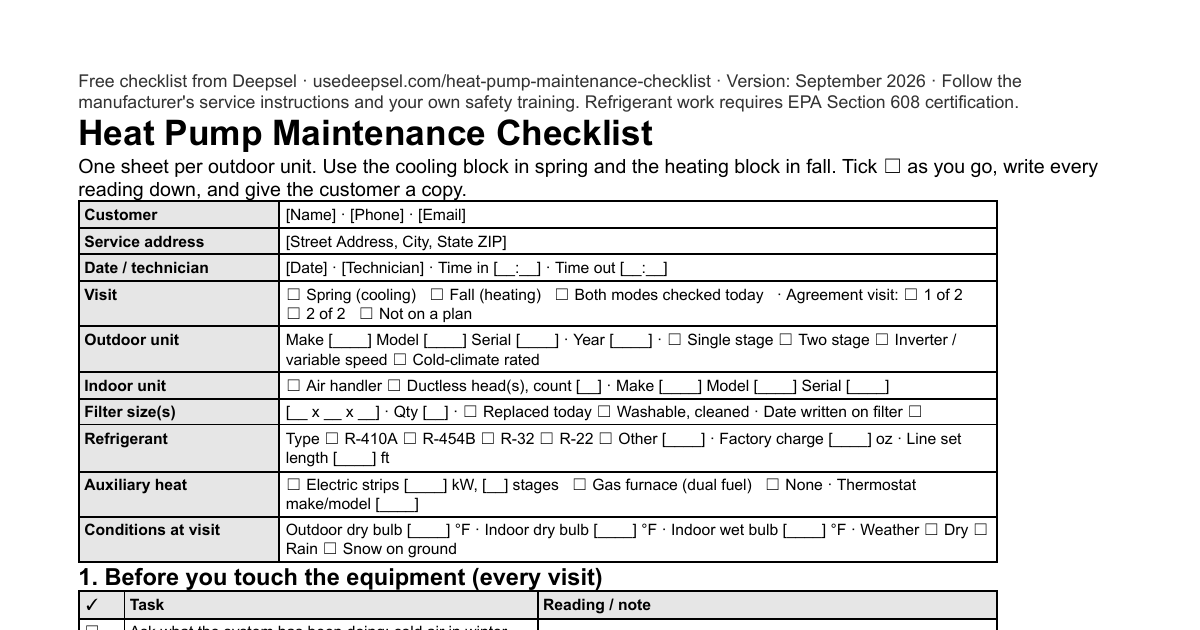
The printable version has a header block first: customer, service address, date and tech, which agreement visit this is, outdoor and indoor unit make, model and serial, filter sizes, refrigerant type and factory charge, heat kit kW and stages, thermostat model, and the outdoor and indoor temperatures at the time of the visit. Fill the filter and nameplate lines once and copy them to the customer record; every later visit starts from them. Then the tasks.
Every visit: outdoor unit
| Task | What to check and the target | Write down |
|---|---|---|
| Power off at the disconnect | Confirm dead with a meter before the panel comes off. | |
| Coil | Washed from the inside out, fins straight, no cottonwood, grass or dryer lint. Skip the wash in freezing weather. | Clean / cleaned today / needs chemical clean |
| Clearance | 2 ft to shrubs and fences on all sides, open above.15 In winter the unit sits above the snow line with no ice under the base.1 | Clearance in inches, riser height |
| Base pan drain ports | Open, so defrost water leaves the pan instead of freezing in it. ACCA 4 lists this as a heat-pump-specific task.1 | |
| Fan | Blade, motor mount and guard sound, no wobble; motor amps under nameplate. | Fan FLA vs actual amps |
| Contactor | No pitting or chatter; every lug tight; no heat discoloration on the wire. | |
| Run capacitor | Within 6% of the rated microfarads, measured under load or with a meter.9 | Rated vs actual µF |
| Line voltage | Both legs at the contactor, inside the nameplate range. | Volts |
| Compressor amps | Running amps against RLA. Inverter units: read from the board or the manufacturer app. | RLA vs actual amps |
| Crankcase heater | Shell slightly warm with the compressor off, or ohms across the leads with no OL reading.8 | Warm / ohms / none fitted |
| Refrigerant joints | Oil at brazed joints, service valves and Schrader cores; caps on and tight. | Dry / oil at (location) |
| Defrost board and sensor | No burnt spots; sensor or thermostat clipped tight to the coil tube where the manual says. |
Every visit: indoor unit
| Task | What to check and the target | Write down |
|---|---|---|
| Filter | Replaced or washed; size and date written on it. ENERGY STAR's homeowner line is monthly inspection.17 | Size, qty |
| Indoor coil | Inspected with a light and mirror; cleaned if you can see dirt on the fins. | Clean / cleaned / quote pull-and-clean |
| Blower | Wheel and housing clean; motor amps under nameplate; ECM motor reports no faults; PSC capacitor within 6%. | Blower FLA vs actual, µF |
| Drain | Pan flushed, trap primed, line cleared, pan treatment added, float switch tripped by hand. A heat pump makes condensate in both modes, indoors in summer and outdoors in winter. | Float switch trips |
| Static pressure | Return plus supply with the filter in, 0.5 inches of water column or less on most residential equipment.10 | Return, supply, total |
| Heat kit terminals | Lugs and sequencer terminals tight; no browned insulation. Loose heat-kit lugs are the fall-visit find that shows up as "no heat" in January. | |
| Ductwork | Visible disconnects, crushed flex, missing insulation, return leaks in the attic or crawl. |
Spring: cooling-mode readings
Run cooling for 10 to 15 minutes first. Use the manufacturer's charging chart for the indoor wet bulb and outdoor dry bulb you measured. If it's under about 65 °F outside, note that and do the heating block instead of forcing a charge check; HVAC School's no-gauges process, the one most shops use on maintenance calls, works best between 70 and 95 °F outdoors.11
| Reading | Target | Why it matters |
|---|---|---|
| Outdoor dry bulb, indoor dry bulb, indoor wet bulb | Needed to read any chart | A pressure logged without the conditions it was taken at can't be read against any chart next year |
| Suction pressure and suction line temperature | Per chart | Charge and airflow |
| Superheat (fixed orifice) or subcooling (TXV, EEV) | Chart or nameplate; TXV subcool within 3 °F11 | The charge check itself |
| Liquid pressure and liquid line temperature | Per chart | Condenser performance |
| Supply and return dry bulb, temperature split | Delta T chart for the indoor wet bulb, within 3 °F11 | The number the customer feels |
| Reversing valve on a cool call | Shifts; suction-to-suction line difference 3 to 5 °F or less6 | A leaking valve reads like a low charge |
| Compressor, condenser fan and blower amps | Under nameplate | Trend visit to visit |
| Condensate at the drain termination | Flowing |
Fall: heating-mode readings
Run heating for 10 to 15 minutes. Below 65 °F outdoors the manufacturer's heat-mode chart is a guideline, and if the charge is in doubt the accurate fix is recover, evacuate and weigh in the nameplate charge plus the line-set allowance. The forced-defrost and heat-strip rows are the ones a cooling-only checklist never reaches.
| Check | Target | Why it matters |
|---|---|---|
| Reversing valve shifts to heat | Discharge gas goes to the indoor coil; line-to-line difference across the valve 3 to 5 °F or less6 | The part that makes it a heat pump |
| Suction and liquid pressure in heat | Manufacturer heat-mode chart for the outdoor and indoor dry bulb4 | Guideline, see the charge section below |
| Discharge line temperature over outdoor ambient | About 100 to 110 °F over ambient on a healthy charge4 | A charge sanity check that works in cold weather |
| Supply air temperature at the nearest register | Varies with outdoor temperature; record it and compare with the last fall visit | The number the customer feels |
| Forced defrost via test pins or speed-up tap | Valve shifts to cooling, outdoor fan stops, 24 V from O to C and from W2 to C, aux heat energizes5 | Proves the board, sensor, valve and strips work together |
| Defrost terminates, fan restarts | Ends on coil temperature or the time limit, about 10 minutes on most boards5 | A defrost that never ends is a cold house |
| Defrost sensor or thermostat | Resistance matches the manufacturer's table for the coil temperature5 | Bad sensors are the most common defrost complaint |
| Aux heat amps, each stage | About 20 A per 5 kW at 240 V; kW × 1000 ÷ volts7 | A dead strip hides until the first cold night |
| Sequencer staging and blower interlock | Strips come on in order; blower runs before any strip; never strips without airflow7 | Safety and limit trips |
| Emergency heat from the thermostat | Compressor off, strips on | What the customer will use when the outdoor unit fails |
| Aux lockout and balance point | Aux lockout recorded; utility programs want 35 °F or lower13 | The setting behind most high-bill complaints |
| Outdoor coil condensate | Drains, doesn't pool or freeze under the unit | |
| Crankcase heater | Energized with the compressor off |
Inverter, cold-climate and ductless units
| Task | What to do | Write down |
|---|---|---|
| Test run or diagnostic mode | Use the manufacturer's test run for the mode check; read and clear the error-code history. | Codes found |
| Gauges | Stay off the ports unless capacity is short after coils and filters are clean. Charge is by weight on these systems. | Not opened / opened, reason |
| Communicating controls | Indoor and outdoor units see each other; dip switches and firmware per the manual. | |
| Ductless heads | Filters washed; blower wheel pulled or bibbed and cleaned; coil cleaned; drain pan and line flushed.21 | Heads done, of total |
| Condensate pump | Reservoir cleaned, float tested, discharge line clear.21 | |
| Line hide and wall sleeve | Sealed; line set insulation intact where it enters the house. | |
| Mounting | Wall bracket or riser above the local snow depth, drain path clear beneath. | Height in inches |
The PDF closes with a findings table (item, what I found, recommendation, price after the plan discount), an overall condition line, and a sign-off block with a line for the office: visit logged against the agreement, plan tier, next visit due, filter size confirmed in the customer record.
How do you test a heat pump defrost cycle?
Force it. With the system running in heating, use the defrost board's test pins or speed-up tap to start a defrost, then verify four things while it runs: the reversing valve shifts to cooling, the outdoor fan stops, and the board sends 24 volts to the reversing valve and to the backup heat. HVAC School's troubleshooting guide puts the meter checks in one line each: "Voltage between O (reversing valve) and Common = 24v" and "Voltage between W (backup heat) and Common = 24v," then "Watch the system come out of defrost and verify that the condenser fan comes back on."5
The sensor gets its own check. A snap-action defrost thermostat should close at the board's initiation point and open at termination; on Carrier boards the guide gives 32 °F to close and 65 °F to open, with a maximum defrost of about 10 minutes.5 A thermistor gets ohmed out and compared with the manufacturer's resistance table for that temperature. Techs on the 2022 r/HVAC thread about common heat pump maintenance finds answered bad boards and bad sensors before anything else, which is why both are on the every-visit list and again in the fall block.27
One more reason to force it in fall rather than wait: the aux heat that runs during defrost is what keeps the supply air from going cold. Skip the forced defrost and a dead W2 output gets found by the customer in January. One tech in the r/hvacadvice thread joked: "I'm going to start checking defrost cycle on cooling maintenances. Sorry ma'am I HAVE to run heating for 15 minutes."26 The joke is the checklist.
How do you check a reversing valve?
Temperature across the lines. HVAC School's diagnostic article states the rule: "The generally accepted temperature differential for a properly functioning valve from hot line to hot line or cold to cold is 3-5 degrees Fahrenheit."6 More than that and refrigerant is bleeding across a valve that hasn't seated, which shows up as low capacity in both modes and gets misdiagnosed as a low charge. Check that it shifts on a mode change, and if it doesn't, pull the O/B wire and see whether the valve moves on its own; if pressures change, the control wiring and the solenoid are cleared.6
The thermostat has to be told which way the valve works. "Most systems will energize the reversing valve in cooling mode (usually via the orange wire and O terminal)," HVAC School's NATE prep notes, and some brands do the opposite.12 A thermostat set to B on an O system heats when it's asked to cool. The first row of the checklist records the setting so the next tech doesn't guess.
How do you test heat strips and the sequencer?
Amps, one stage at a time. Call for auxiliary heat, watch the sequencer bring the strips on in order, and clamp each one. HVAC School's electric heat class gives the rule of thumb: "you can usually (but not always) expect 5kW heaters to draw 20 amps and 10kW to draw 40 amps but still 20 amps per strip."7 The math behind it is watts divided by volts, so a 4.6 kW element at 240 volts should read about 19 amps. A strip drawing zero is open. A strip drawing high is a shorted element or a wrong voltage. Then confirm the blower is interlocked to run before any strip does, and check emergency heat from the thermostat: compressor off, strips on.7
The setting that decides how often those strips run is the auxiliary heat lockout, and it belongs on the sheet. Bonneville Power's technician reference for its heat pump program is blunt about why: "Lockout controls minimize use of strip heat, maximizing energy savings," and "Incorrect lockout settings result in the majority of inspection failures."13 Its spec sets "auxiliary heat lockout to 35°F or lower" and says the balance point "can be no greater than 30°F."13 The balance point, as Copeland's Jim Fultz defines it on the HVAC School podcast, is the outdoor temperature at which the heat pump can no longer meet the heating demand and backup heat must engage.14 Record both settings. When the customer calls in February about a $400 bill, the sheet from November says whether the strips were locked out.
Can you check a heat pump's refrigerant charge in heating mode?
You can read pressures in heating mode. You can rarely set a charge from them. The manufacturer heat-mode charts exist for a reason, and HVAC School's winter charge article explains the limit: "you can still check the subcool and superheat in heat mode; the problem is that since there are rarely any set guidelines, it is difficult to tell when the charge is set correctly by simply checking the subcool or superheat alone."4 Carrier is explicit that it "only wants the heat mode pressure chart used as a guideline, not as a charging tool."4
So the fall block treats the chart as a sanity check and adds one that works in cold weather: discharge line temperature, which on a healthy charge runs about 100 to 110 °F over the outdoor ambient.4 A tech on r/HVAC described the maintenance-call version: "if it is a pm and it is heating season most units have a chart that tells you that if it is 40 degrees outside and 70 inside your suction pressure should be x."28 When the readings say the charge is wrong, another tech in the same thread gave the only reliable fix: "It's literally impossible to get an accurate charge unless you evac and weigh in."28 That's a repair, quoted from the findings table, and by federal rule it's done by someone with a Section 608 card, since "technicians who maintain, service, repair, or dispose of equipment that could release refrigerants into the atmosphere must be certified."19
Inverter, cold-climate and ductless heat pumps
A growing share of the heat pumps a shop maintains are inverter-driven, and many are cold-climate rated under NEEP's specification, which since version 4.0 (effective January 1, 2023) identifies units "best suited to heat efficiently in cold climates (IECC climate zone 4 and higher)."22 Three things change on the checklist.
First, the mode check runs through the manufacturer's test mode rather than the thermostat. Mitsubishi's M-Series procedure, for example, uses the emergency operation switch on the indoor unit: push once and "it will run for cooling in a fixed operation for 30 minutes," push twice and "it will run in heating if the unit is a heat pump."20 The wired controllers have a test run menu, and the outdoor board has forced-operation jumpers for the hyper-heat units.20 Read the error-code history while you're in there. ACCA 4's own footnote on charge checks says "See OEM instructions for inverter-driven equipment."1
Second, gauges stay in the truck. These systems hold small charges, an electronic expansion valve controls superheat, and every hose connection loses refrigerant. A Mitsubishi owner on r/hvacadvice in May 2026 complained that his techs "never do the same thing," and the first reply drew the line: "I'm pretty sure Mitsubishi doesn't want you checking pressures unless it's not cooling/heating due to how sensitive having the correct charge is."30 The checklist has a box for "not opened" and a box for "opened, reason," and the reason should be a capacity problem that survived clean coils and clean filters.
Third, on ductless heads the work moves indoors. SpeedClean's maintenance guide for mini-splits, which HVAC School distributes, lists the cleaning pass: "Clean and sanitize the blower wheel," "Clean and sanitize the evaporator coil," "Clean the drain line and condensate pump (if applicable)," then take amps, voltage, "outlet air temperature & delta T," and suction pressure and superheat at full cooling.21 The blower wheel gets skipped because it means bibbing or pulling the head, and it's the item behind the musty-smell callback. Outside, the unit should sit on a bracket or riser above the snow that falls in your county, with a clear drain path beneath it so defrost water doesn't build an ice block under the coil.
What the tech writes down, and why the readings matter
Thirteen numbers per visit, at most: outdoor and indoor temperatures, line voltage, compressor amps, fan amps, blower amps, capacitor microfarads, total static, suction and liquid pressure with line temperatures, superheat or subcooling, temperature split, and in fall the strip amps per stage and the defrost time. Each one has a target on the sheet, and each one has a history if the last sheet was kept.
The history is the point. A capacitor at 5% under its rating passes today; the same capacitor at 5% under last spring and 9% under this spring is a recommendation with evidence behind it. Static pressure creeping from 0.45 to 0.7 over two years is a coil getting dirty or a duct that got crushed, found before the blower motor fails. Strip amps that were 20, 20, 20 last fall and 20, 0, 20 this fall is a dead element, found in October instead of January. None of that works if the sheet says "checked" with no number next to it.
It's also the difference between a maintenance visit and the visit a homeowner on r/hvacadvice cancelled his plan over: "watching them come out and just testing the heat strips and cap and not much else, I stopped using them."29 A filled-in sheet with 13 readings and two of them trending the wrong way is a visit the customer can see. It's also what the office needs, which is where this ends up.
Heat pumps now outsell furnaces, so the fall visit is changing
The fall visit used to be a furnace visit. That's over in most of the country. RMI's market tracker, updated May 2026, reports that "Heat pumps have outsold gas furnaces consistently since 2021," and that "In 2025, manufacturers shipped 12% more heat pumps than gas furnaces (3.6M units versus 3.2M units)."23 The Building Decarbonization Coalition's read of the same AHRI data adds that heat pumps "outsold gas furnaces for the fourth consecutive year in 2025" and that "heat pump shipments eclipsed air conditioner shipments for the first time in September 2025, a trend that continued through the end of the year."24 Through April 2026, AHRI shipments of air-source heat pumps were up 1.2% to over 1.3 million units, while gas furnaces fell 11.6% to 966,919.25
For a maintenance program, the two-visit agreement stays at two visits and the second visit gets harder. The fall stop on a heat pump is a reversing valve, a forced defrost, staged heat-strip amps and a thermostat audit, instead of a heat exchanger and a flame sensor. The office needs to know which members have a heat pump, which have strips and which are dual fuel, so the fall route gets the time it needs. That's a field on the header block and a column in the ledger. If the system is a furnace, use the furnace maintenance checklist; for a straight air conditioner, the AC maintenance checklist; the general HVAC maintenance checklist covers the shared spring and fall tasks, and the tune-up checklist is the short version for a first visit. All of them are listed on the free HVAC checklists page.
The checklist proves the work. The ledger proves the visit happened.
A signed checklist proves what the tech did on the day. It says nothing about whether the customer got both visits they paid for this year, whether the fall visit was ever booked, or whether the agreement renewed. Those live in a second record, and at 40 or 50 agreements that record stops fitting in anyone's head. The free maintenance agreement tracking spreadsheet is the simplest version: one row per agreement, equipment and filter sizes from this checklist's header block, visit 1 and visit 2 with owed, booked and done dates, and formulas for visits remaining and days to renewal. The reasoning behind each column is in how to track HVAC maintenance agreements, and the contract that creates each row is the free HVAC maintenance agreement template, whose Section 3.3 visit description matches this checklist.
Past about 80 agreements the sheet needs a person, and the person is usually answering phones. That's the job Deepsel does beside Jobber or Housecall Pro: it keeps the ledger of visits owed versus delivered per covered unit, sends the spring and fall booking links so members book their own tune-ups, charges the card on file at renewal with retries and a text on failure, and warns you before a paid visit expires unbooked. The tech's checklist attaches to the visit; the visit closes against the agreement; the office sees who's still due. The equipment maintenance log template is the paper version of that per-unit history if you'd rather start there.
14-day free trial. No credit card required.Frequently asked questions
How often should a heat pump be serviced?
Twice a year, once before cooling season and once before heating season. Trane and Bryant both publish that schedule, and the reason is mechanical: a heat pump is the only piece of residential HVAC that runs every month of the year, and its heating-side parts (reversing valve, defrost control, auxiliary heat) can only be tested properly in heating mode. The EPA's floor is at least once a year with monthly filter changes.
What's the difference between a heat pump tune-up and an AC tune-up?
The cooling half is the same job: coils, capacitor, contactor, drain, static pressure, charge by the chart. A heat pump adds four checks an air conditioner doesn't have. The reversing valve has to shift both ways with a 3 to 5 °F or smaller difference across its lines, the defrost cycle has to initiate and terminate, the electric heat strips have to draw their rated amps stage by stage, and the thermostat has to be set up so auxiliary heat stays off until it's needed.
Can a heat pump be serviced in winter?
Yes, and the heating-side checks are the point of a winter visit. What changes below about 65 °F outdoors is the charge check: manufacturers publish heat-mode pressure charts as guidelines, and the reliable way to set a charge you doubt is to recover, evacuate and weigh in the nameplate amount. Techs also skip washing the outdoor coil in freezing weather, because the rinse water freezes in the base pan.
Does a ductless mini-split heat pump need professional maintenance?
Yes, mostly at the indoor heads. The homeowner washes the filters monthly. Once a year a tech pulls or bibs each head to clean the blower wheel and coil, flushes the drain pan and line, cleans the condensate pump if there is one, and washes the outdoor coil. Charge is checked by weight on these inverter systems, so gauges stay off the ports unless capacity is short after everything is clean.
Is there a heat pump maintenance checklist PDF I can print without giving an email?
This one. The PDF, the Word file and the one-click Google Docs copy on this page are free and ask for nothing. Three printed pages: a header block for the unit and filter sizes, every-visit tasks for the outdoor and indoor units, a cooling-mode readings block for spring, a heating-mode block for fall with forced defrost and heat-strip amps, a section for inverter and ductless units, findings, and a sign-off line.
Sources
- Air Conditioning Contractors of America, ANSI/ACCA 4 QM-2013, "Maintenance of Residential HVAC Systems" - Checklist 5.8-HP "Additional Tasks for Air-to-Air Heat Pump Condensers": "Test reversing valve operation," "Test defrost cycle controls," "Inspect outdoor unit condensate drain ports" with the unit "elevated above obstructions ... for seasonal obstructions like snow"; Checklist 5.9 fan coil: "Test electric heater's capacity and sequence of operation"; footnote 5: "See OEM instructions for inverter-driven equipment." transductiontechnologies.com (hosted copy), 2013 edition, read September 5, 2026.
- The ACHR News, "Standard for Residential HVAC Maintenance Reaffirmed." achrnews.com, September 16, 2024, read September 5, 2026.
- HVAC School, Bryan Orr, "The Basic Residential Maintenance for a Heat Pump / Electric System" - the full visit walkthrough, ending with heat strips tested on an amp meter, the reversing valve tested, and 45 minutes to two hours per system. hvacrschool.com, September 21, 2022, read September 5, 2026.
- HVAC School, Bryan Orr, "Checking the Charge on a Heat Pump in the Winter" - "Carrier only wants the heat mode pressure chart used as a guideline, not as a charging tool"; "since there are rarely any set guidelines, it is difficult to tell when the charge is set correctly by simply checking the subcool or superheat alone"; the "100°-110° over the outdoor ambient discharge rule." hvacrschool.com, January 21, 2020, read September 5, 2026.
- HVAC School, "Heat Pump Defrost Troubleshooting Tips" - "Voltage between O (reversing valve) and Common = 24v," "Voltage between W (backup heat) and Common = 24v," "Watch the system come out of defrost and verify that the condenser fan comes back on"; Carrier defrost thermostats close at 32°F and open at 65°F; maximum defrost about 10 minutes. hvacrschool.com, November 30, 2024, read September 5, 2026.
- HVAC School, Matthew Bruner, "Diagnosing a Reversing Valve" - "The generally accepted temperature differential for a properly functioning valve from hot line to hot line or cold to cold is 3-5 degrees Fahrenheit." hvacrschool.com, March 17, 2023, read September 5, 2026.
- HVAC School, Bryan Orr, "Electric Heat Troubleshooting, Service, and Math Class" - "you can usually (but not always) expect 5kW heaters to draw 20 amps and 10kW to draw 40 amps but still 20 amps per strip"; watts divided by rated voltage; sequencers close at different times; never run strips without the blower. hvacrschool.com, November 1, 2021, read September 5, 2026.
- HVAC School, JD Kelly, "Field Guide to Crankcase Heaters" - the heater's job is to "prevent liquid refrigerant from migrating into the compressor crankcase during the off-cycle"; with power applied "the compressor shell should feel slightly warm to the touch"; a failed heater reads "OL." hvacrschool.com, September 23, 2025, read September 5, 2026.
- HVAC School, Bryan Orr, "Testing Run Capacitors the Smart (and Easy) Way" - "Most capacitors allow for a 6%+/- tolerance." hvacrschool.com, March 4, 2017, read September 5, 2026.
- HVAC School, Bryan Orr, "Static Pressure, Manometers, and Magnehelics" - "Total external static pressure is return plus supply, positive plus negative, and in general, you would like to see it be 0.5″ or less." hvacrschool.com, April 12, 2024, read September 5, 2026.
- HVAC School, Bryan Orr, "Checking the Charge Without Gauges (Our Process)" - the procedure works best at outdoor temperatures from 70°F to 95°F; "if the split is within +/- 3°F, it is within range"; TXV subcooling within 3°F of target. hvacrschool.com, March 12, 2019, read September 5, 2026.
- HVAC School, Bryan Orr, "Reversing Valves (RSES NATE Prep)" - "Most systems will energize the reversing valve in cooling mode (usually via the orange wire and O terminal)." hvacrschool.com, May 13, 2020, read September 5, 2026.
- Bonneville Power Administration, "PTCS Lockouts and Balance Points: Reference Guide" - "Lockout controls minimize use of strip heat, maximizing energy savings"; "Incorrect lockout settings result in the majority of inspection failures"; "PTCS Spec: Set auxiliary heat lockout to 35°F or lower"; "Balance point can be no greater than 30°F." bpa.gov, undated PDF, read September 5, 2026.
- HVAC School podcast, "Balance Point Explained w/ Jim Fultz" (Copeland / White-Rodgers) - capacity balance point: the outdoor temperature at which the heat pump can no longer meet the heating demand and backup heat must engage. hvacrschool.com, read September 5, 2026.
- Trane, "Home Heat Pump Maintenance" - "Schedule a preventative maintenance checkup with your local dealer twice a year"; dealer list includes "Inspect the reversing valve" and "Check the defrost control operation (in the fall only)"; "keep shrubs and plants at least 2 ft. away from the heat pump on all sides"; check for snow or ice build-up in winter. trane.com, read September 5, 2026.
- Bryant, "Heat Pump Maintenance: Complete Checklist & Guide" - a technician on "checking the refrigerant charge in both heating and cooling mode because they do have different charge levels in each mode"; twice-yearly schedule, spring and fall. bryant.com, read September 5, 2026.
- ENERGY STAR, "Maintenance Checklist" - contractor tasks (tighten electrical connections, check the condensate drain, clean coils, check refrigerant, clean and adjust blower components) and the homeowner line to "Inspect, clean, or change air filters once a month." energystar.gov, read September 5, 2026.
- U.S. EPA, Burn Wise, "Heat Pumps" - "Cleaning or changing the filters monthly or as needed optimizes performance"; "have a professional technician service your heat pump at least once a year." epa.gov, updated February 12, 2026, read September 5, 2026.
- U.S. EPA, "Section 608 Technician Certification Requirements" - "technicians who maintain, service, repair, or dispose of equipment that could release refrigerants into the atmosphere must be certified." epa.gov, updated July 15, 2026, read September 5, 2026.
- Mitsubishi Electric, "M-Series EO and Test Run Information" - emergency operation switch: push once and "it will run for cooling in a fixed operation for 30 minutes," push twice and "it will run in heating if he unit is a heat pump" (sic); wired-controller test run menus; CN31 forced-operation jumper on hyper-heat outdoor units. mehvac.com, March 2016, read September 5, 2026.
- SpeedClean (Crossford International), "Mini-Split Maintenance Best Practices," distributed with HVAC School - cleaning steps "Clean and sanitize the blower wheel," "Clean and sanitize the evaporator coil," "Clean the drain line and condensate pump (if applicable)"; measurements "Measure outlet air temperature & delta T," "Check suction pressure and superheat at full cooling." thdstatic.com (hosted PDF), 2019, read September 5, 2026.
- Northeast Energy Efficiency Partnerships, "ccASHP Specification & Product List" - version 4.0 effective January 1, 2023; designed to identify heat pumps "best suited to heat efficiently in cold climates (IECC climate zone 4 and higher)." neep.org, read September 5, 2026.
- RMI, "Tracking the Heat Pump & Water Heater Market in the United States" - "Heat pumps have outsold gas furnaces consistently since 2021"; "In 2025, manufacturers shipped 12% more heat pumps than gas furnaces (3.6M units versus 3.2M units)." rmi.org, updated May 2026, read September 5, 2026.
- Home Pros News, Deirdra Funcheon, "Heat pump shipments have started outpacing air conditioners, report highlights" (Building Decarbonization Coalition report on AHRI data) - "air-source heat pumps outsold gas furnaces for the fourth consecutive year in 2025"; "heat pump shipments eclipsed air conditioner shipments for the first time in September 2025, a trend that continued through the end of the year"; January 2026 "nearly 230,000" heat pumps versus "roughly 210,000" air conditioners. homepros.news, April 9, 2026, read September 5, 2026.
- Utility Dive, Joe Burns, "Heat pump shipments rise through April, with more use for both heating and cooling" - AHRI data through April 2026: air-source heat pumps up 1.2% to over 1.3 million units; gas warm-air furnaces down 11.6% to 966,919 units from 1,093,683. utilitydive.com, June 17, 2026, read September 5, 2026.
- r/hvacadvice, "AITA? Should a tune-up include both sides of a heat pump?" (193 upvotes) - "in winter they will check the aux heat strips in the indoor unit and maybe the defrost board on the outdoor unit. Those they don't check over in summer usually"; "ensure reverse valve engages (or disengages) with the call for heat. Run a test on the defrost cycling, change the filter"; "I'm going to start checking defrost cycle on cooling maintenances. Sorry ma'am I HAVE to run heating for 15 minutes." reddit.com, September 22, 2025, read September 5, 2026.
- r/HVAC, "Heat Pump maintenance. Wha is really needed?" - "Prewinter = clear drain, treat drain pan, reprime drain trap, vacuum entire airhandler coil blower inner cabinet, check amp draws, check capacitors, check contactors, inspect ductwork, check Freon in heat, check defrost switch/sensor, check aux/emergency heat." reddit.com, March 30, 2020; and r/HVAC, "Heat Pump Maintenance - most common issues you guys see?" - the two top-voted answers, profanity removed, were boards and sensors. reddit.com, April 1, 2022, both read September 5, 2026.
- r/HVAC, "Problems charging Heat Pumps in HEAT by Subcooling?" - "It's literally impossible to get an accurate charge unless you evac and weigh in"; "if it is a pm and it is heating season most units have a chart that tells you that if it is 40 degrees outside and 70 inside your suction pressure should be x." reddit.com, January 21, 2022, read September 5, 2026.
- r/hvacadvice, "HVAC tune up versus Preventative maintenance contracts?" - "watching them come out and just testing the heat strips and cap and not much else, I stopped using them." reddit.com, September 15, 2024, read September 5, 2026.
- r/hvacadvice, "Mitsubishi heat pump maintenance" - owner: "They never do the same thing"; reply: "I'm pretty sure Mitsubishi doesn't want you checking pressures unless it's not cooling/heating due to how sensitive having the correct charge is." reddit.com, May 2, 2026, read September 5, 2026.
- Maptrack, "Heat Pump Maintenance Checklist | Free 30-Point PDF" - 30 line items, no target readings; "Enter your email to download the heat pump maintenance checklist as a free PDF." maptrack.com, read September 5, 2026.
- Mitti, "Free Heat Pump Maintenance Checklists | PDF" - 21 line items, no target readings; "Use template" leads to a platform signup. mitti.com, read September 5, 2026.