Free preventive maintenance schedule template for HVAC shops (Google Sheets, Excel and printable PDF)
- Free. No signup and no email asked; the links below go straight to the sheet.
- Deepsel is our product. It gets the visits on this schedule booked and recorded, and the last section says so.
- Intervals come from ENERGY STAR, ACCA Standard 4 and ASHRAE/ACCA Standard 180. Where the manufacturer's manual says something else, the manual wins.
A preventive maintenance schedule template is a 12-month grid with one row per unit: what the equipment is, how often it needs service, which month the cycle starts, and who does the work. This free one fills the due months in for you, turns a cell red when the month passes with nothing done, and lists who's due this month on its own tab.
Get it three ways: make your own copy in Google Sheets (one click, opens in your Drive), download the Excel version (.xlsx), or print the PDF, which has a filled-in example, a blank grid for the wall, and the task list. You can also look at the sheet first without copying anything.
I built it because the templates that rank for this search were written for factories. Sockeye's are plain equipment-and-task tables with a priority dropdown, and the page says they are generic by design.1 ProjectManager's Excel file asks for "Frequency of Maintenance (in Days)" and a condition color.2 None of them know what a spring tune-up is. A service shop's year has a shape, spring for cooling and fall for heat, and the schedule should be built around it. So this one is: the sample rows are a two-truck shop's agreement customers plus three light-commercial accounts, and the task list is HVAC only.
What's in the template
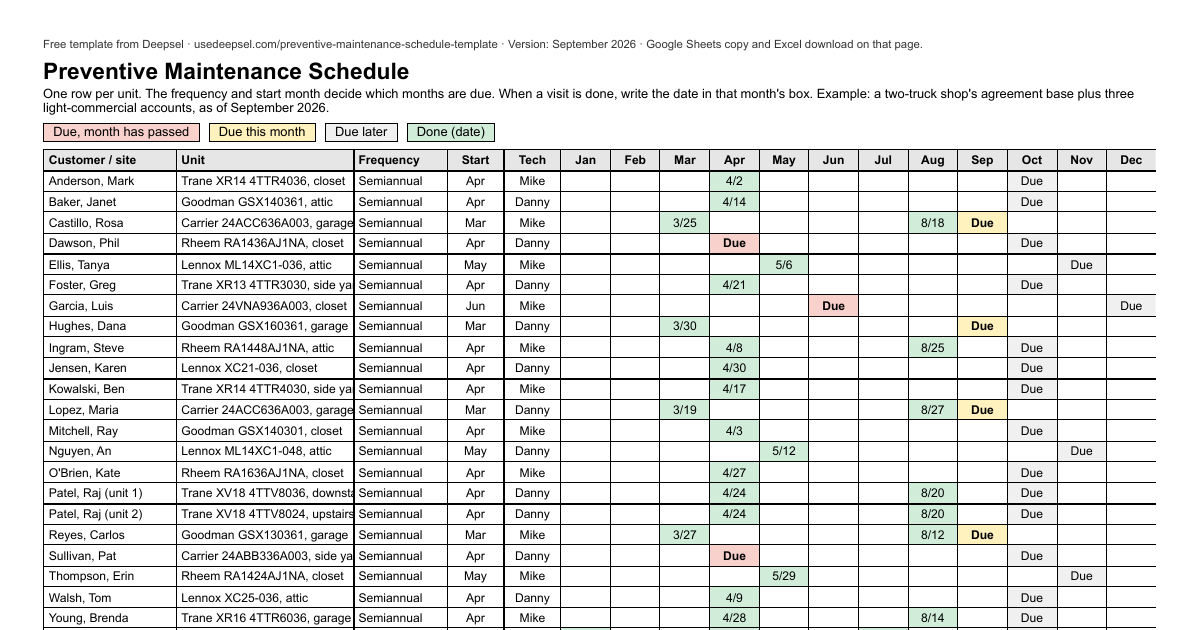
Three tabs. The Schedule tab is the grid. The Task list tab says what "service" means for each piece of equipment and how often. The This month tab is the call list.
Schedule tab: one row per unit, 24 columns
You type the first six columns. Everything from column G onward is a formula, and the formulas are filled down to row 200 so new rows work the moment you type a unit into them.
| Column | Header | What goes in it |
|---|---|---|
| A | Customer / site | Name as it appears in your FSM or QuickBooks, so a row matches a record later |
| B | Unit | Make, model and where it sits: "Trane XR14 4TTR4036, closet". A second system at the same house is a second row |
| C | Equipment type | Dropdown: split AC + gas furnace, heat pump, AC only, furnace only, mini split, rooftop unit, boiler, exhaust / make-up air, other |
| D | Frequency | Dropdown: monthly, quarterly, semiannual (spring + fall), annual |
| E | Start month | Dropdown, Jan to Dec. For a semiannual residential unit, the month of the spring visit; fall lands six months later by itself |
| F | Tech | Whoever owns the route |
| G | Every (months) | Formula from the frequency: 1, 3, 6 or 12. Type a number over it for an odd interval like every two months |
| H | Last done | Formula: the latest date typed anywhere in the month grid |
| I | Next due | Formula: last done plus the interval, or the first of the start month if nothing has been done yet |
| J to U | Jan to Dec | Formula writes "Due" in the right months. When a visit is done, type the date over the word |
| V | Due this month | Formula: "Yes" if the current month's cell still says Due |
| W | Overdue | Formula: how many earlier months this year still say Due |
| X | Notes | Gate code, roof hatch key, "call before 9" |
The month formula is short enough to read. It takes the month's position, subtracts the start month's position, and checks whether the interval divides the difference evenly. April start, every six months: April and October say Due, the other ten stay blank. Quarterly from January: January, April, July, October. Monthly: every cell. Three conditional-format rules color the grid: a typed date is green, a Due cell in the current month is yellow, and a Due cell in a month that has already ended is red. Red is the whole point. It is the visit that was paid for and never happened.
Task list tab: what "service" means, by equipment
Twenty-one rows, each with the equipment, the tasks, the interval, the best months, the standard it came from, and the checklist page on this site that walks a tech through it. The short version is below; the sheet has the full wording.
| Equipment | Task | How often | Source |
|---|---|---|---|
| Any forced-air system | Check the 1-inch filter; replace when loaded | Check monthly; replace every 1 to 3 months | ENERGY STAR3, 4 |
| Any forced-air system | Replace 4 to 5 inch media filter | Every 6 to 12 months | Filter guidance5 |
| AC or heat pump, cooling side | Clean condenser coil, check charge and temperature split, clear the condensate drain, test capacitor and contactor, check blower amps | Annually, March to May | ENERGY STAR; ACCA 4 Checklists 5.7 and 5.83, 6 |
| Gas furnace | Inspect heat exchanger, burners, flame sensor, gas pressure and venting; test safeties | Annually, September to November | ENERGY STAR; ACCA 4 Checklist 5.43, 6 |
| Heat pump, heating side | Test defrost, auxiliary heat and reversing valve | Annually, fall | ACCA 4 Checklist 5.8-HP6 |
| Thermostat | Replace battery, check wiring and settings | Annually | ACCA 4 Checklist 5.36 |
| Rooftop unit | Filters and UV lamp | Quarterly | Standard 180 Table 5-227 |
| Rooftop unit | Belts and sheaves, controls, P-trap, coil fouling | Semiannually | Standard 180 Table 5-227 |
| Rooftop unit | Refrigerant temperatures, contactor, fan blades, drain pan, condenser surfaces, combustion section | Annually | Standard 180 Table 5-227 |
| Exhaust, supply and return fans | Belt tension and wear | Semiannually; bearings and drive alignment annually | Standard 180 Table 5-147 |
| Commercial furnace or unit heater | Oil fuel filter; air filters; heat exchanger, burner, flue and safeties | Monthly; quarterly; annually | Standard 180 Table 5-167 |
Every row links to the page that has the actual checklist: AC maintenance, furnace maintenance, heat pump maintenance, commercial HVAC maintenance, and the master HVAC maintenance checklist with its PDF. The schedule says when. Those pages say what.
This month tab: the call list
Two lists side by side, both live. The left one is every unit whose current-month cell still says Due. The right one is every unit with a red cell, meaning an earlier month this year went by with nothing typed in. Open it on the first of the month and you have the list to text.
How to use it
Setting up, about ten minutes
Make a copy, delete the 26 sample rows, and type your units into columns A through F. If you already keep the free maintenance agreement tracking spreadsheet, paste its customer and system columns straight in; the names match on purpose. Pick the frequency and the start month for each row. The grid fills itself. For a two-system home, enter two rows with the same customer name, the way the Patel rows do in the sample.
Start month is the one judgment call. For a semiannual residential plan, use the month you want the cooling visit, usually March, April or May depending on how far north you are, and the heating visit lands six months later. A heat pump that a customer signed for in June gets a June start, which is why Luis Garcia's row shows a red June in the sample: he signed at a repair, nobody ever did the first check, and the sheet says so.
When the season opens
Six weeks before your spring window, sort the Schedule tab by start month and you have the whole spring list in order. Text first, in batches by zip code so the tech is in one part of town for prepaid work. This is where the reminder rounds go. The most useful thread I've read on the topic is an office manager on r/ProHVACR who used to call every agreement customer and ran out of hours: "Previously we called each customer but as we've grown and my role has grown and taken on more and more responsibilities I now have the issue of not having the time to call individuals."8 The top answer was an email blast, blind-copied, twice, then "one friendly call and if they don't respond to any of those then as far as I am concerned they can reach out when they want the service."8 I replied in that thread with two changes: text instead of email for the first two rounds, and start six weeks early. Either way, the schedule is the list you blast from.
When a visit is done
Type the date over the word Due, in the Due month, even if the tech went two weeks early. The cell turns green, Last done and Next due update, and the row drops off the This month tab. That one habit is the whole system, and it fails first when the person who owns the sheet is also answering phones. Give it to one named person. If you want the readings from the visit somewhere, that is the equipment maintenance log template, one row per visit, same unit names.
Once a month
Open This month. Work the left list, then the right one. The right list is the one that matters, because a red cell in a service shop is a customer who paid for a visit that never came. The r/ProHVACR office manager who took over her shop's agreements from a binder put the goal in one line: "I just need something to help me stay more organized and not let people slip through the cracks."9 The red cells are the cracks.
In January
Make a fresh copy from this page, paste columns A through F from last year's sheet, and the new grid is empty and correct. Keep the old sheet; it is your record of what got done in which month.
Why the year has this shape
ENERGY STAR's maintenance checklist gives the reason in one sentence: "Contractors get busy once summer and winter come, so it's best to check the cooling system in the spring and the heating system in the fall."3 That is the homeowner's view. The shop's view is the same calendar from the other side. Ben Reed's piece for HVAC Know It All describes the quiet: "April arrives, heating calls drop, cooling calls have not started, and the phone goes quiet."10 His fix is the agreement base, and he sizes it: at 50 agreements you are running about 100 visits a year, and "your spring or fall maintenance schedule fills itself."10 An ACHR News column on the slow times says the same in plainer words: "There will always be peaks and valleys. If we understand that and prepare for it, we can make the shoulder seasons more tolerable."11
So the residential default in the sheet is semiannual, spring and fall. ACCA Standard 4, the residential maintenance standard, expects that: its foreword says maintenance "will likely take the form of annual/semiannual visits to perform the inspection and applicable remediation actions, though the exact frequency may vary,"6 and section 5.4.1 requires the cooling and heating checks to happen while the equipment can actually run in its operating range, which is another way of saying spring for AC and fall for heat.6 When the 2019 update was reviewed, a contractor objected that seasonal equipment under an annual agreement would need two visits to comply, and the standard added language "that allows homeowners or contractors the ability to adjust service frequencies based on equipment usage."12 That is why the Frequency column has an Annual option and why column G accepts any number.
Between the two visits sit the filters. ENERGY STAR says to inspect, clean or change them once a month and, at a minimum, change the filter every three months, because "airflow problems can reduce your system's efficiency by up to 15 percent."3, 4 The interval depends on the filter. A September 2025 guide puts 1-inch fiberglass at every 30 days, 1-inch pleated MERV 8 to 11 at every 60 to 90 days, and 4 to 5 inch media at every 6 to 12 months.5 Most shops leave the monthly filter change to the homeowner and swap a filter at each visit. If you sell a filter-delivery add-on, give it its own row with Monthly or Quarterly and the grid tracks it.
For facility managers: the same sheet with Standard 180 intervals
If you run a building instead of a service route, the commercial rows in the sample are your starting point. ASHRAE/ACCA Standard 180 sets minimum inspection and maintenance tasks for commercial HVAC with a frequency per task, and the sheet's task list carries them over. Rooftop units: filters and UV lamp quarterly; belts, sheaves, controls and coil fouling semiannually; refrigerant temperatures, contactors, fan blades, drain pans and the combustion section annually.7 Fans: belts semiannually, bearings and drive alignment annually.7 Oil-fired furnaces and unit heaters: fuel filter monthly.7 The standard also says the frequency can be adjusted from the table when you document why, in section 4.2.2, so a dusty loading dock can go to monthly filters without breaking anything.7 Set the row to Quarterly with a January start and the grid marks January, April, July and October, which is the sample dental office.
Does it work in Excel?
Yes, with one difference. I exported the .xlsx and re-imported it to check what survived. Every formula on the Schedule tab comes through as a real Excel formula: the due-month grid, Every (months), Last done, Next due, Due this month and Overdue all recalculate in Excel, and the three color rules and the dropdowns come with them. The This month tab uses FILTER, which Google exports as a frozen snapshot, so in Excel that tab shows the values from the day I exported it and stops updating. In Excel, use the Schedule tab instead: put a filter on the header row and show Due this month equals Yes, or Overdue greater than zero. Same list, one more click. If you are on Excel 365 you can also retype the two FILTER formulas from the sheet and they run natively.
The PDF is the printable version. Page 1 is the sample as of September, which is useful for showing the office what the colors mean. Page 2 is a blank grid with 18 rows for the wall. Page 3 is the task list.
This is the year plan. The agreement ledger is a different sheet
A schedule answers "which units are due this month." It does not answer "does this customer still have a paid visit owed, and when does the plan renew." Those live in the maintenance agreement tracking spreadsheet, one row per agreement with plan and tier, renewal date, payment method, both visits owed versus delivered, and the discount. The two sheets use the same customer and unit names so you can move between them, and the contract that creates each ledger row is the free HVAC maintenance agreement template. If you want the reasoning behind the ledger columns, it is in how to track HVAC maintenance agreements. The full set of free HVAC checklists and templates is on the checklists page.
A small-business owner on r/smallbusiness described the exact moment the year plan stops being enough: "after a year it's easy to lose track of who is due for service, especially as the customer list grows. Right now I'm using spreadsheets and calendar reminders, but it's becoming messy."13 The best reply in the thread named the real problem: "you don't have a scheduling/dispatch problem, you have a 'who's due and did anyone tell them' problem."13 The sheet handles who's due. The second half, did anyone tell them, is a person with a phone until you automate it.
Getting the due visits booked and recorded
Run with the habits above, this schedule is a real system to about 80 to 100 units, the same ceiling as the ledger. Above that, the sheet is fine and the hours are the problem: three reminder rounds per season per customer, dates typed in by hand, and a This month list that only gets worked when someone remembers to open it.
That is the job Deepsel does. It keeps the schedule and the ledger as one record per agreement, sends the season booking text and email rounds on its own, lets the customer pick a slot, writes the completed visit back against the agreement, and warns you before a paid visit expires. It works beside Jobber or Housecall Pro rather than replacing them. Upload this sheet, or the ledger, during the trial and the schedule is built from your rows.
14-day free trial. No credit card required.Frequently asked questions
How do I make a preventive maintenance schedule in Excel?
One row per unit, one column per month. Put the service interval in months and the start month in their own columns, then use a formula in each month cell that writes Due when the month number minus the start month divides evenly by the interval. Add a column that counts Due cells in months that have already passed, and filter on it once a month. That is exactly how this template is built, so downloading the .xlsx is faster than building it.
How often should HVAC preventive maintenance be done?
For a home: a cooling check in spring and a heating check in fall, with the filter checked monthly and replaced every one to three months for a 1-inch filter. That is the ENERGY STAR guidance, and ACCA Standard 4 describes the same annual or semiannual pattern. For commercial rooftop units, ASHRAE/ACCA Standard 180 puts filters at quarterly, belts and controls at semiannual, and refrigerant and coils at annual, with a documented way to adjust either way.
What should a preventive maintenance schedule include?
The unit (make, model and where it sits), the type of equipment, how often it needs service, which month the cycle starts, who is assigned, the last date it was done, the next due date, and a month grid showing what is due when. A schedule for a service shop also needs a way to see who's due this month without scrolling, which is why this sheet has a This month tab.
What is the difference between a maintenance schedule and a maintenance log?
The schedule looks forward: it says which units are due in which month. The log looks back: it records what was done on each visit, with the readings and the tech's name. You need both. This page is the schedule. The equipment maintenance log template is its companion, one row per visit, and the two share the same unit names so a log entry answers the question the schedule raised.
Is there a free preventive maintenance schedule template in Google Sheets?
Yes, this one. Make your own copy in one click, no email and no form. It has a Schedule tab with 200 formula-ready rows, a Task list tab with intervals from ENERGY STAR, ACCA 4 and Standard 180, and a This month tab that filters who's due. The same file downloads as Excel, and there is a three-page printable PDF for the wall.
Sources
- Sockeye Technologies, "Free Preventive Maintenance Schedule Templates" - Excel and Google Sheets tables of "equipment, tasks, priorities, and due dates," described as generic for any equipment. getsockeye.com, January 10, 2025, read September 5, 2026.
- ProjectManager, "Maintenance Schedule Template" - Excel template with columns including "Frequency of Maintenance (in Days)," condition, assignee, last and next maintenance date. projectmanager.com, read September 5, 2026.
- ENERGY STAR, "Maintenance Checklist" - "Inspect, clean, or change air filters once a month in your central air conditioner, furnace, and/or heat pump"; "Contractors get busy once summer and winter come, so it's best to check the cooling system in the spring and the heating system in the fall"; "Airflow problems can reduce your system's efficiency by up to 15 percent." energystar.gov, read September 5, 2026.
- ENERGY STAR, "Heat & Cool Efficiently" - "At a minimum, change the filter every 3 months." energystar.gov, read September 5, 2026.
- PickHVAC, Rene Langer, "How Often Should You Change Your Furnace Filter? Schedules, MERV, and Money-Saving Tips" - 1-inch fiberglass "Replace every 30 days"; 1-inch pleated MERV 8 to 11 every 60 to 90 days; 4 to 5 inch media every 6 to 12 months. pickhvac.com, September 21, 2025, read September 5, 2026.
- ANSI/ACCA 4 QM, "Maintenance of Residential HVAC Systems" (public PDF) - foreword: maintenance "will likely take the form of annual/semiannual visits to perform the inspection and applicable remediation actions, though the exact frequency may vary"; section 5.4.1: "Inspection tasks for cooling and heating shall be performed when the equipment is operating within the temperature parameters established by conditions which meet the manufacturer's operating range"; Checklist 5.3 thermostat: "Replace battery annually"; Checklists 5.4, 5.7, 5.8 and 5.8-HP task lists. transductiontechnologies.com mirror of the ACCA document, read September 5, 2026.
- ANSI/ASHRAE/ACCA Standard 180, "Standard Practice for Inspection and Maintenance of Commercial Building HVAC Systems" (public PDF) - Table 5-22 Rooftop Units (filters and UV lamp quarterly; belts, controls, P-trap and heat-exchange fouling semiannually; refrigerant temperatures, contactor, fan blades, drain pan and combustion section annually); Table 5-14 Fans; Table 5-16 Furnaces (fuel filter monthly); Table 5-2 Air Handlers; section 4.2.2 on adjusting frequency with documentation. philcoaircontrol.com mirror, read September 5, 2026.
- r/ProHVACR, "Scheduling maintenance for service agreements" - original post: "Previously we called each customer but as we've grown and my role has grown and taken on more and more responsibilities I now have the issue of not having the time to call individuals"; top reply: "I've had the best luck with blasting an email to all of them at once, with each recipient Blind copied... I do that twice, then one friendly call and if they don't respond to any of those then as far as I am concerned they can reach out when they want the service." reddit.com, May 22, 2025, read September 5, 2026. My own reply in the thread is dated September 3, 2026.
- r/ProHVACR, "Service Agreement Management" - "Originally they had a binder to track customer's service agreements, then we moved to excel"; "I just need something that tracks if and when they get their 2 maintenance visits, renewal date, tier level, last visit date, etc."; "I just need something to help me stay more organized and not let people slip through the cracks." reddit.com, February 19 to 20, 2025, read September 5, 2026.
- HVAC Know It All, Ben Reed, "Service Agreements Are Shoulder-Season Insurance" - "April arrives, heating calls drop, cooling calls have not started, and the phone goes quiet"; "You now have 10 to 20 agreements. Your spring or fall maintenance schedule fills itself"; 50 agreements as roughly 100 visits a year. hvacknowitall.com, April 1, 2026, updated April 6, 2026, read September 5, 2026.
- ACHR News, Will Merritt, "How to Weather the Slow Times in the HVACR Business" - "We have to understand the seasonality of heating and air conditioning. There will always be peaks and valleys. If we understand that and prepare for it, we can make the shoulder seasons more tolerable." achrnews.com, January 16, 2025, read September 5, 2026.
- ACCA HVAC Blog, Don Prather, "Does Your Residential Maintenance Service Plan Meet Minimum Standards?" - a reviewer's concern from "a contractor who has annual maintenance agreements on seasonal equipment that required semiannual servicing for compliance with the standard," and the added language "that allows homeowners or contractors the ability to adjust service frequencies based on equipment usage." hvac-blog.acca.org, April 22, 2019, read September 5, 2026.
- r/smallbusiness, "How do you keep track of annual maintenance customers?" - original post: "after a year it's easy to lose track of who is due for service, especially as the customer list grows. Right now I'm using spreadsheets and calendar reminders, but it's becoming messy"; reply: "you don't have a scheduling/dispatch problem, you have a 'who's due and did anyone tell them' problem." reddit.com, June 16 to 17, 2026, read September 5, 2026.