AC maintenance checklist: the cooling visit, with the target readings (free PDF, Google Docs and Word)
- Free. No signup and no email asked; the links below go straight to the file.
- Deepsel is our product. It tracks whether the visits on a maintenance agreement got delivered, and the last section says so.
- The checklist does not replace the manufacturer's service instructions or your safety training. Where the nameplate gives a number, the nameplate wins.
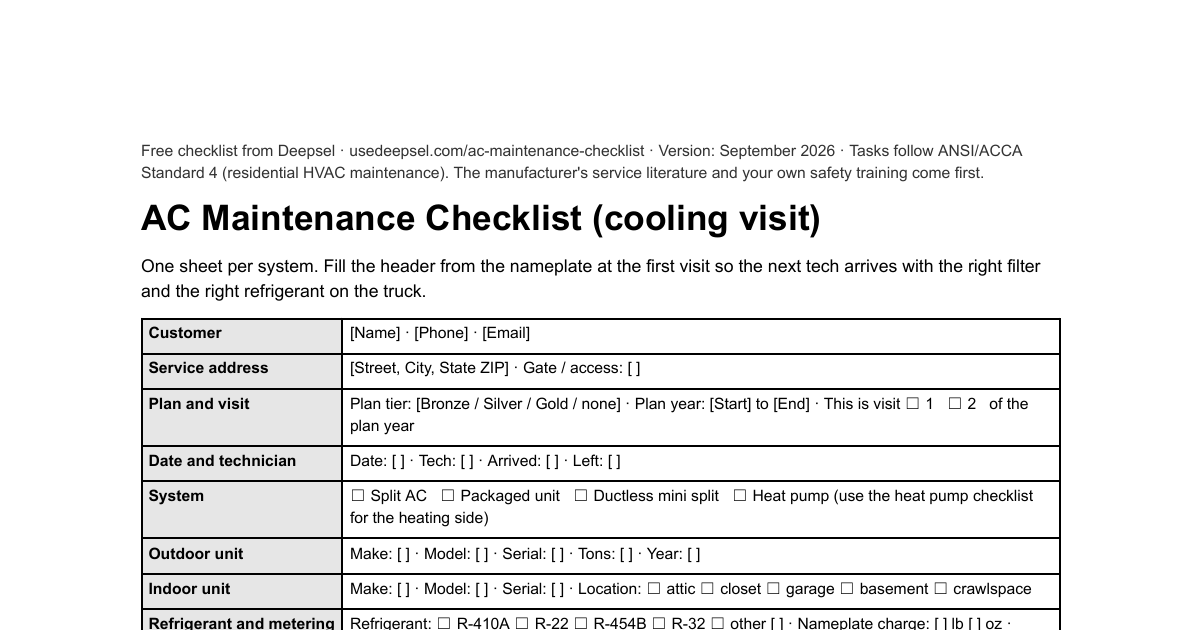
An AC maintenance checklist covers the cooling-season visit on a split or packaged air conditioner: thermostat and safety switches, filter, evaporator coil and blower, condensate drain, static pressure, then the outdoor unit's disconnect, contactor, capacitors, motors and coil, and finally the refrigerant readings, superheat or subcooling, against the manufacturer's target. This one prints the target range beside each task and leaves a line to record every reading.
Get it three ways: make your own copy in Google Docs (one click, opens in your Drive), download the Word version (.docx), or download the PDF. You can also read it in Google Docs first without copying anything. Four printed pages, one sheet per system. It's the cooling half of the full-year HVAC maintenance checklist, and all the free checklists are listed at the checklist hub.
No form, no follow-up email. I built it because the checklists that rank for this search are task lists without numbers. Of the two downloadable ones on page one that I opened, Filterbuy's and ServiceChannel's, neither prints a temperature split, a static pressure ceiling, a capacitor tolerance or a subcooling target.25, 26 A checklist without targets is a list of things to glance at. A tech can tick "checked capacitor" without ever putting a meter on it, and a customer can't tell the difference. The numbers are what make the visit provable, which matters more than usual when the customer prepaid for it on a maintenance agreement.
Where the task list comes from
The tasks follow ANSI/ACCA Standard 4, "Maintenance of Residential HVAC Systems." ACCA describes it as "a nationally recognized, manufacturer-endorsed set of minimum tasks that should be performed for HVACR equipment maintenance inspections," and ANSI reaffirmed the 2019 edition in September 2024.2 Its foreword is honest about why it exists: "There are many types and intensity levels of 'seasonal tune-ups', 'clean and checks', and 'maintenance services' performed on HVAC equipment. This standard establishes the minimum level of acceptable compliance."1
The standard's cooling checklists (5.7 evaporator coil, 5.8 condensing unit, 5.9 fan coil) tell you what to inspect and what to do about it. They mostly don't print numbers, because the numbers belong to the equipment. So the target ranges on this page come from the field guidance techs already use, mainly HVAC School's articles on temperature split, superheat, subcooling, capacitors and static pressure, each cited where it appears. Where two sources disagree, I print both. ENERGY STAR's homeowner checklist lists the same jobs in plainer words: clean the coils, check the refrigerant charge, tighten electrical connections, measure motor voltage and current, inspect the condensate drain, check the controls.3
What does AC maintenance include?
AC maintenance includes eight groups of tasks, in the order a tech works through a house: the conditions at the visit, thermostat and controls, filter and return, the indoor unit, the outdoor unit, the refrigerant circuit, then the extras for mini splits and packaged units, and the findings and sign-off. Here is the full list as it appears in the PDF, with the target for each task and what gets written down.
1. Conditions at the visit
Take these first. The system needs to have run in cooling for at least 15 minutes. Every refrigerant and airflow target further down depends on these numbers, and a reading without its conditions can't be compared to last year's.
| Reading | Why it's recorded | Target |
|---|---|---|
| Outdoor dry bulb | Sets the target superheat and the expected head pressure | Record |
| Return dry bulb and wet bulb, indoor RH | Sets the target superheat; explains a low split on a humid day | Record |
| Supply dry bulb | Return minus supply is the temperature split | Record |
| Temperature split | The first sign that airflow or charge is off | 16 to 22°F; manufacturer's chart governs |
On the split: HVAC School's "Solving Delta T" says "Most equipment falls into the 16-20°F range, but the designed delta T can often be found in manufacturers' literature."5 An older HVAC School piece on the same subject puts it at 18 to 22 and spends its length showing why the number moves: it "depends on the temperature and water vapor content of the air entering the evaporator coil."4 Wet air lowers the split, because the coil spends capacity condensing moisture instead of dropping the air temperature. Faster airflow lowers it too, and a choked filter raises it. That's why the split gets recorded with the conditions beside it and read as a symptom. On its own it fails nothing.
2. Thermostat and controls
| Task | What to check, and the target | Recorded |
|---|---|---|
| Thermostat calls, satisfies and reads true | Displayed temperature within 2°F of a reference thermometer; battery replaced; level; not mounted over a supply or in sun | Set point, room temperature |
| Low-voltage wiring and control board | Terminals tight, no chafed insulation, no scorch marks on the board | OK / repair |
| Float switch and other low-voltage safeties | Lift the float; the outdoor unit must stop. Reset it | Passed / failed / none installed |
The float switch test is the one people skip, and it's a 20-second job. A condensate switch is "designed so that they will remain closed when water is going down the drain as it's supposed to and then open when an overflow condition occurs," as Bryan Orr put it in an HVAC School piece from August 2026 that also notes the mechanical code requires overflow protection.13 The residential code language, IRC M1411.3.1 in the 2015 through 2021 editions, requires a secondary drain or auxiliary pan wherever overflow would damage the building, and lists a water-level detection device that shuts the equipment off as one of the compliant options.14 If the switch doesn't stop the unit when you lift it, the attic ceiling is unprotected.
3. Filter and return
| Task | What to check, and the target | Recorded |
|---|---|---|
| Replace or clean the filter; write the size on the header | Correct size, airflow arrow toward the blower, no bypass gaps around the frame | Replaced / cleaned / customer supplies |
| Return grille, filter rack and return duct | Grille open and unblocked; rack seals; no collapsed or disconnected return run | OK / repair |
Filter size goes on the header block on purpose. ENERGY STAR tells homeowners to "inspect, clean, or change air filters" monthly.3 They mostly don't, so the size should live in the customer record rather than in one tech's head. The static pressure reading in Section 4 is taken with the new filter in, which is why the tasks are in this order.
4. Indoor unit (air handler or furnace coil)
| Task | What to check, and the target | Recorded |
|---|---|---|
| Power off and verified | Zero volts at the unit before the cabinet opens | Verified |
| Cabinet, panels, fasteners, insulation | Panels seal, no air leaks at seams, insulation intact | OK / repair |
| Evaporator coil, with the access panel off | Fins clean, straight and open; no oil stains at joints; no ice; coil visible on both faces where accessible | Clean / cleaned today / needs cleaning |
| Blower wheel and housing | No buildup on the blades; wheel tight on the shaft, no wobble | Clean / cleaned today / quote |
| Blower motor amps | At or below nameplate FLA. Above FLA points to a restriction, the wrong speed tap or a failing motor | Amps / FLA |
| Blower run capacitor (PSC motors) | Measured microfarads within plus or minus 6% of rated; no bulge, no leak | Rated / measured |
| Condensate drain | Line cleared and flushed; trap holds water; slope correct; no standing water in the pan; pan not rusted through | Flushed / cleared clog / repair |
| Secondary pan and overflow protection | Attic and above-ceiling units: pan dry and sound; secondary line or float switch present and tested | OK / water found / none present |
| Static pressure, clean filter in place | Total external static at or below the nameplate rating, usually 0.5 in. w.c. or less; 0.8 or above is a problem to chase | Return, supply, total, rated |
| Line voltage at the unit | Within the nameplate range | Volts |
Two of these rows are where "maintenance" quietly turns into a visual inspection. The first is the evaporator coil. A homeowner on r/hvacadvice, 15 years and a yearly maintenance plan into a system that had stopped keeping up, wrote: "I've NOT ONCE seen a HVAC tech even open the air handler, much less inspect the evap coil."23 ACCA Standard 4 lists coil fins, oil stains, drain pan growth and pressure drop across the coil as separate inspection tasks, none of which can be done through a closed panel.1
The second is static pressure, which most companies never take. A tech on the same subreddit: "Most companies won't run a combustion analysis or check static air pressure either, on tune ups or diags."22 It's a two-minute reading with a manometer. Total external static "is return plus supply, positive plus negative, and in general, you would like to see it be 0.5″ or less," and on most newer residential equipment 0.8 or higher means trouble.9 A return-side reading alone of 0.4 in. w.c. or more usually means a dirty filter or undersized return duct.10 Recorded every year, static is also the earliest warning that a coil is loading up, before the temperature split moves.
5. Outdoor unit (condenser)
| Task | What to check, and the target | Recorded |
|---|---|---|
| Disconnect, fuses, wiring, ground | Right fuse size and not bypassed; case intact; connections tight; no heat-discolored wire; grounded | OK / repair |
| Line voltage | Within the nameplate range | Volts |
| Contactor | Light pitting and black oxide are normal; replace for heavy pitting, melting, a burned coil or a stuck armature | OK / replaced / quote |
| Run capacitor, each section | Measured microfarads within plus or minus 6% of rated; no bulge or oil. Power off and discharge first | Herm and fan: rated / measured |
| Condenser fan motor and blade | Amps at or below FLA; blade tight, no wobble, minimal end play; bearings quiet | Amps / FLA |
| Compressor amps | At or below nameplate RLA; note any hard-start kit | Amps / RLA |
| Condenser coil cleaned inside out | Power off and verified; top pulled where the coil needs it; electrical protected; low-pressure water; cleaner only where the manufacturer allows; rinse until clear | Water only / cleaner / top pulled |
| Fins and cabinet | Fins straight and open, no crushed sections; panels tight; base drains | OK / straightened |
| Clearance and level | Nothing inside the manufacturer's clearance; pad level and not sunk | OK / note |
| Line set insulation and service caps | Suction insulation intact end to end; caps on, cores tight; no oil at valves or joints | OK / repair |
The capacitor row has the number that turns a guess into a finding. "Most capacitors allow for a 6%+/- tolerance. If it's outside of that range, then replacement of the capacitor may be necessary."8 A 45/5 dual cap reading 41.5 on the herm side is out of tolerance and on its way to a no-cool call in July; a tech who writes "45 / 43.2" has shown their work. ACCA Standard 4 adds the visual criteria: replace capacitors "that are bulged, split, incorrectly sized, or do not meet OEM specifications," and replace contactors "demonstrating evidence of excessive contact arcing and pitting."1 On pitting, a little is expected. "Some minor pitting as well as a black oxide coating, is normal, but severe pitting or any melting or deforming of the contact surface is a sure sign" the part is done.11
The coil cleaning method matters as much as whether it happened. HVAC School's step-by-step: shut off the power and test with a meter, unwire the fan and remove the top, protect the controls, "pre-rinse the coil from the inside out," foam with the proper dilution, dwell five to ten minutes, then "rinse straight through the fins and between the tubes from the inside out," and never use more pressure than the fins can take.12 One caution from a tech on r/HVAC: "Most coils specifically say to only clean them with water."21 Check the manufacturer's literature before the foam gun comes out, and record which you used.
6. Refrigerant circuit
Gauges go on with a reason, and the reason gets written down. Every hose connection loses a little refrigerant, and a system that is cooling with a normal split, normal static and normal amps doesn't need its ports opened to prove it. The triggers are a split that's off with airflow verified, oil at a joint, or a customer complaint. ACCA Standard 4 says the same in its own way: check the charge "if indoor airflow is within OEM specifications but TD is not," and it calls measuring superheat or subcooling "a good diagnostic field practice."1
| Task | What to check, and the target | Recorded |
|---|---|---|
| Suction side | Pressure, saturation temperature, suction line temperature at the outdoor unit | psig, sat °F, line °F |
| Liquid side | Pressure, saturation temperature, liquid line temperature | psig, sat °F, line °F |
| Superheat (fixed orifice: the charging method) | Compare to the target superheat chart for the return wet bulb and outdoor dry bulb from Section 1. There is no single number | Measured / target |
| Subcooling (TXV and EEV: the charging method) | Match the nameplate design subcooling. 10 to 12°F is most common; some systems call for up to 16 | Measured / target |
| If low: leak check before adding | Electronic detector at joints, valves and headers; oil stains. Customer chooses in writing: find and repair, or top off as a stopgap with today's readings as the baseline | No leak / leak at / customer chose |
| Refrigerant added or recovered | Type and amount; certified tech only; no venting | Added, recovered |
| A2L systems (R-454B, R-32) | Refrigerant detection sensor present and tested per the manufacturer; mitigation blower runs on alarm | Tested / not applicable |
Which reading sets the charge depends on the metering device, which is why the header block asks for it. On a fixed orifice or piston system the charging method is superheat, and the target comes from a chart, since "you will need the return air wet bulb and the outdoor dry bulb temperatures" to find it. It moves a long way with conditions: "In some conditions, it could be below 5, and it could be as high as 40 in others."6 On a TXV or EEV system the valve holds superheat for you, so you charge by subcooling. "Generally speaking, 10-12°F of subcooling at the outlet of the condenser coil is most common," but "you must look for the proper design subcooling for the particular system you are working on. Some systems will require subcooling readings of up to 16°F for maximum efficiency."7 Low subcooling points to undercharge, poor compression or a metering device failing open; high subcooling to overcharge or a restriction. Inverter and mini split systems are a separate case, charged only by the manufacturer's procedure.
The A2L row is new this year. Since January 1, 2025, EPA's technology transitions rule caps the GWP of refrigerant in newly manufactured residential and light commercial air conditioners and heat pumps at 700, which is why new equipment ships on R-454B or R-32 instead of R-410A.19 Most of those systems carry a refrigerant detection sensor and a mitigation sequence, and a maintenance visit now tests them per the manufacturer's procedure. Recording the refrigerant type on the header stops a tech from arriving with the wrong tank.
7. Mini splits and packaged units
| Task | What to check, and the target | Recorded |
|---|---|---|
| Mini split: filters, blower wheel and coil on every head | Filters washed and dried; no black buildup on the wheel blades, no odor on startup; clean with a bib kit or pull the wheel per the manufacturer | Heads; clean / cleaned / quote |
| Mini split: drain pan, drain line, condensate pump | Pour water in the pan; it must leave at the termination; pump runs and stops | OK / repair |
| Inverter outdoor unit | Section 5 applies; charge only by the manufacturer's procedure | Done |
| Packaged unit: curb, seams, duct collars | No air or water leaks; panels sealed | OK / repair |
| Packaged unit: belt drive and drain | Belt tension and wear, pulley alignment, bearings; drain trapped, sloped, clear, terminating away from the unit | OK / belt replaced / repair |
Ductless heads collect a film on the blower wheel that a filter wash never touches, and the result is airflow loss and the smell customers call about. HVAC School's Mitsubishi walkthrough removes the vanes, cover, drain pan and wheel to hose the wheel outside, or uses a bib kit to clean it in place.15 Either way it's a 45-minute job per head, which is why a mini split maintenance is priced per head. Heat pumps get this cooling checklist in spring plus a reversing valve and defrost check; that version is the heat pump maintenance checklist. Rooftop packaged equipment on a commercial contract has its own list under ASHRAE/ACCA Standard 180, the commercial HVAC maintenance checklist.
8. Findings, recommendations and sign-off
The last block is where the visit becomes a record: findings with photos, repairs recommended with the price after any member discount and an urgency (now, this season, watch), parts replaced today, refrigerant type and amount with the reason, the next visit due, and two signatures. The tech signs for the work. The customer signs that the visit happened and the findings were explained. That second line is the one that ends "I paid for two visits and got one" a year later.
What readings should be recorded on an AC maintenance visit?
Record twelve numbers at every visit: outdoor and return temperatures (dry and wet bulb), supply temperature and the split, return and supply static, blower, condenser fan and compressor amps beside their nameplate ratings, each capacitor's rated and measured microfarads, line voltage, and, when gauges go on, suction and liquid pressures with superheat and subcooling. A reading on its own is a snapshot. The same reading against last spring's is a trend, and the trend is what catches a coil loading up or a capacitor drifting before the failure call.
A tech on r/HVAC described a shop that does this without selling anything on the visit: "If it's an AC PM, they clean the coils, replace filters, check sc sh, check delta T, check capacitor uF, remove condenser jacket and clean the inside of that, scrub out the drains. If a capacitor is bad, we don't even charge for the part. We have very few callbacks."20 That's the readings list in one sentence, from someone who does it for a living. One sheet per system per year files into a folder or, better, into one row of the equipment maintenance log, where the trend is visible without digging out last year's paper.
Should refrigerant be added during AC maintenance?
Only when the readings say the charge is low, and only after the leak question has been put to the customer. A sealed system doesn't use up refrigerant, so a low charge means it left somewhere. The gas-and-go debate on r/HVAC is worth reading in full; the two most upvoted answers are "Definitely make it the customer's decision. Would you like me find the leak and give options or piss away $300?" and, from a tech who sometimes does top off on a first visit, the reason to write the readings down: "When you've never been there, you have no idea if it's always been low or not."24 Today's subcooling is next year's baseline. That's why the checklist has a line for it even on a system that needed nothing.
The legal side is simpler than the folklore. Anyone who maintains, services, repairs or disposes of equipment that could release refrigerant must hold EPA Section 608 certification.16 Venting is prohibited for ozone-depleting refrigerants and their substitutes alike, with an exception for "de minimis quantities of refrigerant released while making good faith attempts to recapture and recycle or safely dispose of refrigerant including releases that occur when connecting or disconnecting hoses."17 Mandatory leak repair is a different rule with a size threshold: starting January 1, 2026, owners and operators of appliances holding 15 pounds or more of an HFC refrigerant must calculate the leak rate whenever refrigerant is added, and comfort-cooling equipment leaking above 10 percent a year must be repaired within 30 days.18 Most residential splits are under that threshold, so the repair decision there is the customer's, made with the readings in front of them. A light commercial rooftop unit may well be over it, and then the leak rate calculation on the checklist is a compliance record with a three-year retention rule behind it.
AC maintenance vs an AC tune-up: what's the difference?
The task list can be word-for-word the same. The difference is the time allowed and what the visit is for. When a tech asked r/HVAC what companies actually tell techs to do on a $49 loss-leader maintenance, the answers included "Visual inspection. Try and sell air scrubber (up to 3 per system)" and "Jeez they want me done in 30 min and they're like 30 things to check."21 Another tech's rule for customers: "If they advertise a '$89' tune-up, and advertise it everywhere, it's a sales pitch." His time estimate for a real program: "You should be paying for about 3 hours of the techs time a year and the trips."22 Three hours a year is roughly 90 minutes for this cooling visit and 90 for the furnace or heat pump visit in fall. Thirty minutes buys the visual inspection.
"Tune-up" is a fine word. It's the word customers search for and the word half the trade uses for the same visit. What separates a tune-up from maintenance is whether the readings got taken and written down. There's a shorter version of this list, written for the sales visit, on the HVAC tune-up checklist page, along with what a tune-up is for. If the customer has a two-visit maintenance agreement, though, this is the checklist, because the agreement promised a maintenance visit and the readings are the proof it was one.
How long does AC maintenance take, and how often?
Plan 60 to 90 minutes per system for this list, longer on the first visit while the header block is filled from the nameplates, and about 45 minutes per head on a ductless system. Once a year for cooling, in spring before the first heat wave, matches ENERGY STAR's advice for an annual pre-season contractor visit, with the filter looked at monthly in between.3 On a maintenance agreement that's the spring visit; the fall visit uses the furnace maintenance checklist or the heat pump one, and the two together are the full-year HVAC maintenance checklist. Anything sold as an annual inspection rather than maintenance follows the HVAC inspection checklist instead, which looks without cleaning or adjusting.
The checklist proves the work. The ledger proves the visit happened.
Here's the part of that r/hvacadvice thread that I keep coming back to. The homeowner had paid for a decade of yearly maintenance and never seen the air handler opened. The most useful reply came from a tech: "unless you've signed some kind of contract stating that they are performing 'x' maintenance items, then it is what it is."23 He's right, and it cuts both ways. A checklist that's attached to the agreement is what the customer can hold the shop to. It's also what protects the shop when a member claims the spring visit never happened: a signed sheet with twelve readings on it, dated, one per system.
So the header block on this checklist is written to match the agreement. Plan tier, plan year, visit 1 or 2, the systems by serial, filter sizes: those are the same fields as Section 1 of the free HVAC maintenance agreement template, whose Section 3.3 lists what a visit includes in language a customer can read. Fill the sheet, and the visit is documented against the promise.
What the sheet can't do is tell you, in March, which of your 120 members haven't had it filled yet. That's a different object: one row per agreement, visits owed against visits delivered, renewal date, card on file. Start with the free maintenance agreement tracking spreadsheet, which has those columns and a "due this season" view, and read how to track HVAC maintenance agreements for the reasoning behind each column and the point where the sheet stops working, around 80 to 100 agreements.
Past that point is the job Deepsel does. It keeps the ledger of visits owed and delivered per covered unit, sends members the spring booking text so the office isn't dialing the list, charges the renewal to the card on file and flags the ones that fail, and warns you before a paid visit expires unbooked. It works beside Jobber or Housecall Pro rather than replacing them. The tech still fills this checklist on the truck; Deepsel is what knows the visit got done, and which ones are still owed.
14-day free trial. No credit card required.Frequently asked questions
What is included in an AC maintenance checklist?
A complete AC maintenance checklist covers the thermostat and safety switches, the filter, the evaporator coil and blower, the condensate drain and float switch, static pressure, the outdoor unit's disconnect, contactor, capacitors, motors and coil, and the refrigerant readings, superheat or subcooling, checked against the manufacturer's target. ANSI/ACCA Standard 4 is the industry minimum, and the checklist on this page follows it task by task with a place to record each reading.
What should the temperature split be on an air conditioner?
Between about 16 and 22 degrees Fahrenheit across the indoor coil, return air minus supply air, with the system running at least 15 minutes. HVAC School's two articles on the subject give 16 to 20 and 18 to 22, and both say the manufacturer's chart wins. Humid indoor air lowers the split because the coil spends its capacity pulling out moisture, so a 14-degree split on a muggy day can be normal. Airflow and charge decide the rest.
How often should an air conditioner be serviced?
Once a year for cooling, before the season starts, and the filter checked monthly. ENERGY STAR's maintenance checklist calls for an annual pre-season contractor check-up in spring for cooling and fall for heating, with the homeowner inspecting, cleaning or changing the filter every month. A two-visit maintenance agreement is built on that schedule: a cooling visit from this checklist in spring and a heating visit in fall.
Is an AC tune-up the same as AC maintenance?
The task list can be identical. The difference is time and intent. A $49 or $89 advertised tune-up is priced as a door-opener, and techs on r/HVAC describe being given 30 minutes for 30 checks. A maintenance visit that follows ACCA Standard 4 with readings recorded runs closer to 60 to 90 minutes per system. Ask any company for the checklist and the readings from the last visit; that answers the question.
Does AC maintenance include adding refrigerant?
No. Refrigerant is added only when the recorded superheat or subcooling shows the charge is low, and then only after a leak check and a conversation with the customer about repairing the leak versus topping off as a stopgap. A sealed system does not consume refrigerant. Only an EPA Section 608 certified technician can add or recover it, venting is prohibited, and the checklist has lines for the type, the amount and the reason.
Is there a PDF, Word or Excel version of this AC maintenance checklist?
PDF, Word and Google Docs, all free with no email. The Google Docs copy link puts an editable copy in your own Drive in one click. There is no Excel version, because a checklist is a document a tech fills in on site. The spreadsheet-shaped part of the job, one row per system with every visit's readings over the years, is the free equipment maintenance log template, which is a separate download.
Sources
- ANSI/ACCA 4 QM-2013, "Maintenance of Residential HVAC Systems," Air Conditioning Contractors of America - foreword ("There are many types and intensity levels of 'seasonal tune-ups', 'clean and checks', and 'maintenance services'... This standard establishes the minimum level of acceptable compliance"); Checklist 5.7 Evaporator Coil, 5.8 Condensing Unit ("Replace those that are bulged, split, incorrectly sized, or do not meet OEM specifications"; "Replace contactors and relays demonstrating evidence of excessive contact arcing and pitting"; "If indoor airflow is within OEM specifications but TD is not... check refrigerant charge"; footnote "A good diagnostic field practice is to measure superheat or subcooling"), 5.9 Fan Coil. Public copy: transductiontechnologies.com (PDF), 2013, read September 5, 2026.
- ACCA, "ACCA announces ANSI approval for reaffirmation of ACCA 4 QM - 2019 (R2024), Maintenance of Residential HVAC Systems" - "The ACCA 4 QM standard provides a nationally recognized, manufacturer-endorsed set of minimum tasks that should be performed for HVACR equipment maintenance inspections." acca.org, September 16, 2024, read September 5, 2026.
- ENERGY STAR, "Maintenance Checklist" - technician tasks ("Check your central air conditioner's refrigerant level," "Clean evaporator and condenser air conditioning coils," "Tighten all electrical connections," "Check and inspect the condensate drain," "Check controls of the system") and the homeowner task to "Inspect, clean, or change air filters" monthly, with an annual pre-season contractor check-up. energystar.gov, read September 5, 2026.
- HVAC School, Genry Garcia, "20° ΔT (Delta T), A Lazy Rule of Thumb" - "the answer will range between 18-22 degrees Fahrenheit"; it "depends on the temperature and water vapor content of the air entering the evaporator coil." hvacrschool.com, April 5, 2019, read September 5, 2026.
- HVAC School, JD Kelly, "Solving Delta T" - "Most equipment falls into the 16-20°F range, but the designed delta T can often be found in manufacturers' literature"; humidity and airflow effects. hvacrschool.com, April 1, 2025, read September 5, 2026.
- HVAC School, JD Kelly and Ty Branaman, "Solving Superheat" - target superheat needs "the return air wet bulb and the outdoor dry bulb temperatures with the chart or the app"; "In some conditions, it could be below 5, and it could be as high as 40 in others." hvacrschool.com, February 22, 2025, read September 5, 2026.
- HVAC School, Bryan Orr, "What Should My Subcooling Be?" - "Generally speaking, 10-12°F of subcooling at the outlet of the condenser coil is most common"; "Some systems will require subcooling readings of up to 16°F for maximum efficiency"; what low and high subcooling indicate. hvacrschool.com, November 26, 2024, read September 5, 2026.
- HVAC School, Bryan Orr, "Testing Run Capacitors the Smart (and Easy) Way" - "Most capacitors allow for a 6%+/- tolerance. If it's outside of that range, then replacement of the capacitor may be necessary." hvacrschool.com, March 4, 2017, read September 5, 2026.
- HVAC School, Bryan Orr, "Static Pressure, Manometers, and Magnehelics" - "Total external static pressure is return plus supply, positive plus negative, and in general, you would like to see it be 0.5″ or less"; 0.8″ or higher signals a problem on most newer residential systems. hvacrschool.com, April 12, 2024, read September 5, 2026.
- HVAC School, Kaleb Saleeby, "Total External Static Pressure (TESP): A Basic Review" - "A high return static reading (typically 0.4in w.c. and above) can be caused by dirty filters or undersized ductwork." hvacrschool.com, July 22, 2021, read September 5, 2026.
- HVAC School, Jason Pinzak, "Commercial Contactor Considerations" - "Some minor pitting as well as a black oxide coating, is normal, but severe pitting or any melting or deforming of the contact surface is a sure sign of misapplication." hvacrschool.com, November 15, 2018, read September 5, 2026.
- HVAC School, Bryan Orr, "Condenser Coil Cleaning Step by Step" - "Shut off the power and test with a meter"; "Pre-rinse the coil from the inside out"; "Allow the foam to dwell for 5-10 minutes"; "Rinse straight through the fins and between the tubes from the inside out." hvacrschool.com, October 17, 2022, read September 5, 2026.
- HVAC School, Bryan Orr, "Condensate Switch Controversy" - float switches "remain closed when water is going down the drain as it's supposed to and then open when an overflow condition occurs"; the mechanical code requires overflow protection. hvacrschool.com, August 29, 2026, read September 5, 2026.
- UpCodes, IRC Section M1411.3.1 "Auxiliary and Secondary Drain Systems" (2015, 2018 and 2021 editions; M1411.9.1 in the 2024 edition) - a secondary drain or auxiliary pan is required "where damage to any building components will occur as a result of overflow from the equipment drain pan or stoppage in the condensate drain piping," with a water-level detection device that "will shut off the equipment served prior to overflow" among the compliant options. up.codes, read September 5, 2026.
- HVAC School, Bryan Orr, "How to Clean a Mitsubishi Mini-Split Blower Wheel" - full-disassembly method and the bib-kit alternative; dirty heads "spread gunk beneath them and make a room smell quite nasty." hvacrschool.com, December 19, 2020, read September 5, 2026.
- U.S. EPA, "Section 608 Technician Certification Requirements" - "Technicians who maintain, service, repair, or dispose of equipment that could release refrigerants" must be certified. epa.gov, updated July 15, 2026, read September 5, 2026.
- U.S. EPA, "Stationary Refrigeration - Prohibition on Venting Refrigerants" - prohibits "intentionally venting ozone-depleting substances (ODS) or their substitutes while maintaining, servicing, repairing, or disposing of air-conditioning or refrigeration equipment"; de minimis exception quoted in the text. epa.gov, updated December 8, 2025, read September 5, 2026.
- U.S. EPA, fact sheet, "Leak Repair Requirements for Appliances Containing HFCs and Certain Substitutes" - "Beginning January 1, 2026, owners or operators and certified technicians must comply with leak repair requirements for certain refrigerant-containing appliances with a charge size of 15 pounds or more"; "10% - Comfort cooling"; leaks above threshold "must be repaired within 30 days." epa.gov (PDF), January 13, 2026, read September 5, 2026.
- U.S. EPA, "Technology Transitions HFC Restrictions by Sector" - residential and light commercial air conditioning and heat pumps: GWP limit 700, manufacture and import compliance date January 1, 2025. epa.gov, updated August 28, 2026, read September 5, 2026.
- r/HVAC, "Is Maintenance Actually Worth It?" - comment by BigTerpFarms: "If it's an AC PM, They clean the coils, replace filters, check sc sh, check delta T, check capacitor uF, remove condenser jacket and clean the inside of that, scrub out the drains. If a capacitor is bad, we don't even charge for the part. We have very few callbacks." reddit.com, August 23, 2023, read September 5, 2026.
- r/HVAC, "[ACTUAL] Techs that do $49 maintenance deals, what does your company tell you to do?" - "Visual inspection. Try and sell air scrubber (up to 3 per system)" (jferris1224); "Jeez they want me done in 30 min and they're like 30 things to check" (RIPAROD); "Most coils specifically say to only clean them with water" (fallinouttadabox). reddit.com, March 10, 2024, read September 5, 2026.
- r/hvacadvice, "So are HVAC maintenance contracts unnecessary/scammy in general?" - "Most companies won't run a combustion analysis or check static air pressure either, on tune ups or diags" (ZekkTalo); "If they advertise a '$89' tune-up, and advertise it everywhere, it's a sales pitch... You should be paying for about 3 hours of the techs time a year and the trips" (JustABugGuy96). reddit.com, November 22, 2024, read September 5, 2026.
- r/hvacadvice, "HVAC companies never check evap coil?!" - original post: "I've NOT ONCE seen a HVAC tech even open the air handler, much less inspect the evap coil"; reply by ElectronicAd9822: "unless you've signed some kind of contract stating that they are performing 'x' maintenance items, then it is what it is." reddit.com, June 27, 2025, read September 5, 2026.
- r/HVAC, "Your thoughts on Gas and go?" - "Definitely make it the customer's decision. Would you like me find the leak and give options or piss away $300?" (Yanosh457); "When you've never been there, you have no idea if it's always been low or not" (ho1dmybeer). reddit.com, July 22, 2022, read September 5, 2026.
- Filterbuy, "What HVAC Pros Check Every Season: Free AC Maintenance Checklist" - PDF and Excel downloads, no email gate, no target readings printed. hvac.filterbuy.com, March 16, 2026, read September 5, 2026.
- ServiceChannel, "Air Conditioning Maintenance Checklist [Free PDF Download]" - facilities-oriented task list, no target readings printed. servicechannel.com, last modified August 5, 2025, read September 5, 2026.