Free equipment maintenance log template for HVAC: Google Sheets, Excel and a printable PDF
- Free. No signup and no email asked; the links below go straight to the files.
- Deepsel is our product. It runs maintenance agreements beside Jobber and Housecall Pro, and the last section says where the log stops and it starts.
- The retention rules and warranty clauses are quoted from the source documents, with links at the bottom. They are a starting point, and a local attorney or your state board has the final word.
An equipment maintenance log template keeps one row per unit (make, model, serial, install date, refrigerant, filter size, warranty end) and one row per visit (date, tech, work done, readings, parts, refrigerant added, next due). This free one is built for HVAC service: a two-tab Google Sheet with lookups and next-due formulas, an Excel download, and a one-page printable for the truck.
Get the spreadsheet two ways: make your own copy in Google Sheets (one click, opens in your Drive) or download the Excel version (.xlsx). You can look at it first without copying anything. The printable one-sheet-per-unit log is a separate file: PDF, Word, or a Google Docs copy if you want to add your logo before printing (read it first).
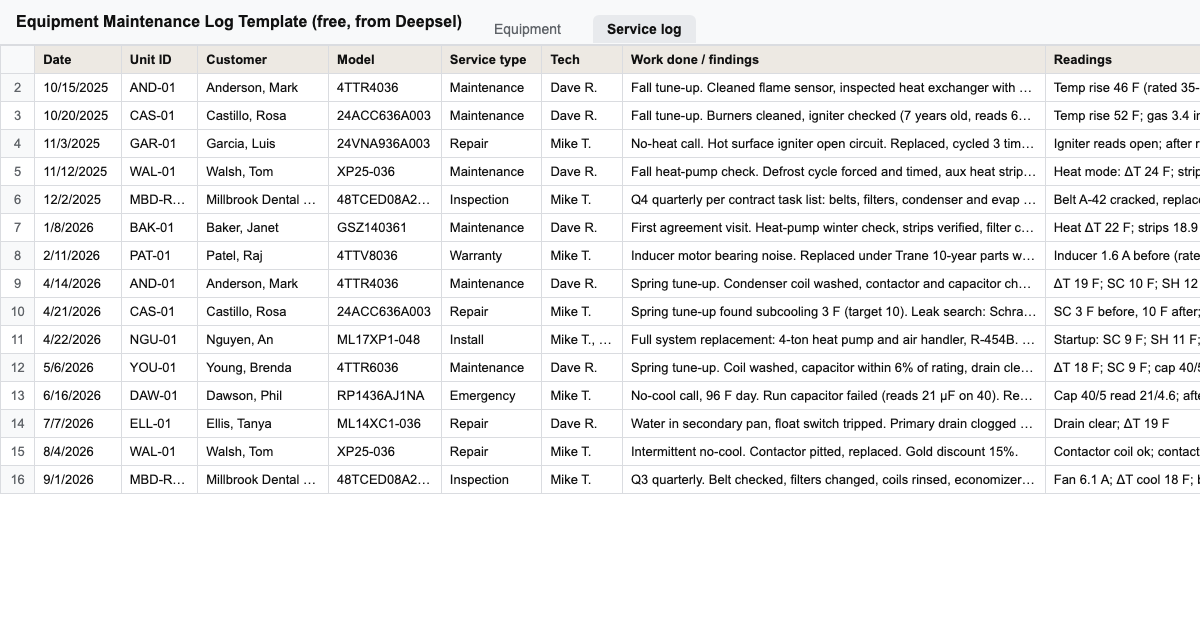
No form and no follow-up email. I built this one because the templates that rank for this search are written for factories and truck fleets. They have columns for machine hours and odometer readings and none for refrigerant type, filter size or serial number. Several want an email before the download; MapTrack's page, updated August 2026, has a form that reads "Enter your email to download the equipment maintenance log as a free PDF."1 Sockeye's is an on-ramp to a CMMS.2 An HVAC shop with two trucks needs neither. It needs the sheet below, filled in for 18 months by a made-up Raleigh shop so you can see how every column gets used, then emptied and typed over.
What should an equipment maintenance log include?
An equipment maintenance log should hold two kinds of record. The first is the unit itself: where it is, what it is by model and serial, when it went in, what refrigerant and filter it takes, and when the parts warranty ends. The second is every visit to that unit: the date, who went, what they did, what they measured, what parts and refrigerant went in, and when the unit is due again. Two tabs, then, one for each.
Tab 1: Equipment, one row per unit
| Column | Header | What goes in it |
|---|---|---|
| A | Unit ID | Short code you'll type on every visit row: AND-01, PAT-02, MBD-RTU1. A two-system home gets two IDs |
| B | Customer / building | Name as it appears in your invoicing system, so rows match later |
| C | Service address | Service address, never billing |
| D | Location on site | "Condenser side yard; furnace in attic" or "Roof, NE corner, serves exam rooms" |
| E | Type | Dropdown: split AC + gas furnace, heat pump + air handler, package rooftop unit, mini split, and so on. Type your own if the list is missing one |
| F, G, H | Make, outdoor model, outdoor serial | From the nameplate, photographed on the first visit |
| I | Indoor unit (model / serial) | Furnace or air handler; "n/a (packaged)" for a rooftop unit |
| J | Installed | Date. Decides warranty end and the replace-or-repair conversation later |
| K | Refrigerant | Dropdown: R-410A, R-454B, R-32, R-22, R-407C, R-134a |
| L | Factory charge (lb) | From the nameplate. The number the leak-rate math starts from |
| M, N | Filter size(s), belt | "4x 20x20x2" and "A-42" are what the truck needs stocked before it leaves |
| O | Parts warranty ends | Install date plus the registered term, usually 10 years |
| P | Agreement tier | Dropdown: none, Bronze, Silver, Gold. Which units are covered by a plan |
| Q | Last serviced | Formula: the latest date in the Service log for this unit ID |
| R | Next due | Formula: the latest next-due date logged for this unit ID |
| S | Days to next due | Formula: next due minus today. Negative means overdue, and the row turns pink |
| T | Notes | Gate code, dog, attic ladder, "homeowner wants readings emailed" |
Tab 2: Service log, one row per visit
| Column | Header | What goes in it |
|---|---|---|
| A | Date | Day of the visit |
| B | Unit ID | Dropdown fed by the Equipment tab, so nobody types "AND-1" on Tuesday and "AND-01" on Thursday |
| C, D | Customer, model | Formulas: filled from the unit ID. Leave them alone |
| E | Service type | Dropdown: maintenance, repair, inspection, install, warranty, emergency |
| F | Tech | First name and initial is enough |
| G | Work done / findings | Two or three sentences in plain words, including anything you told the customer |
| H | Readings | Temperature split, subcooling, superheat, static pressure, capacitor microfarads, amps, gas pressure. Whatever the checklist had you measure |
| I | Parts replaced | "Capacitor 40/5 µF", "Belt A-42", "Filter 20x25x1" |
| J, K | Refrigerant added (lb), refrigerant type | Pounds you weighed in; type fills itself from the unit. This pair is the EPA line |
| L, M | Labor hours, invoice total | What it cost you and what it billed. Agreement visits bill $0 here and get paid by the plan |
| N | Invoice / job # | The number in Jobber, Housecall Pro or QuickBooks, so the two records point at each other |
| O | Agreement visit? | Yes or no. Whether this visit was one the customer had already paid for under a plan |
| P | Next due | Date you expect to be back for planned work. Repairs usually leave it blank |
| Q | Checklist / photos | Link to the filled checklist or the job's photo folder |
Three formulas do the work. Last serviced and next due on the Equipment tab look across the Service log for that unit ID and take the latest dates. Days to next due counts down, and a conditional format turns the row pink when it goes negative and yellow inside 30 days. Both tabs have a filter on the header row, so "show me Gold-tier units due in the next 30 days" is two clicks.
Why the log is one row per unit and never one row per customer
Because the unit is what you work on. Raj Patel in the sample rows has two systems on one Gold plan, an upstairs Trane and a downstairs Trane, and in February one of them needed an inducer motor under warranty. The claim needed that unit's serial and its install date, and a log kept per customer would have given the tech a choice of two serials and no way to know which furnace made the noise last time.
Techs already keep this record in whatever will hold ink. In a December 2024 r/HVAC thread about writing filter sizes on the filter door, one tech described going further: "If there's not already a sticker with it inside, I'll write the manufacturer, model, serial, and factory charge on the inside of the control panel. Always a pain when the nameplate disintegrates."3 Another keeps a phone contact per regular customer with "Client name, address, filter size and quantity, belt size and quantity. This way even if the writing fades I still have the info."3 A third answered the question with a question: "What system do you use for scheduling? Create a note for that customer on their page for filter sizes.. so you know beforehand what to bring."3
The Equipment tab is those three habits in one place the office can read. Columns F through N are the control-panel Sharpie note, typed. A tech who runs the same maintenance routine every time, "record model, serial, filter size and check filter while furnace starts, record numbers and get amperages,"4 is producing exactly one Equipment row and one Service log row per stop.
The payoff shows up on the next call. A veteran tech offered this to new techs in a thread on tricks of the trade: "make sure you know the service history of any equipment you diagnose before you talk to the customer. It can save you having egg on your face depending on who was out there last doing what."5 A former installer turned service tech said the same thing from the other side: "logging in and seeing the details of the previous tech's work, notes, and future recommendations goes a long way in properly diagnosing a unit. Sometimes I'll show up and just fix what I think is most obvious then I get call backs for another issue."6 The "work done / findings" column is where the previous tech's notes go, and the "open items" table on the printable version is where the future recommendations go.
The refrigerant column is a legal record on big equipment
On any appliance holding 50 pounds or more of an ozone-depleting refrigerant, the log is a federal requirement, and the columns in this template are the ones the rule names. Under 40 CFR 82.157(l), the owner or operator must keep a record of each time such an appliance is "maintained, serviced, repaired, or disposed of," and if someone else does the work, "that person must provide a record." The record lists the identity and location of the appliance, the date, the parts worked on, the type of service, "the name of the person performing the maintenance," and "the amount and type of refrigerant added."7 Those are columns B, A, G, E, F, J and K on the Service log. The same regulation says the records "must be kept for at least three years."7
The companion section, 82.166, puts the duty on the contractor in plainer words: "Persons servicing appliances normally containing 50 or more pounds of refrigerant must provide the owner/operator of such appliances with an invoice or other documentation, which indicates the amount of refrigerant added to the appliance," and the owner "must keep servicing records documenting the date and type of service, as well as the quantity of refrigerant added."8 A 7.5-ton rooftop unit holding 14 pounds is well under the line. A chiller or a large commercial rack is over it. If your shop touches anything over 50 pounds, the Service log row for that unit is the record the EPA will ask to see.
The refrigerant type column matters on the small stuff too, starting this year. Under the EPA's technology transitions rule, new residential and light commercial systems moved to lower-GWP refrigerants, with a carve-out that systems above the 700 GWP limit "can be installed until January 1, 2027, so long as all components are manufactured or imported prior to January 1, 2026."9 So for the next decade your fleet is mixed: R-410A units installed through 2026 next to R-454B and R-32 units from 2025 on. The sample rows include one of each. An A2L system needs different recovery gear and a different bottle on the truck, and column K is how the dispatcher knows before the tech leaves the yard.
How long do you have to keep HVAC maintenance records?
Long enough to satisfy the longest rule that applies to you. Three years covers the EPA refrigerant records above and the IRS in the ordinary case. Five covers California's contractor board. The life of the unit covers a manufacturer warranty.
| Rule | How long | What it says |
|---|---|---|
| EPA Section 608 (40 CFR 82.157 and 82.166) | 3 years | Service records for appliances of 50 lb or more, including refrigerant added; "a minimum of three years unless otherwise indicated"7, 8 |
| California Business and Professions Code 7111 | 5 years | A licensee must keep records "for a period of not less than five years after completion of any construction project or operation to which the records refer," or face disciplinary action10 |
| IRS | 3 years, 4 for employment tax, 7 for a bad-debt deduction | "Keep records for 3 years" in the ordinary case; "Keep employment tax records for at least 4 years"; 7 years for a claim of loss from bad debt11 |
| Manufacturer parts warranty | Life of the warranty, usually 10 years | Lennox: "Proof of prior maintenance and purchase may also be required"; Trane: customer "shall make records of said maintenance available to Trane upon request"12, 13 |
The warranty clause is the one shops underrate. Lennox's equipment limited warranty opens with "Failure to maintain equipment will void this limited warranty," and its claim section says the owner must provide and the service provider must collect the model and serial, the owner's name and the equipment location, and "the date of original Equipment installation," with the note that proof of prior maintenance may be required.12 Trane's extended warranty terms make the customer promise to "maintain the Equipment in accordance with Trane literature and instructions" and to "make records of said maintenance available to Trane upon request."13 Goodman's claim form has the contractor sign "I hereby certify the service shown has been performed and purchase date verified."14 Every one of those fields is on the Equipment tab.
In practice the distributor rarely asks. A tech answering a homeowner on r/hvacadvice put it at "more than 95% of warranty claims are made through a wholesaler with no questions asked," adding that "the manufacturer is allowed to ask for service records" and that a $30,000 compressor gets a different look than a $200 gas valve.15 A homeowner in the same thread reported the other outcome: "Lennox basically told me that if I can provide proof that an annual maintenance has been done by a specialised HVAC tech, that is all that is required in order to keep my warranty."15 You will not know in advance which claim gets questioned. The log costs one row per visit either way.
How to use the log
Three passes, and only the first one happens in the field.
At the visit: the tech fills the row
The tech starts from the unit ID and lets the customer and model fill themselves. Service type, a plain-words description, the readings, the parts, refrigerant weighed in, hours, and the job number from your invoicing app. The readings column is the one that pays for the whole exercise. "Cap 40/5 reads 38.4/4.9 (ok, watch)" in May is a capacitor you replace in the fall tune-up instead of on a 96-degree emergency call. The printable version rides in the truck for shops that don't want a phone out in the attic, and someone types it in at the office the same week.
The checklist tells the tech what to measure. This site has a free printable set, one per equipment type and season: the HVAC maintenance checklist, the AC maintenance checklist, the furnace maintenance checklist, the heat pump maintenance checklist and the commercial HVAC maintenance checklist for rooftop units on a quarterly contract. The findings from an HVAC inspection checklist belong on the Equipment tab: a cracked heat exchanger or a 20-year-old condenser is a fact about the unit, so it goes in the notes column and in the open-items table, and every later visit starts from it. The whole set is listed on the checklists page.
Weekly at the office: next due and open items
Once a week, someone in the office sorts the Service log by date, reads the new rows, and makes sure each planned visit has a next-due date. That date is what drives the Equipment tab. Open items go to whoever sells: a recommended repair that nobody quoted is money the tech found and the office lost. On a commercial contract this weekly pass is what Standard 180 means by documentation. The standard requires that "execution of the task shall be documented and archived for future reference," and its minimum documentation package is a listing of the systems, the tasks and how they're tracked, and "sufficient record detail and verification (written or electronic) to demonstrate implementation of the maintenance plan."16 Two tabs of this sheet, kept current, are that package for a small building.
Monthly: the due list and the age list
Filter the Equipment tab on days to next due, ascending. Pink rows are overdue and get booked first. Yellow rows inside 30 days get the reminder text. Then sort once by install date. ENERGY STAR's rule of thumb is that a heat pump or air conditioner "more than 10 years old" and a furnace "more than 15 years old" are candidates for replacement,17 and the install column shows you which customers are due that conversation before the unit decides for them.
Log, checklist, tracker: three documents that get confused
Shops ask for a "maintenance spreadsheet" and mean three different things. They live in three different files on purpose.
| Document | One row per | Answers | Who fills it | Free version |
|---|---|---|---|---|
| Checklist | Task on a visit | What do I do to this unit today, and what do I measure? | Tech, during the visit | HVAC maintenance checklist and the rest of the set |
| Maintenance log (this page) | Unit, and each visit to it | What has been done to this unit, by whom, with what readings, and when is it due? | Tech fills the row, office keeps it | The sheet above |
| Agreement tracker | Maintenance agreement | Who is a member, what tier, which of the two paid visits are delivered, when do they renew, how do they pay? | Office | Agreement tracking spreadsheet |
| Maintenance schedule | Task and frequency | What is supposed to happen to each unit, and how often? | Owner or facility manager, once | Preventive maintenance schedule template |
The log and the tracker overlap on one column, and that overlap is the seam between the two halves of a maintenance program. Column O on the Service log, "agreement visit?", says whether a visit was one the customer had already paid for. The tracker holds the other side of that same fact: two visits owed, one delivered, one still owed. If the shop's office manager keeps both files by hand, that column is the join, and it's the first place the two drift apart.
Where the log stops
The log is a history. It tells you what happened to the Anderson furnace and when. It cannot tell you that Mark Anderson paid $249 last October for two visits and has had one, that his card on file expires in November, or that the fall visit has to be booked in the next six weeks before the plan year closes with a paid tune-up still owed. That is agreement bookkeeping, and it's the part of the program that fails quietly, because nothing in the log or the FSM turns pink when a member is owed a visit nobody scheduled.
For a shop under about 80 agreements, the fix is the free maintenance agreement tracking spreadsheet beside this log: one row per agreement, visits owed versus delivered, days to renewal. The contract that creates each of those rows is the free HVAC maintenance agreement template, and its equipment schedule uses the same model, serial and filter-size fields as the Equipment tab here, so the two documents describe the same units. The reasoning behind each column is in how to track HVAC maintenance agreements.
Past that count, two hand-kept files stop agreeing with each other, usually in the busy season when the person keeping them is also answering the phones. That's the job Deepsel does. It holds the unit record from this page's Equipment tab, with the nameplate captured from the tech's phone, and the agreement ledger from the tracker, and it charges the renewal to the card on file, sends the season booking links and warns you before a paid visit expires. It works beside Jobber or Housecall Pro rather than replacing them. Upload this sheet during the trial and the unit records come with you.
14-day free trial. No credit card required.Frequently asked questions
Is there an Excel version of the equipment maintenance log?
Yes. Download the .xlsx above, or open your Google Sheets copy and use File, Download, Microsoft Excel. The lookups, the last-serviced and next-due formulas, the dropdowns and the overdue highlighting all come with it. The formulas use MAXIFS, so you need Excel 2019, Excel 2021 or Microsoft 365. Older Excel shows a #NAME? error in those three columns and everything else still works.
What is the difference between a maintenance log and a maintenance schedule?
The schedule is the plan: which task, on which unit, how often. The log is the record: what was actually done, by whom, on what date, with what readings. You need both. A schedule with no log cannot prove anything happened, and a log with no schedule cannot tell you what is due next. The free preventive maintenance schedule template on this site is the planning half; this page is the record half.
Can I use this log for a commercial building or a facility?
Yes. The sample rows include a dental office with two rooftop units on a quarterly contract, and the columns hold what Standard 180 asks a maintenance program to document: the equipment inventory, the task performed, and enough record detail to show the plan was carried out. Facility managers with more than about 40 units usually outgrow a spreadsheet and move to a CMMS, and the columns here match what those systems import.
How do I record refrigerant for the EPA in this log?
Every Service log row has a refrigerant-added column in pounds and a refrigerant-type column pulled from the Equipment tab. For appliances holding 50 pounds or more, 40 CFR 82.157 requires a record of the date, the part serviced, the type of service, the name of the technician and the amount and type of refrigerant added, kept for three years. For a residential split system under 50 pounds the federal rule does not apply, and I still fill the column, because the pounds you added last April is the first thing you want when the same unit is low again in July.
Do I need a maintenance log for a manufacturer warranty claim?
Usually the distributor processes the claim on the serial number and the install date without asking for service history. The warranties themselves reserve the right to ask: Lennox's says failure to maintain equipment voids the warranty and proof of prior maintenance may be required, and Trane's extended terms say the customer shall make records of maintenance available on request. The log gives you the install date, the serial and the dated visits in one place when a large claim gets questioned.
Sources
- MapTrack, "Free equipment maintenance log template" - download form reads "Enter your email to download the equipment maintenance log as a free PDF." maptrack.com, updated August 10, 2026, read September 5, 2026.
- Sockeye, "Free Equipment Maintenance Log Template in Excel and Google Sheets" - "it's best to keep your maintenance log in digital form, preferably in your CMMS." getsockeye.com, October 31, 2025, read September 5, 2026.
- r/HVAC, "what do we say about writing filter sizes on the filter door" - comments: "I'll write the manufacturer, model, serial, and factory charge on the inside of the control panel. Always a pain when the nameplate disintegrates"; "Client name, address, filter size and quantity, belt size and quantity"; "Create a note for that customer on their page for filter sizes.. so you know beforehand what to bring." reddit.com, December 3, 2024, read September 5, 2026.
- r/HVAC, "Boss says I need to spend at least an hour at maintenances" - a tech's furnace routine: "record model, serial, filter size and check filter while furnace starts, record numbers and get amperages." reddit.com, June 4, 2025, read September 5, 2026.
- r/HVAC, "Best tips and tricks from experienced techs" - "make sure you know the service history of any equipment you diagnose before you talk to the customer. It can save you having egg on your face depending on who was out there last doing what." reddit.com, December 19, 2024, read September 5, 2026.
- r/HVAC, "What's a skill, routine, or task you always perform on every job" - "logging in and seeing the details of the previous tech's work, notes, and future recommendations goes a long way in properly diagnosing a unit." reddit.com, November 17, 2023, read September 5, 2026.
- 40 CFR 82.157, "Appliance maintenance and leak repair," paragraph (l) Recordkeeping - records for appliances of 50 or more pounds must include the date, parts, type of service, "the name of the person performing the maintenance," and "the amount and type of refrigerant added"; "All records identified in this paragraph must be kept for at least three years." law.cornell.edu, current e-CFR, read September 5, 2026.
- 40 CFR 82.166, "Reporting and recordkeeping requirements," paragraphs (j), (k) and (m) - "Persons servicing appliances normally containing 50 or more pounds of refrigerant must provide the owner/operator of such appliances with an invoice or other documentation, which indicates the amount of refrigerant added"; owners "must keep servicing records documenting the date and type of service, as well as the quantity of refrigerant added"; "a minimum of three years unless otherwise indicated." law.cornell.edu, current e-CFR, read September 5, 2026.
- US EPA, "Technology Transitions HFC Restrictions by Sector," residential and light commercial air conditioning note 7 - "New systems with a GWP above 700 can be installed until January 1, 2027, so long as all components are manufactured or imported prior to January 1, 2026." epa.gov, read September 5, 2026.
- California Business and Professions Code 7111(a) - records must be available for inspection "for a period of not less than five years after completion of any construction project or operation to which the records refer." leginfo.legislature.ca.gov, read September 5, 2026.
- Internal Revenue Service, "How long should I keep records?" - "Keep records for 3 years if situations (4), (5), and (6) below do not apply to you"; "Keep records for 7 years if you file a claim for a loss from worthless securities or bad debt deduction"; "Keep employment tax records for at least 4 years." irs.gov, read September 5, 2026.
- Lennox, "Lennox Quality Care Program Equipment Limited Warranty" (commercial packaged units) - "Failure to maintain equipment will void this limited warranty"; claim requirements list the model and serial, owner's name and equipment location, and "the date of original Equipment installation"; "NOTE - Proof of prior maintenance and purchase may also be required." lennox.com (PDF), read September 5, 2026.
- Trane, "Extended Warranty Terms and Conditions" (form 1-27.98) - the customer shall "maintain the Equipment in accordance with Trane literature and instructions and shall make records of said maintenance available to Trane upon request." trane.com (PDF), May 20, 2021, read September 5, 2026.
- Goodman, "Warranty Claim Form, Air Conditioning & Heating" - contractor signature line: "I hereby certify the service shown has been performed and purchase date verified." apps.goodmanmfg.com (PDF), read September 5, 2026.
- r/hvacadvice, "Annual service required to maintain HVAC manufacturer warranty?" - a tech: "The manufacturer is allowed to ask for service records... more than 95% of warranty claims are made through a wholesaler with no questions asked"; a homeowner: "Lennox basically told me that if I can provide proof that an annual maintenance has been done by a specialised HVAC tech, that is all that is required in order to keep my warranty." reddit.com, November 2, 2023 and July 13, 2024, read September 5, 2026.
- ANSI/ASHRAE/ACCA Standard 180-2012, "Standard Practice for Inspection and Maintenance of Commercial Building HVAC Systems," sections 4.2.2.e and 4.3 - documentation package includes "sufficient record detail and verification (written or electronic) to demonstrate implementation of the maintenance plan"; "execution of the task shall be documented and archived for future reference." philcoaircontrol.com (PDF copy of the 2012 edition; the current edition is 180-2018), read September 5, 2026.
- ENERGY STAR, "When is it time to replace?" - "Your heat pump or air conditioner is more than 10 years old"; "Your furnace or boiler is more than 15 years old." energystar.gov, read September 5, 2026.