Free HVAC inspection checklist: nameplate capture, readings with targets, condition grade and report
- Free. No signup and no email asked; the links below go straight to the file.
- Deepsel is our product. It tracks the maintenance agreements an inspection often starts, and the last section says so.
- The checklist doesn't replace the manufacturer's service instructions or your safety training. Targets on it are field references, and the data plate wins wherever the two disagree.
An HVAC inspection checklist records what a tune-up doesn't: the data plate for every unit (make, model, serial, age, capacity, refrigerant, filter sizes), safety checks with CO limits, cooling and heating readings against printed target ranges, static pressure, a five-point condition grade, and a findings table that marks pre-existing problems. This one is free, prints on three pages per unit, and copies into Google Docs in one click.
Get it three ways: make your own copy in Google Docs (one click, lands in your Drive), download the Word version (.docx), or download the PDF. You can also read it in Google Docs first without copying anything. Every section is reproduced on this page below, so you can read it before you print it. The maintenance and tune-up versions, plus a matching equipment log, are on the free HVAC checklists page.
No form, no follow-up email. I built this one because the inspection checklists that rank for this search are either a list of "check the capacitor" lines with nowhere to write the microfarads, or a PDF you get by handing over your email so a software company can call you.28 A checkmark next to "capacitor" is worth nothing in a dispute six months later. The reading is. So every line here has a blank for the number and the target it should land inside.
What is an HVAC inspection, and how is it different from a tune-up?
An HVAC inspection looks, measures and records. The technician photographs the data plates, runs the system, takes readings, grades the condition of each unit and writes up what needs attention. Nothing gets cleaned, adjusted or added. A tune-up does the work: coils, drain, filter, connections, settings. Maintenance is the tune-up repeated on a schedule under an agreement. Inspect first, quote from the findings, then maintain.
That separation is the whole point of the sheet. When a tech adjusts things during an inspection, the report describes a system that no longer exists. One thread on r/hvacadvice shows the mess this makes. A buyer's home inspector measured a 10-degree split on a 2008 Lennox and called it end of life. The seller's HVAC company came out, "added refrigerant," and reported a 23-degree split and five to seven more years.4 Both reports were true on the day they were written. Neither one told the buyer the thing that mattered, which the top comment did: "The tech added refrigerant meaning it was down on charge. Did they find a leak? Did they repair a leak?"4 An inspection sheet with a "suspected leak" box and a rule against adding anything would have said so.
Two more things an inspection is not. It isn't a home inspection: both national home-inspector standards say the inspector operates the system with normal controls and describes it, and is not required to inspect heat exchangers or the inside of flues,2 or to "determine the uniformity, temperature, flow, balance, distribution, size, capacity, BTU, or supply adequacy of the heating system."3 As one HVAC tech put it in that same thread, "Home inspectors typically are not certified HVAC technicians. They just check it to see if it's cooling or not."4 And it isn't the ACCA maintenance standard either. ACCA 4 QM, reaffirmed by ANSI in 2024, is the "manufacturer-endorsed set of minimum tasks that should be performed for HVACR equipment maintenance inspections,"1 and it covers the doing. If you want the doing, take the HVAC maintenance checklist or the tune-up checklist instead. This page is the looking.
What should an HVAC inspection checklist include?
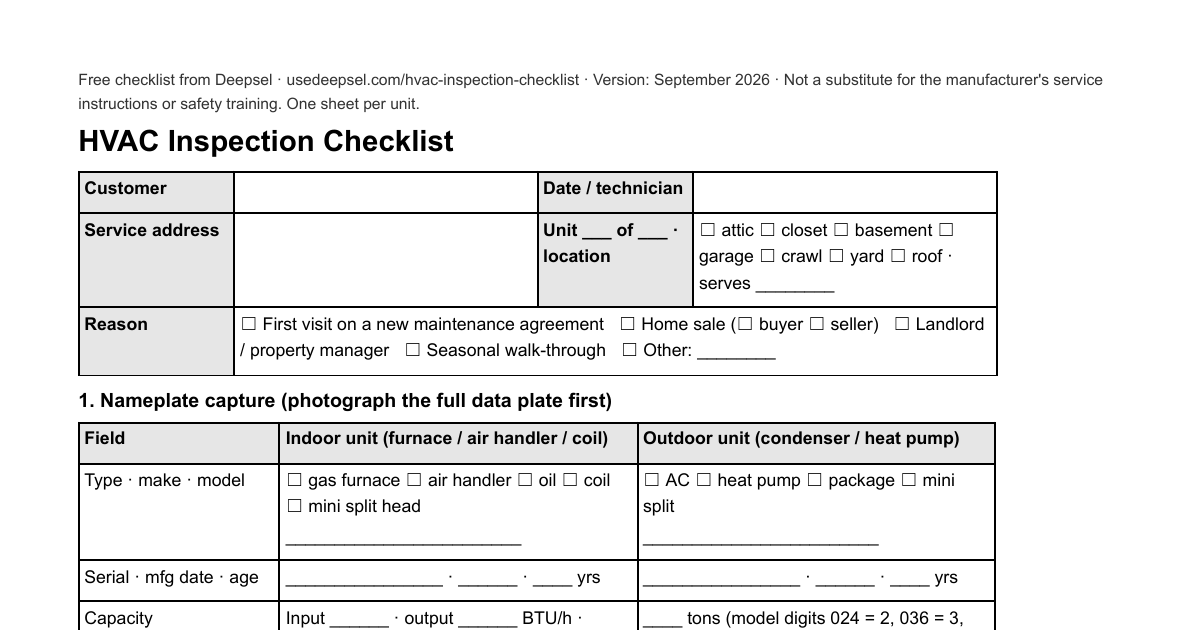
A header block and eight sections, one sheet per unit: the reason for the visit, then nameplate capture, safety, cooling readings, heating readings, airflow and ducts, a condition grade, findings with photos and pre-existing flags, and an age note with signatures. The order matters. Safety comes before readings because a CO reading over the limit ends the visit. Here is each section as it prints, with the reasoning.
1. Nameplate capture, photographed before anything is written
The first instruction on the sheet is to photograph both data plates. Then the fields: type, make, model, serial, manufacture date and age, capacity, refrigerant and factory charge, plate electrical (voltage, MCA, MOP) next to the breaker actually installed, filter nominal and actual size, UV bulb type, thermostat. The columns match Section 1 of the HVAC maintenance agreement template and the equipment columns of the tracking spreadsheet on purpose. One inspection fills all three.
| Field | What to write | Why it's on the sheet |
|---|---|---|
| Type, make, model | Indoor and outdoor units separately; coil-only and mini-split heads count | A plan covers the listed systems and nothing else, so each unit gets its own row and its own sheet |
| Serial, manufacture date, age | Decode from the serial (table below) or read the plate's printed date | Age drives the replacement conversation and the median-life comparison in Section 8 |
| Capacity | Furnace input and output BTU/h; condenser tons from the model digits (024 = 2 tons, 036 = 3, 048 = 4, 060 = 5)24 | Home-sale reports get argued over tonnage; a reader on r/hvacadvice was handed two illegible model numbers and could not find the size of the unit she was buying4 |
| Refrigerant and factory charge | R-410A, R-454B, R-32, R-22, other; ounces from the plate | R-22 hasn't been produced or imported since 2020,18 which changes every repair-or-replace answer on that unit |
| Electrical, plate vs installed | Voltage, MCA and MOP from the plate; breaker size actually in the panel | A breaker bigger than the plate's MOP is a finding you can only catch by writing both numbers next to each other |
| Filter, nominal and actual | The size printed on the filter and the size of the rack, plus type, location and quantity | Nominal sizes lie by up to half an inch; the truck needs the real one on the next visit |
| Photos taken | Both plates, each unit overall, filter rack, disconnect and breaker, drain and pan, flue, line set, every defect | "I try to put serial number pictures on the customer account. On spot or it'll never be on there," an owner-operator on r/HVAC8 |
2. Safety, done first
Seven lines, and a Fail on any of them stops the inspection until it's reported. The carbon monoxide line has two readings: ambient air at the unit and at a supply register. Homes without gas stoves normally sit between 0.5 and 5 ppm;16 the sheet says investigate above 9 and leave and report above 35, which is the NIOSH eight-hour limit (OSHA's is 50).16 If you carry a combustion analyzer, the flue line records CO air free and O2: the ANSI Z21.47 certification ceiling for a gas furnace is 400 ppm air free, and field practice treats 100 ppm as the point to stop and investigate.15 HVAC School's furnace guide draws the same two lines: under 100 is the target, and at 400 or above "you are required to shut down the furnace."11
Then the gas leak sweep at the valve, unions, flex connector and drip leg with a combustible gas detector, and a bubble test on any hit,11 the venting, the burner flame and rollout, the visible surfaces of the heat exchanger (the sheet says out loud that a full inspection needs a scope), the disconnect and wiring, condensate protection, combustion air, and whether the house has a CO alarm at all.
| Check | Reading and target on the sheet | Result |
|---|---|---|
| CO in ambient air, at unit and at a register | ppm at each; typical home 0.5 to 5; investigate over 9; leave and report over 3516 | Pass / Flag / Fail |
| Flue CO air free (analyzer, gas furnace) | ppm, O2 percent, stable at 10 minutes; under 100 target; 400 or more, shut down11, 15 | Pass / Flag / Fail / N/A |
| Gas leak check | Detector sweep of valve, unions, flex and drip leg; bubble test on any hit; location of leak | Pass / Fail / N/A |
| Venting and flue | Connected, sloped, no corrosion or holes, clearances, termination clear | Pass / Flag / Fail |
| Burner flame, rollout, heat exchanger | Blue and steady vs yellow or lifting; scorch marks; visible cracks or rust-through | Pass / Flag / Fail |
| Electrical | Disconnect works; breaker at or below MOP; no burnt or loose wiring; ground present | Pass / Flag / Fail |
| Condensate, combustion air, CO alarm | Drain flows; float switch or secondary drain; pan rust or standing water; clearances; CO alarm in the home | Pass / Flag / Fail |
3. Cooling readings, with the system running ten minutes
Every reading has a blank and a target. The one people argue about most is the temperature split, so the sheet prints the honest version: about 18 to 22 degrees, and only at 45 to 55 percent return-air humidity. HVAC School's article on the "20-degree rule" runs the psychrometrics and shows the rule holding at 72 degrees and 45 percent humidity, then falling apart at 80 degrees and mid-60s humidity, which is exactly what a house looks like after the system has been off all day.9 That's why the line above it asks for return dry bulb, wet bulb and humidity. A low split is a finding, not a diagnosis, and the sheet says so in print.
| Reading | Target printed on the sheet | Source |
|---|---|---|
| Return DB, WB, RH; outdoor; supply DB; split | Split 18 to 22 °F at 45 to 55% RH; lower when humid | HVAC School9 |
| Compressor amps, condenser fan amps | Compared with RLA and FLA on the plate | Data plate |
| Run capacitors, herm and fan | Measured µF within ±6% of the rating | HVAC School10 |
| Contactor | Clean or pitted | Visual |
| Refrigerant circuit | Suction and liquid line temperatures; gauges only if the charge is in question: pressures, superheat (fixed orifice) or subcooling (TXV) vs the plate; oil or frost location; a "suspected leak" box | Data plate method |
| Coils, line set, outdoor setting | Condenser and evaporator condition, line insulation, level, clearance in inches | Visual |
The capacitor line reads "within ±6% of the rating" because that is the tolerance most run capacitors are built to; HVAC School's testing guide says outside that range "replacement of the capacitor may be necessary," and then tells you to double-check the math before you quote it.10 The refrigerant line is deliberately non-invasive first. Line temperatures and a split tell you whether the charge is in question. Gauges go on only when it is, and only in the hands of someone with an EPA Section 608 certification, which the rules require for anyone who could release refrigerant.17 If something was added, the sheet has no place to hide it.
4. Heating readings
| Reading | Target printed on the sheet | Source |
|---|---|---|
| Ignition sequence and limit | Inducer, pressure switch, lights on the first try, retries counted, high limit cycling during the run | Observation |
| Manifold gas pressure | Against the plate; natural gas usually about 3.5 in WC, LP about 10 | HVAC School11 |
| Temperature rise | Return, supply, rise, and the plate range (printed like 45 to 75 °F); near the top means low airflow | HVAC School12 |
| Flame sensor | 1 to 10 µA, ideally 2 to 6 | HVAC School11 |
| Blower and inducer | Amps against FLA; PSC or ECM; rust or water at the inducer | Data plate |
| Heat pump only | Reversing valve shifts, defrost board present, strip kW and amps, coil ice | Observation |
Temperature rise is the heating reading that predicts the most trouble, and the sheet asks for the plate range beside it because every furnace is different. HVAC School's guide to the measurement puts it plainly: mind the high end of the range, because a rise near the top means the furnace is cycling on its limit and overheating the heat exchanger, and the cause is airflow, so look at the filter, the blower wheel and the static pressure.12 The flame sensor target of 1 to 10 microamps, preferably 2 to 6, comes from the same site's furnace reference.11 A furnace-specific version of these lines, with the cleaning steps included, is in the furnace maintenance checklist, and heat pumps get their own treatment in the heat pump maintenance checklist.
5. Airflow and ducts
Total external static pressure, return and supply, against the plate maximum. Most residential equipment is rated at 0.5 inches of water column,13 and a return-side reading of 0.4 or more is high on its own, usually a dirty filter or an undersized return.14 Then the filter as found (clean, dirty, collapsed, missing, wrong size), visible duct damage and leaks at the plenum, a count of returns and supplies, and a thermostat check against a reference thermometer.
6. The condition grade
A grade forces a verdict. Property condition assessments under ASTM E2018 use "good, fair and poor,"26 and Housecall Pro's own inspection template suggests Pass, Flag and Fail per line.27 The sheet uses both: Pass, Flag or Fail on each line, then a five-point grade per unit that maps back to good, fair and poor so a property manager can drop it straight into a portfolio report.
| Grade | Label | Meaning on the sheet |
|---|---|---|
| 5 | Like new | Under 3 years old, every reading inside target, no findings |
| 4 | Good | Inside targets; minor findings only (dirty filter, missing insulation, cosmetic rust) |
| 3 | Fair | Runs, but a reading is outside target or a wear part is near its limit; repairs recommended |
| 2 | Poor | A major component at risk, a refrigerant leak, a safety flag, or past median service life with findings |
| 1 | Replace or unsafe | Locked out, high CO, suspected cracked heat exchanger, failed compressor, or age times repair quote over $5,000 |
7. Findings, photos and the pre-existing column
Each finding gets a line: what, where, the reading, a priority (Safety, Now, Watch), a photo number, an estimate, and a box that says "Excluded." That last box is the reason a maintenance shop should inspect before it signs anyone up. An r/HVAC contractor who was asked how to price maintenance on a site with eleven mini-split heads gave the procedure in three sentences: "Do an initial 'as found' inspection and list all the pre-existing problems. Quote those repairs as a sum total... As you get the site to an 'only maintenance needed' condition... you'll then know how to quote a maintenance inspection cost. Always repairs are extra."6
The written record also settles who pays later. A first-time buyer in Arizona closed on a house in July 2025 and the compressor died the same day. The home-warranty company called it pre-existing and left them with $3,035 of a $3,110 repair, until, in their words, "I was able to provide my home inspection showing it didn't exist prior."7 A dated sheet with readings on it is that document. A checkmark isn't.
The three inspections a small shop actually does
The same sheet serves three visits, and the "Reason" line at the top is there so the file tells you which one it was.
The first visit on a new maintenance agreement. This is the one that matters to a shop selling plans. Section 1 fills the agreement's equipment schedule and the tracking spreadsheet. Section 7's Excluded column documents what the plan will not cover until it's fixed, and Section 8's acknowledgement has the customer sign that those conditions existed on that date. Skip this visit and every later breakdown becomes an argument about whether the plan should have caught it.
The home-sale inspection. Buyers arrive here holding a home-inspector report that says "end of life" and an agent who says they cannot ask for money on something that works.5 What they need is a document with numbers on it. Age from the serial, the split with humidity next to it, static pressure, capacitor readings, a CO number, and the leak box either ticked or not. The r/hvacadvice thread from February 2026 is the whole conversation in one comment: "15-18 is about what you should expect to get out of it, although it may go longer. Can't really predict how long it will last, that's why they generally go based off of age."5 A sheet that records age and condition separately lets the buyer make that call instead of the tech.
The landlord or property-manager walk-through. One sheet per unit, a condition grade per unit, and the grades roll up into a portfolio table by building. Property managers already think in good, fair and poor,26 which is why the five-point grade maps onto those three words. Run it seasonally, and the grades become a replacement schedule instead of a string of emergency calls. The commercial HVAC maintenance checklist covers the rooftop-unit version of this visit, and the preventive maintenance schedule template is where the roll-up lives.
How old is the unit? Reading the serial number
Section 1 asks for manufacture date and age, and most of the time the plate does not say. The serial does, brand by brand. The rules below are from HVAC Base's decoder and Ray Franco's date-code reference,24, 25 and the first instruction on both is the one on the sheet: photograph the entire plate first, because the model number reveals size and refrigerant and the serial reveals the date.
| Brand | Where the date is | Example |
|---|---|---|
| Goodman, Amana, Daikin | First four digits are year and month (YYMM) | 0606111539 was built in June 200625 |
| Carrier, Bryant, Payne | Digits 1 and 2 are the week, 3 and 4 the year | 0122B12345 is week 1 of 202224 |
| Rheem, Ruud | First character is a month letter, second is the last digit of the year (the letter I is skipped) | Decoder needed to pin the decade24 |
| Lennox | Skip the serial; the plate prints "MFG DATE" in plain text on almost every unit | MFG DATE: 03/201924 |
| Heil, Tempstar, Comfortmaker (ICP) | First letter is the plant, next pair the year, next pair the week | E031136011 is week 11 of 200325 |
| Trane, American Standard | Several formats over the years; the year sits at the front of the serial and the decade can be ambiguous, so confirm with the AHRI directory or Trane's support line | 523B456789 is week 23 of 2015 or 202624 |
Then the replacement math, which the sheet does in one line. ASHRAE's equipment life chart puts the median at 15 years for a residential split air conditioner or air-to-air heat pump and 18 for a gas or oil furnace.21 ENERGY STAR tells homeowners to start considering replacement when a heat pump or AC passes 10 years and a furnace or boiler passes 15.22 The $5,000 rule that homeowners bring to the kitchen table multiplies age by the repair quote and points at replacement above $5,000.23 The sheet prints all three next to each other so the customer sees the same numbers you do. Age alone is a weak predictor, and the Houston tech who runs an annual contest with a coworker for the oldest working condenser (this year's winner was 26 years old, "out of 1000's of condensers") would tell you 12 to 14 is where the major failures start showing up in his market.4
Refrigerant belongs in the same conversation, so it's on the same line. R-22 stopped being produced or imported in 2020.18 New residential air conditioners and heat pumps have had a 700 GWP limit since January 1, 2025, which ended R-410A in new equipment;19 a May 2026 EPA rule lets contractors keep installing the R-410A units built before that date until supplies run out, except in New York, which kept its January 2026 cutoff.20 An R-22 system with a leak and a 2005 serial is a replacement quote, and the sheet should make that obvious before anyone prices a compressor.
What the tech writes down, and why the numbers matter more than the checkmarks
Every competing inspection checklist I read has a line for the capacitor. Almost none has a blank for the microfarads, the rating, and the tolerance. That difference decides what the sheet is worth later. "Checked capacitor" is a claim. "Herm 42.1 of 45 rated, 6.4 percent low" is evidence, and it tells the next tech, the customer, and if it comes to it the customer's lawyer, exactly what was true on that date.
The same goes for the split. A temperature split written down without the return humidity beside it is the number the seller's tech and the buyer's inspector fought over in that r/hvacadvice thread, 10 degrees against 23, with a refrigerant top-off in between that nobody explained.4 Written with humidity and outdoor temperature beside it, the split is a data point. Written with the words "nothing added," it's a defensible one.
Photos are the other half. The owner-operators who answered a question on r/HVAC about how they handle paperwork after going independent agreed on what the photos are for: "The 90% is just nameplates and data tags."8 The sheet's photo line lists eight shots, and the findings table has a photo-number column so each finding points at its picture. Do it before leaving the driveway. The tech who said "on spot or it'll never be on there" was describing every shop I've read about.8
One more habit the sheet enforces: the tech's signature and license number go next to the customer's. An inspection report is a professional opinion, and a signed one is worth more to a buyer, a landlord and a warranty company than an unsigned checklist from an app.
The checklist proves the work. The ledger proves the visit happened.
An inspection sheet answers "what did we find?" It does not answer "did this customer get the two visits they paid for this year?" That's a different record, and it's the one that goes missing first. Once the inspection turns into a signed maintenance agreement, three things have to be tracked per customer: the equipment and filter sizes from Section 1, the visits owed against the visits delivered, and the renewal date with the card on file.
Start with the free maintenance agreement tracking spreadsheet. Its equipment and filter columns are the same fields as Section 1 here, so the inspection sheet fills the row. The contract itself is the free HVAC maintenance agreement template, whose Section 1 equipment schedule and Section 9 pre-existing exclusions are what Sections 1 and 7 of this checklist feed. The equipment maintenance log template is where each unit's inspection history stacks up visit after visit, and how to track HVAC maintenance agreements explains the whole system, column by column.
Past 80 or 100 agreements, the spreadsheet stops being the problem and time becomes it. That's the job Deepsel does. It holds the equipment record with the filter sizes from this sheet, keeps the ledger of visits owed versus delivered, sends the season booking texts, charges the renewal to the card on file and flags the failed ones. It runs beside Jobber or Housecall Pro rather than replacing them. Every inspection report stays in your field app; Deepsel just makes sure the next visit it promised gets booked, done and recorded.
14-day free trial. No credit card required.Frequently asked questions
What is the difference between an HVAC inspection and a tune-up?
An inspection looks, measures and records. The tech photographs the data plates, takes readings with the system running, grades the condition and writes up findings, and touches nothing. A tune-up (or maintenance visit) does the work: cleans the coils and drain, replaces the filter, tightens connections and adjusts what is out of range. Most shops inspect first and quote repairs from the findings, then maintain on a schedule. The maintenance version of this sheet is the HVAC maintenance checklist.
Does a home inspector check the furnace and air conditioner?
Only from the outside. Both national home-inspector standards say the inspector operates the system with normal controls and describes it, and is not required to inspect heat exchangers, the inside of flues, or the capacity and supply adequacy of the equipment. No gauges, no combustion analyzer, no serial-number age check unless the inspector chooses to. That is why a buyer who gets an end-of-life note on the report should book an HVAC inspection before closing.
How do I find the age of an HVAC unit from the serial number?
Read the data plate on the outdoor unit or inside the furnace cabinet. Goodman, Amana and Daikin serials start with the year and month (YYMM). Carrier, Bryant and Payne start with the week, then the year. Rheem and Ruud use a month letter followed by a year digit. Lennox prints the manufacture date on the plate in plain text, so skip the serial. Photograph the whole plate before decoding anything; the model number gives capacity and refrigerant, the serial gives the date.
What temperature split should an air conditioner have?
About 18 to 22 degrees Fahrenheit between return and supply air, and only when the return air is near 45 to 55 percent relative humidity. In a humid house that has been off for hours, a healthy system can read 12 to 15 degrees while it wrings the moisture out. So a low split by itself is a finding to write down and follow up on, not a diagnosis. Record return dry bulb, wet bulb and humidity next to it and the number means something.
Can a technician add refrigerant during an inspection?
They can, and they should not. Refrigerant does not get used up; a system that is low has a leak, and adding gas hides the evidence the customer is paying you to find. Write the readings down, mark the circuit as a suspected leak, and quote the leak search as a repair. Anyone who opens the circuit needs an EPA Section 608 certification, and any refrigerant added or recovered should be noted on the report by type and amount.
What is the $5,000 rule for HVAC?
Multiply the system's age in years by the repair quote. Over $5,000, replacement is usually the better long-term move; under it, repair. A 12-year-old condenser with a $500 capacitor-and-contactor repair scores $6,000, which points at replacement, although most owners would take that repair and start saving. The rule is a conversation opener, not a verdict. Section 8 of the checklist has a line for the math.
Sources
- ACCA, "ACCA announces ANSI approval for reaffirmation of ACCA 4 QM - 2019 (R2024), Maintenance of Residential HVAC Systems" - "a nationally recognized, manufacturer-endorsed set of minimum tasks that should be performed for HVACR equipment maintenance inspections." acca.org, September 16, 2024, read September 5, 2026.
- American Society of Home Inspectors, Standard of Practice, Section 8 Heating - "The inspector is NOT required to: Inspect: Interiors of vent systems, flues, and chimneys that are not readily accessible. Heat exchangers." homeinspector.org, 2026 edition, read September 5, 2026.
- InterNACHI, Residential Standards of Practice, Section 3.4 Heating - the inspector is not required to "inspect, measure, or evaluate the interior of flues or chimneys, fire chambers, heat exchangers" or "determine the uniformity, temperature, flow, balance, distribution, size, capacity, BTU, or supply adequacy of the heating system." nachi.org, read September 5, 2026.
- r/hvacadvice, "Home Inspector Said HVAC Near End of Life and Seller's HVAC Guy Disagreed." - inspector: return 66.4, supply 57.4, "AC is cooling across the coil by 10 degrees. Standard is 15-20 degrees"; seller's tech "added refrigerant" and reported 72.5 return, 49.5 supply. Top comment: "The tech added refrigerant meaning it was down on charge. Did they find a leak? Did they repair a leak?" Also "Home inspectors typically are not certified HVAC technicians. They just check it to see if it's cooling or not" and, from a Houston tech, "12-14 is reaching an age that we see major failures... This years winner was 26 years old... out of 1000's of condensers." reddit.com, October 20, 2024, read September 5, 2026.
- r/hvacadvice, "Buying a home with a 15 year old hvac. How long will it last?" - "The realtor said we can't ask for a deduction on something that is working. The inspector said it's at the end of its life"; top comment: "15-18 is about what you should expect to get out of it, although it may go longer. Can't really predict how long it will last, that's why they generally go based off of age." reddit.com, February 7, 2026, read September 5, 2026.
- r/HVAC, "Maintenance, how much should I be charging" - "Do an initial 'as found' inspection and list all the pre-existing problems. Quote those repairs as a sum total... Always repairs are extra." reddit.com, December 11, 2024, read September 5, 2026.
- r/hvacadvice, "Closed on my home on 7/11, compressor went out same day" - "My out of pocket would be $3035 because they claim it's a preexisting condition. I was able to provide my home inspection showing it didn't exist prior." reddit.com, July 22, 2025, read September 5, 2026.
- r/HVAC, "Techs who went independent, how do you handle the..." (post since removed by moderators; comments live) - "I try to put serial number pictures on the customer account. - On spot or it'll never be on there" and "The 90% is just nameplates and data tags." reddit.com, April 15, 2026, read September 5, 2026.
- HVAC School, "20° ΔT (Delta T), A Lazy Rule of Thumb" - "depending on who you ask, the answer will range between 18-22 degrees Fahrenheit"; the rule holds at 72 °F and 45% RH and is "busted" at 80 °F with humidity in the mid-60s. hvacrschool.com, read September 5, 2026.
- HVAC School, "Testing Run Capacitors the Smart (and Easy) Way" - "Most capacitors allow for a 6%+/- tolerance. If it's outside of that range, then replacement of the capacitor may be necessary. Always double-check your math before you quote a customer." hvacrschool.com, read September 5, 2026.
- HVAC School, "Gas Furnaces - What a Tech Needs to Know" - flame sensor "between 1 and 10 microamps, preferably between 2 and 6"; nameplate heat rise "usually something like 45-65°F"; manifold pressure "often 3.5" WC (for a range of 3.2-3.8" WC)"; "400 PPM is the maximum allowable concentration of CO air free in the flue. If you have 400 PPM or above, you are required to shut down the furnace. Below 100 PPM is the recommended CO air free target"; gas leaks: "use a combustible gas leak detector... apply a leak reactant and look for bubbles." hvacrschool.com, read September 5, 2026.
- HVAC School, "Furnace Air Temperature Rise" - "Every gas furnace data plate/tag has a specification for the temperature rise through that furnace. It is shown in a range like 50-80° or 45-75°"; "It's more important that we mind the high end of the rated range... the furnace may begin cycling on the limit control." hvacrschool.com, read September 5, 2026.
- HVAC School, "Air Filter Static Pressure Drop" - "With most systems being rated at 0.5″wc TESP (total external static pressure), that filter makes up more than half of that number." hvacrschool.com, read September 5, 2026.
- HVAC School, "Total External Static Pressure (TESP): A Basic Review" - "A high return static reading (typically 0.4in w.c. and above) can be caused by dirty filters or undersized ductwork." hvacrschool.com, read September 5, 2026.
- HVAC Know It All, "Combustion Analysis: A Thinking Tech's Guide" - "the National Comfort Institute (NCI) uses 100 ppm as-measured as their best-practice max. The ANSI Z21.47 standard allows up to 400 ppm air-free for vented equipment... Above 400 ppm air-free requires immediate shutdown." hvacknowitall.com, read September 5, 2026.
- U.S. EPA, "Carbon Monoxide's Impact on Indoor Air Quality" - "Average levels in homes without gas stoves vary from 0.5 to 5 parts per million (ppm)"; OSHA PEL 50 ppm eight-hour TWA; NIOSH REL 35 ppm eight-hour TWA. epa.gov, read September 5, 2026.
- U.S. EPA, "Section 608 Technician Certification Requirements" - "technicians who maintain, service, repair, or dispose of equipment that could release refrigerants into the atmosphere must be certified." epa.gov, read September 5, 2026.
- U.S. EPA, "Phaseout of Class II Ozone-Depleting Substances" - phaseout table: "2020: No production or import of HCFC-142b and HCFC-22." epa.gov, read September 5, 2026.
- U.S. EPA, "Technology Transitions HFC Restrictions by Sector" - stationary residential and light commercial air conditioning and heat pumps: GWP limit 700, compliance date January 1, 2025. epa.gov, read September 5, 2026.
- NAHB, "EPA Finalizes Refrigerant Rule Update to Allow Older HVAC Unit Installation" - the final rule "will allow the continued installation in homes of HVAC units manufactured or imported prior to Jan. 1, 2025, that use R-410A refrigerant until existing supplies of these HVAC units are depleted"; effective July 27, 2026; "no R-410A systems can be installed in New York." nahb.org, May 26, 2026, read September 5, 2026.
- ASHRAE Equipment Life Expectancy chart (median years) - air conditioners, residential single or split: 15; heat pumps, residential air-to-air: 15; furnaces, gas- or oil-fired: 18. naturalhandyman.com (PDF), read September 5, 2026.
- ENERGY STAR, "When is it time to replace?" - "Your heat pump or air conditioner is more than 10 years old... Your furnace or boiler is more than 15 years old." energystar.gov, read September 5, 2026.
- CBS News, "What is the $5,000 rule for HVAC systems?" - "The age of your HVAC system x the estimated repair cost... If the result of that formula is more than $5,000, a replacement is often considered the better long-term option." cbsnews.com, June 24, 2026, read September 5, 2026.
- HVAC Base, "HVAC Serial Number Decoder: Find Age of Any Brand" - "Take a photo of the entire data plate"; Carrier/Bryant/Payne "1st-2nd: Week of manufacture, 3rd-4th: Year"; Goodman/Amana/Daikin "First four digits = YYMM"; Lennox "look for the manufacture date printed on the data plate"; Rheem/Ruud "First character = month (letter), Second character = year (last digit)"; Trane "5 23B456789 = 2015 or 2026, week 23"; "024=2 ton, 036=3 ton, 048=4 ton, 060=5 ton." hvacbase.org, read September 5, 2026.
- Dr. Ray Franco, PE, "Air Conditioner Date Codes" - Goodman "SN: 0606111539 was manufactured in 2006, June"; ICP "The first pair of numbers is the year, and the second pair of numbers is the week... SN: E031136011 was Manufactured in 2003, Week 11." electrical-forensics.com, read September 5, 2026.
- NV5, "ASTM E2018 Standards for Property Condition Assessments" - physical condition opinions "commonly employ terms such as good, fair and poor." nv5.com, read September 5, 2026.
- Housecall Pro Help Center, "Checklist Templates for HVAC" - Inspection Checklist: "Use Pass/Flag/Fail to make it easy for technicians to assess if in good condition, needs attention, or needs repair/replacement." help.housecallpro.com, January 21, 2026, read September 5, 2026.
- ServiceTitan, "HVAC Inspection Checklist Template: Free PDF Download" - "To get your free template, fill out our form... and we'll email it to you straightaway." servicetitan.com, read September 5, 2026.