Commercial HVAC maintenance checklist: a quarterly rooftop-unit PM sheet built on ASHRAE/ACCA Standard 180 (free Google Docs, Word and PDF)
- Free. No signup and no email asked; the links below go straight to the file.
- Deepsel is our product. It tracks the contract visits this checklist documents, and the last section says so.
- The checklist does not replace the manufacturer's service instructions, the site's written sequence of operation, or safety training. The roof safety block is the OSHA floor, not a substitute for your company's fall-protection program.
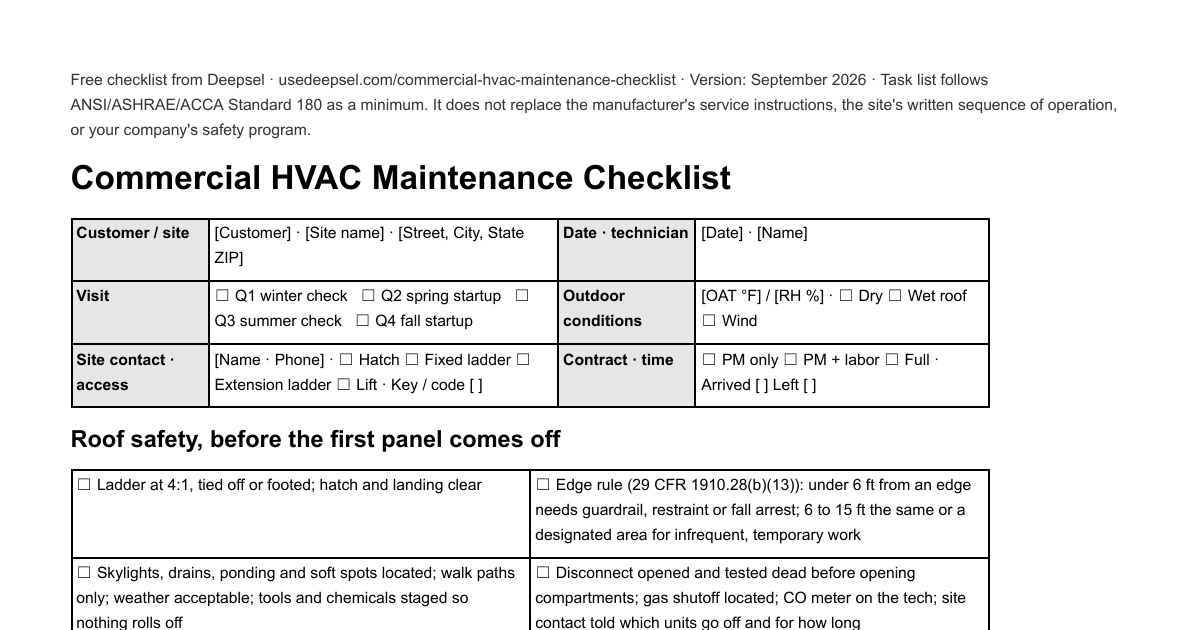
A commercial HVAC maintenance checklist is the task list a technician works through on each scheduled visit to rooftop units, split systems, exhaust fans and make-up air, every reading written against a target: filters, belts, coils, condensate, electrical, refrigerant, economizer, gas heat, controls and cabinet. This one follows ANSI/ASHRAE/ACCA Standard 180 and fits a six-unit roof on one page.
Get it three ways: make your own copy in Google Docs (one click, lands in your Drive), download the Word version (.docx), or download the PDF. You can also read it in Google Docs first without copying anything. Five pages: the roof sheet, then a four-page per-unit detail sheet you print once per unit at the spring and fall startups. The residential version is the HVAC maintenance checklist, and every free checklist in the set is listed on the checklists page.
No form, no follow-up email. I built this because the checklist that ranks first for this search makes you type your email into a form and then emails you the file,25 and the ungated ones are written for facilities managers (change the filter, call a contractor) or as the front door to a maintenance-software demo. None of them has a place to write a subcooling reading or a minimum outdoor-air position.
What is ASHRAE/ACCA Standard 180, and why build a checklist on it?
ANSI/ASHRAE/ACCA Standard 180 is the published minimum for inspecting and maintaining HVAC in commercial buildings. The Department of Energy's Better Buildings program describes it as establishing "minimum HVAC inspection and maintenance requirements that preserve a system's ability to achieve acceptable thermal comfort, energy efficiency, and indoor air quality in new and existing commercial buildings."2 The 2018 edition is current.3 It does not cover single-family houses or multifamily buildings of three stories or fewer, which is why the residential checklist is built on ACCA Standard 4 instead.1
The useful part of the standard is Section 5: 25 tables, one per equipment type, each listing inspection and maintenance tasks with a frequency. Rooftop units are Table 5-22, with 27 tasks from "check for particulate accumulation on filters" (quarterly) through belts, drives and coils (semiannually) to contactors, refrigerant temperatures, dampers and the combustion section (annually). Air-side economizers get their own Table 5-12, fans Table 5-14, furnaces and combustion unit heaters Table 5-16, and controls Table 5-9, which includes the line most shops skip: "check time-of-day schedule to confirm consistency with facility operation," semiannually.1
Two other clauses matter to a contractor more than the tables. Section 4.3 says that "execution of the task shall be documented and archived for future reference." And Section 4.2.2.d, on what to investigate when a unit keeps failing inspection, lists "insufficient time budgeted for tasks" right after poor field practices.1 A checklist tied to a published standard makes the scope of a quarterly visit defensible when a property manager asks what they paid for. The commercial maintenance contract template names Standard 180 as the minimum in its Section 3.2, and this checklist is the sheet that delivers that clause.
How often should commercial HVAC be maintained?
Quarterly visits with filter changes at every visit is the working cadence for rooftop units, with the spring and fall startups as the two deep inspections. Standard 180's minimum frequencies are lower for most tasks, so a quarterly program exceeds the standard on belts, drains, electrical and controls. A tech who does mostly rooftop work put it this way when a residential contractor asked what to bid on three heat-pump RTUs: "4 visits per year should be standard also. 2 visits being in depth inspections of the units (heating/cooling startups for the season) and the other 2 simply a basic operational check. Change the filters every visit."5 That is the cadence this checklist assumes.
| Task group | Standard 180 minimum (Table 5-22 rooftop units, 5-12 economizers) | This checklist |
|---|---|---|
| Filters | Quarterly; economizer filters monthly; filter fit and housing seal annually | Every visit, size and MERV recorded |
| Belts, sheaves, VFD, controls | Semiannually | Checked every visit; belts replaced annually |
| Condensate trap | Prime semiannually; pan, line and coil for growth annually | Every visit |
| Economizer sensors, dampers, actuators, controller | Semiannually; low-limit stat annually | Spring and fall startups, screen every visit |
| Coils | Fouling on heat-exchange surfaces semiannually; condenser surfaces, evaporator fins annually | Inspected every visit, condenser cleaned at spring startup and as the site needs |
| Refrigerant system temperatures | Annually | Spring startup, and whenever split or amps look wrong |
| Contactors, control box, fan drive, bearings, panels and curbs, dampers | Annually | Every visit (contactors, panels), spring startup (drive, bearings) |
| Combustion chamber, burner and flue | Annually | Fall startup, with combustion analysis |
| Thermostat or BAS schedule | Semiannually (Table 5-9) | Every visit, checked against the site's written settings |
Sites push the cadence up, and the reason is usually on the ground next to the building. A tech with 12 rooftop units at one account washed the condensers twice a year until a new manager asked why: "I pointed to two Cottonwood next to their parking lot. 'Those.' When I went for winter inspection, the trees were gone."22 The roof sheet has a "roof conditions" line so those reasons end up in the customer's file, where they justify the fourth visit.
Does the maintenance pay? The federal O&M Best Practices Guide puts preventive maintenance at "12% to 18% cost savings over reactive maintenance program," and adds that facilities running purely on breakdowns "could save much more than 18%."19
The roof sheet: one row per unit
Page 1 is the sheet the tech carries: a site header, the safety block, one row per unit with the readings the office needs without opening the detail sheets, and a sign-off. Seven rows fit, six rooftop units and a line for the exhaust fan or make-up air unit. On a bigger roof, print two.
| Column | What goes in it | Why it is on the roof sheet as well as the detail sheet |
|---|---|---|
| Unit tag and location | RTU-1, north end; AHU-2, mezzanine | The tag is what is painted on the unit and printed on the roof plan; it is how the property manager talks about the equipment |
| Make, model, serial, tons | From the nameplate, once; carried forward | Warranty, parts and the replacement conversation all start here |
| Filters: size × quantity, MERV, changed? | 20x25x2 × 4, MERV 8, Y | The next visit arrives with the right box; the invoice line matches the contract |
| Belt size, OK or new | A46, OK; BX52, new | Belts are the annual-replacement item in the contract, so the sheet has to show when each was done |
| Split °F, return / supply | 76 / 58 = 18 | One number that says whether the unit is cooling; low split sends the tech to the detail sheet |
| Compressor amps C1 / C2 vs RLA | 14.2 / 13.8 (RLA 17) | Trended across visits, amp draw shows a compressor degrading before it fails |
| Blower amps vs FLA | 6.1 (FLA 7.5) | Rises with a tight belt or a loaded wheel, falls with a slipping one |
| Economizer OK / fault | OK; stuck open; actuator dead | The most-failed component on the roof gets its own column so it cannot be skipped |
| Drain OK / fix | OK; trap dry, primed | A dry trap on a draw-through unit pulls air through the drain and floods the pan |
| Findings | Quote contactor; HX suspect, see detail | The office reads this column to build the quote and the report |
The rule printed above the table: fill every cell, even when the answer is OK. A blank cell reads as "not checked" to the customer, to the landlord who wants the report under the lease, and to the next technician.
The per-unit detail sheet, section by section
Appendix A is printed once per unit and holds the readings: a task column, a reading column with the target printed next to the blank, and a result column. The targets are trade rules of thumb from published sources; the manufacturer's charging chart, nameplate and manual override them for the unit in front of you, and the sheet says so at the top.
A. Filters and airflow (every visit)
| Task | What to check, and the target | Standard 180 minimum |
|---|---|---|
| Replace filters; record size, quantity, MERV | MERV 8 is the minimum ASHRAE 62.1 requires upstream of cooling coils and other wetted surfaces;16 MERV 13 where the site specifies it. Check fit, rack and door seal for bypass | Quarterly (filters); annually (fit and seal) |
| Blower wheel and housing | Clean when the blades are loaded; a loaded wheel moves less air and pulls more amps | Annually (fan blades and housing) |
| Total external static pressure | Read with clean filters; compare with the nameplate maximum. High static after a MERV upgrade means the blower cannot make the airflow | Not listed; condition indicator |
| Return and supply air temperature, cooling mode | After 10 to 15 minutes of run time. Typical split 16 to 22 °F at normal humidity and airflow;10 low with high humidity, low airflow or a weak compressor | Not listed; condition indicator |
Split is the reading the roof tech actually leans on. In a thread asking what a real rooftop maintenance includes, the longest answer was a list ("Filters, belts, amp draws on all motors/compressors. Clean both coils, check incoming voltage, check caps, temp split, check contactors for pitting if possible"), and a second tech explained why gauges stay in the bag on a healthy unit: "If your airflow is good and your coils/filters are clean, temp split is enough for me... I don't see the need to access the system unless something seems fucky."4 Split and amps on every unit, every visit; the refrigerant section when they disagree with the target.
B. Belts, sheaves, motors and bearings (check every visit; replace belts annually)
| Task | What to check, and the target | Standard 180 minimum |
|---|---|---|
| Belt condition | Cracks, glazing, fraying, belt dust in the housing. Record size and install date | Semiannually |
| Belt tension | By deflection: about 1/64 inch per inch of span between sheave centers, with a tension gauge where one fits.9 The target is the lowest tension at which the belt does not slip under peak load | Semiannually |
| Sheave alignment and wear | Align by the belt groove, never the sheave face; look for a dished groove or shiny walls; set screws tight | Semiannually (alignment); annually (fan drive) |
| Blower motor amps per leg | Against nameplate FLA; re-check after any tension change | Not listed; condition indicator |
| Condenser fan motor amps, blades, guard | Against FLA; blades tight, no wobble | Annually (fan blades) |
| Bearings | Noise, heat, play; lubricate field-serviceable bearings per manufacturer | Annually |
Belts are where most rooftop checklists print a myth. Amperage does not set belt tension. HVAC School's Bryan Orr, summarizing a long argument among experienced techs, quotes Browning's rule instead: "Ideal tension is the lowest tension at which the belt will not slip under peak load conditions," and gives the field method, "a deflection of 1/64 of an inch for every 1 inch of distance between the two pulley centers."9 The same article carries two warnings that belong on a PM sheet: the adjustable sheave changes fan speed, "NOT TENSIONING," and "all alignments must be done using the belt groove, not the outside of the sheave as they all vary in thickness."9 The sheet asks for span, deflection and force, and re-checks motor amps after the adjustment, which is the one thing amps are good for here.
C. Coils and condensate (every visit; condenser cleaned at spring startup)
| Task | What to check, and the target | Standard 180 minimum |
|---|---|---|
| Condenser coil | Cottonwood, grease, debris, bent fins; rinse from the inside out, coil cleaner where loaded; straighten fins | Semiannually (fouling); annually (surfaces, leaks) |
| Evaporator coil | Where accessible: dirt, biological growth, signs of past icing; clean when loaded | Semiannually (fouling); annually (fins, growth) |
| Drain pan | Clear, sloped, no standing water or rust-through; pan tablet where used | Annually |
| Trap and drain line | Trap present and primed. On a draw-through unit the pan is under negative pressure, and the trap depth has to be at least double that static pressure in inches of water column;15 line clear to the roof outlet; float switch tested where fitted | Semiannually (prime P-trap) |
D. Electrical and drives (every visit; capacitors measured at least annually)
| Task | What to check, and the target | Standard 180 minimum |
|---|---|---|
| Voltage at the disconnect, unit running | All three legs on three-phase; imbalance under 2 percent, or report it | Not listed; condition indicator |
| Contactors and terminations | Pitted or burned contacts, chattering coil, debris between contacts; terminations tight; insulation, crimps and rodent damage; control box clean and dry | Annually |
| Run capacitors under load | Replace when the measured microfarads are more than 10 percent below nameplate, or the top is bulged or the can is leaking12 | Not listed; condition indicator |
| Compressor amps per leg vs RLA | Trend across visits; crankcase heater working where fitted | Not listed; condition indicator |
| VFD where fitted | Heatsink and cooling fan clean and running, enclosure filter clean, fault log read, parameters match the site sheet. Cooling fans are a 3-to-5-year part21 | Semiannually |
| Safeties | High and low pressure switches, freeze stat, phase monitor exercised | Semiannually (control devices) |
E. Refrigerant circuit (spring startup, and whenever the split or amps look wrong)
| Task | What to check, and the target | Standard 180 minimum |
|---|---|---|
| Leak check | Oil at joints, service valves, Schrader cores and coil U-bends; electronic check where oil is found | Annually (condenser surfaces, leaks) |
| Pressures and saturation temperatures per circuit | Only after coils are clean and airflow is verified; otherwise the numbers describe the dirt, not the charge | Annually |
| Superheat and subcooling per circuit | Charge by subcooling on TXV and EEV units, by superheat on fixed-orifice units, to the manufacturer's chart.11 Rules of thumb: TXV superheat 5 to 15 °F, subcooling 8 to 14 °F, condensing temperature 15 to 20 °F over ambient on modern units10 | Annually |
| Refrigerant added or recovered | Per circuit, with the reason, logged against the unit's full charge | Annually (adjust charge) |
On refrigerant regulation, the sheet carries a note because the rule changed this year and most of the summaries online get it wrong for rooftop units. From January 1, 2026, EPA's leak-repair requirements under the AIM Act apply to appliances holding 15 pounds or more of an HFC refrigerant, with a 10 percent annual leak-rate threshold for comfort cooling and repair within 30 days.17 The same fact sheet exempts appliances "used in the residential and light commercial air conditioning and heat pumps subsector," defined as equipment "for cooling air in individual rooms, single-family homes, and small commercial buildings."17 Older R-22 equipment stays under Section 608, which starts at 50 pounds. So a 10-ton R-410A packaged unit on a strip mall is usually outside the rule. Log every pound added regardless; leak rate is calculated from your log.
How do you check an economizer on a rooftop unit?
Stroke the dampers fully open and closed from the controller's test mode or a BAS override, confirm the outdoor and return dampers move opposite each other and close without daylight, verify the minimum outdoor-air position by measurement with the unit running and not economizing, check the sensors against a calibrated thermometer, and confirm the changeover setpoint matches the site sheet. That is section F of the detail sheet, and it is the section most likely to find something.
| Task | What to check, and the target | Standard 180 minimum (Table 5-12) |
|---|---|---|
| Hood, screen and economizer filter | Clean; no birds, leaves or debris in the intake | Monthly |
| Damper stroke | Fully open and fully closed on command; outdoor and return dampers opposite; relief damper follows | Semiannually (dampers, damper motors) |
| Blade and jamb seals | Close with no daylight; linkage or gear train tight, no slop. Even closed dampers on older economizers "may leak 5 to 10% of outside air"8 | Semiannually |
| Minimum outdoor-air position | Verified with the unit running and not economizing, set by measurement (airflow hood or mixed-air method) to the site's design ventilation, never by eyeballing the blade angle8 | Semiannually (controller) |
| Sensors | Outdoor, return and mixed or discharge air against a calibrated thermometer; enthalpy sensors checked or replaced by age | Semiannually |
| Changeover setpoint and control type | Match the site sheet (dry-bulb high limit, differential, enthalpy); low-limit stat tested; fault diagnostics read where fitted | Semiannually; low-limit annually |
The failure numbers are bad enough that PNNL's federal O&M guidance says outright that "a run-to-failure maintenance approach is not appropriate for air-side economizers, and regular preventive maintenance must be performed."6 E Source's guide for utility customers puts it in one line: "about half of all newly installed economizers don't work properly, and their problems increase as they age," and cites a survey of California contractors who found economizers disabled because their dampers would not move "30% to 40% of the time."7 The expensive direction is stuck open. The same guide's simulation of a Phoenix office found a damper frozen wide open "could add as much as 80% to that building's summer peak load."7 When a new tech posted a low-split call that gauges could not explain, the commercial answer was blunt: "It's probably the economizer. Your damper is full open. You're pulling in too much makeup air, and the unit can't keep up."24
Minimum position is the part every generic checklist reduces to a checkbox. MicroMetl, which builds the economizer sections on a lot of the units you will open, explained in January 2026 why the blade angle is useless as a setting: airflow does not rise in proportion to blade rotation, and "often, airflow at 50% open and 100% open is nearly identical." Their conclusion: "The only reliable method is measurement."8 So the sheet has a line for the design minimum in cfm or percent and a line for what you found. If the site has no design value on file, that is a finding: the customer is either paying to cool outdoor air all summer or under-ventilating. PNNL's own checklist puts "confirm outdoor-air dampers are at the minimum outdoor-air position when HVAC is operating but not economizing" on the quarterly list.6
G. Cabinet, curb and roof (every visit)
| Task | What to check, and the target | Standard 180 minimum |
|---|---|---|
| Panels and gaskets | Every fastener back in; no air leaks at blower compartment doors. The sheet asks how many screws were missing on arrival | Annually (panels and curbs) |
| Curb, flashing, supports | No gaps, rust-through or daylight into the return; duct and flex connections sealed; exposed piping and duct insulation intact | Annually |
| Roof around the unit | Ponding, membrane damage, debris on intakes, condensate discharging onto the membrane. Reported to the owner, not repaired by you | Not listed |
The screws line is there for a reason a commercial tech gave in one sentence: "Have fun pulling 30 screws out of a carrier rtu to do a basic maintenance, putting them all back, then doing it 11 more times for the rest of the units on the roof."23 Missing screws on arrival tell you whether the last contractor opened the unit at all.
H. Gas heat section (fall startup)
| Task | What to check, and the target | Standard 180 minimum (Table 5-16, 5-22) |
|---|---|---|
| Heat exchanger, flue and vent | Where accessible: cracks, rust holes, distortion, moisture staining; flue clear | Annually |
| Burners, igniter, flame rod | Burners clean and seated, crossovers clear; flame rod cleaned with a fine abrasive pad | Annually |
| Flame sensor current | Burners lit: typically 0.5 to 10 microamps depending on the unit, 2 to 6 common14 | Annually (safety devices) |
| Gas pressure | Inlet and manifold at high and low fire against the rating plate. Natural gas manifold is usually 3.2 to 3.8 inches of water column, propane about 10.5 to 11.513 | Annually (adjust combustion) |
| Temperature rise | At steady state, inside the nameplate range | Annually |
| Combustion analysis | CO air-free, O2 and stack temperature in the flue. Stable CO under 100 ppm air-free is the target;13 a rising number is a shutdown | Annually ("clean, test, and adjust combustion") |
| Safeties | High limit, rollout switches, pressure switch and inducer proving; gas valve closes on flame loss | Annually |
| Heat pumps | Defrost cycle forced and observed; auxiliary or electric heat amps | Annually (5-25, water-source; by analogy for air-source) |
I. Controls and thermostat (every visit)
| Task | What to check, and the target | Standard 180 minimum (Table 5-9) |
|---|---|---|
| Setpoints, deadband and schedule | Compared to the site's written settings. The contract says checking, not reprogramming, unless the customer authorizes it; a tenant who changed the schedule is a finding, not a fix | Semiannually (time-of-day schedule) |
| Thermostat or zone sensor | Reads true against a meter; batteries, clock and daylight saving correct | Semiannually (control devices) |
| BAS | Points, alarms and communication for the unit; the trend shows it meeting setpoint | Annually (program backup) |
| Stage test | Cooling, heating and fan-only cycled from the controller, each stage confirmed at the unit | Semiannually |
J. Exhaust fans and make-up air units (every visit, where listed in the contract)
| Task | What to check, and the target | Standard 180 minimum (Table 5-14) |
|---|---|---|
| Belts, sheaves, bearings, amps | As in section B; wheel clean, no grease loading on kitchen exhaust wheels | Semiannually (belts); annually (drive, bearings) |
| Dampers | Backdraft or motorized dampers open freely and close fully; curb and cap secure | Annually |
| Kitchen hood interlock | Make-up air must run whenever the hood exhaust runs. IMC 508.1: "Make-up air shall be supplied during the operation of commercial kitchen exhaust systems that are provided for commercial cooking appliances."20 Hood filters in place | Annually (control system) |
| Make-up air unit | Filters, burner or coil, dampers and freeze protection, as for a rooftop unit | Per the RTU and furnace tables |
Exhaust gets skipped because it is never the reason for the call. It is also what explains the kitchen that is 90 degrees with the rooftop unit running flat out. A tech who does rooftop-and-exhaust PMs at restaurants listed economizers, exhaust fans and the BMS trend as the three things that separate a commercial PM from a residential one: "If it has an economizer you should check the dampers/linkages and test operation. You might have an exhaust fan that also needs checked. If it's connected to a BMS you should look at trends and make sure it's communicating properly."4
Roof safety before the first panel comes off
The safety block at the top of the roof sheet is short on purpose, so it gets read. Its longest line is the OSHA rule for low-slope roofs, 29 CFR 1910.28(b)(13), because it is the rule most often misremembered as "you're fine if you stay away from the edge." The regulation has three zones. Within 6 feet of the edge, a guardrail, safety net, travel restraint or personal fall arrest is required. From 6 to 15 feet, the same systems are required, but "the employer may use a designated area when performing work that is both infrequent and temporary." At 15 feet or more, no fall protection is required for infrequent, temporary work, provided the employer enforces "a work rule prohibiting employees from going within 15 feet (4.6 m) of the roof edge without using fall protection."18 Quarterly PM on a unit set 4 feet from the parapet is not infrequent, and the parapet is not always tall enough to count as a guardrail. That decision belongs to your safety program, which is why the sheet asks for the edge distance before anything else.
The rest of the block is the roof-specific stuff: ladder at 4:1 and tied off, skylights and soft spots located, the disconnect opened and tested dead before a compartment is opened, the gas shutoff located and a CO meter on the tech before the burner section runs, and the site contact told which units are going off and for how long. A dining room at noon should hear that RTU-3 is going off before it notices.
What the tech writes down, and why the readings matter
Every row on the detail sheet has a blank next to a printed target. The blank is the product. A checkmark says the tech looked; a number says what they saw, and a column of numbers across four visits says where the unit is going. Compressor amps creeping up against RLA, or a split that was 20 in April and 15 in July with clean coils, is a compressor or a leak announcing itself a quarter early, at contract rates instead of emergency rates.
The same numbers protect the shop. Standard 180 requires that task execution be "documented and archived for future reference,"1 and a landlord's lease usually requires the reports. When a compressor fails in year six, the sheet showing amps, subcooling and a clean coil at every visit is the difference between "you maintained it, the compressor failed" and "you never opened the panel."
The honest objection is time. The first reply in the thread I quoted earlier was "Filters, belts, clean the coils, bump the contactors and go to lunch," and the reply below it was the reason: "Some accounts have so few hours you barely have time to jump it out."4 A checklist does not create hours. What it does is make the mismatch visible, which is the advice one tech gave in the same thread: "I always ask what was sold and how much time was allocated per unit. If the two don't match up I ask what they want change either time or scope."4 That is exactly the investigation Standard 180 prescribes when a unit keeps failing inspection, "insufficient time budgeted for tasks,"1 and it is why the roof sheet records arrival and departure time. The contract template's pricing note says the same thing from the other side: cost out one quarterly visit honestly and multiply by four before you sign.
The other free checklists in this set cover the residential side of the same job: the HVAC inspection checklist for a first look at a system you have never seen, the tune-up checklist for the split-system visit, the heat pump checklist, and the equipment maintenance log for the per-unit history. The preventive maintenance schedule template is the annual calendar that says which sites get which visit in which month.
The checklist proves the work. The ledger proves the visit happened.
A signed sheet per unit per visit is the deliverable the property manager is paying for. The shop's problem starts the day after: 14 sites on quarterly contracts is 56 scheduled visits a year, plus filter changes on a different cadence, plus the annual belt replacements and the annual condition summary the contract promises. Which site is due this month, which one got skipped in May because the hatch was locked, which contracts renew in October at the adjusted price: those are the questions that cost a contract when the answer is "I think so."
Start with the free maintenance agreement tracking spreadsheet: one row per agreement, the equipment covered, the visits owed and delivered with dates, the renewal date and payment method. The reasoning behind each column is in how to track HVAC maintenance agreements. For residential members the contract is the HVAC maintenance agreement template; for the roofs on this page it is the commercial contract template, whose Section 3.4 records a visit that could not happen because access was unavailable on two offered dates as offered. That clause only helps if the offers were logged.
Above about 80 to 100 agreements the spreadsheet stops being the bottleneck and the office's week does. That is the job Deepsel does: it keeps the ledger of visits owed versus delivered per unit, schedules and invoices the visits on the contract's cadence, sends the booking requests the contract promises and logs them, and warns you before a paid visit expires unbooked. It works beside Jobber or Housecall Pro rather than replacing them, and it is built for membership-style programs: residential and light-commercial agreements on a card on file or a scheduled invoice. A restaurant with five rooftop units on a quarterly plan fits that shape. A distribution center with forty units and a facilities team wants a maintenance management system instead, and the maintenance agreement software page says where that line is.
14-day free trial. No credit card required.Frequently asked questions
How often should commercial HVAC units be serviced?
Quarterly is the working cadence for rooftop units, with filters changed at every visit and the two big inspections at the spring and fall startups. ANSI/ASHRAE/ACCA Standard 180 sets the floor lower for most tasks: filters quarterly, belts, drives and controls semiannually, most other rooftop-unit items once a year. Restaurants, retail with long hours and roofs near cottonwoods or grease exhaust need the quarterly visit; a small office with two units can run on the two startups plus filter changes.
What does a commercial HVAC maintenance checklist include?
Per unit: filters and airflow, belts and sheaves, motor and compressor amps, condenser and evaporator coils, condensate trap and pan, contactors and capacitors, refrigerant pressures with superheat and subcooling, the economizer (damper stroke, seals, minimum position, sensors), the gas heat section in fall, thermostat or BAS setpoints, cabinet and curb, and the exhaust fans and make-up air listed in the contract. Per site: a roof safety block and a sign-off. Each reading gets a written value, not a checkmark.
What is ASHRAE Standard 180?
ANSI/ASHRAE/ACCA Standard 180, Standard Practice for Inspection and Maintenance of Commercial Building HVAC Systems, is the published minimum for maintaining HVAC in commercial buildings. It lists inspection and maintenance tasks with a frequency for each, by equipment type, in 25 tables (rooftop units are Table 5-22, air-side economizers 5-12). The 2018 edition is current. It does not apply to single-family homes or multifamily buildings of three stories or fewer.
Does the 2026 EPA leak-repair rule apply to rooftop units?
Usually no. From January 1, 2026 the rule covers appliances holding 15 pounds or more of HFC refrigerant, with a 10 percent annual leak-rate threshold for comfort cooling and repair within 30 days, but EPA's fact sheet exempts the residential and light commercial air conditioning and heat pump subsector, which is where packaged rooftop units for small buildings sit. Older R-22 equipment stays under the Section 608 rule, which starts at 50 pounds. Log refrigerant added on every visit anyway; the customer's insurer and the next contractor will ask.
What MERV filter should a rooftop unit use?
MERV 8 is the minimum ASHRAE 62.1 requires upstream of any cooling coil or other wetted surface, and it is what most packaged units ship with. MERV 13 is common where the owner or tenant asks for it after the pandemic-era guidance, but it raises static pressure, so check total external static against the nameplate after the change and drop back if the blower cannot make the airflow. Record size, quantity and MERV on the sheet so the next visit arrives with the right box.
Is there an Excel or fillable version?
Google Docs, Word and PDF, no Excel. A checklist is a form the tech fills on the roof, so it lives in a document; the copy link puts an editable version in your Drive and the .docx opens in Word. The spreadsheet-shaped part of a maintenance contract is the visit ledger, which units are due and which visits were delivered, and that is a separate free download, the maintenance agreement tracking spreadsheet.
Sources
- ANSI/ASHRAE/ACCA Standard 180-2012, "Standard Practice for Inspection and Maintenance of Commercial Building HVAC Systems" - Section 2.2.1 (scope excludes "single-family houses or multi-family structures of three or fewer stories above grade"); Section 4.2.2.d ("insufficient time budgeted for tasks"); Section 4.3 ("execution of the task shall be documented and archived for future reference"); Tables 5-9, 5-12, 5-14, 5-16 and 5-22 with task frequencies. Public copy hosted by Philco Air Control, philcoaircontrol.com, read September 5, 2026. The 2018 edition is current; the 2012 tables are the ones quoted here.
- U.S. Department of Energy, Better Buildings Solution Center, "ANSI/ASHRAE/ACCA Standard 180: Standard Practice for Inspection and Maintenance of Commercial Building HVAC Systems" - "establishes minimum HVAC inspection and maintenance requirements that preserve a system's ability to achieve acceptable thermal comfort, energy efficiency, and indoor air quality in new and existing commercial buildings." betterbuildingssolutioncenter.energy.gov, published August 15, 2022, read September 5, 2026.
- ASHRAE, "Standards 180 and 211" - lists Standard 180-2018 as the current edition. ashrae.org, read September 5, 2026.
- r/HVAC, "What do you do exactly on RTU maintenance" - "Filters, belts, clean the coils, bump the contactors and go to lunch"; "If your airflow is good and your coils/filters are clean, temp split is enough for me"; "Filters, belts, amp draws on all motors/compressors. Clean both coils, check incoming voltage, check caps, temp split, check contactors for pitting if possible"; "Some accounts have so few hours you barely have time to jump it out"; "I always ask what was sold and how much time was allocated per unit"; "If it has an economizer you should check the dampers/linkages and test operation." reddit.com, June 10, 2025, read September 5, 2026.
- r/HVAC, "Reasonable rate for RTU maintenance at small commercial building?" - "4 visits per year should be standard also. 2 visits being in depth inspections of the units (heating/cooling startups for the season) and the other 2 simply a basic operational check. Change the filters every visit." reddit.com, July 9, 2020, read September 5, 2026.
- Pacific Northwest National Laboratory, O&M Best Practices, "Best Practices for Air-Side Economizers Operation and Maintenance" - "a run-to-failure maintenance approach is not appropriate for air-side economizers, and regular preventive maintenance must be performed"; Table 1 sample checklist including "Confirm outdoor-air dampers are at the minimum outdoor-air position when HVAC is operating but not economizing" and "Confirm dampers achieve 100 percent closure with no air leakage." pnnl.gov, read September 5, 2026.
- E Source, Business Energy Advisor (SMUD edition), "Economizers" - "about half of all newly installed economizers don't work properly, and their problems increase as they age"; "a survey of California contractors found that economizers were disabled because their dampers wouldn't move 30% to 40% of the time"; a damper stuck wide open "could add as much as 80% to that building's summer peak load." smud.bizenergyadvisor.com, read September 5, 2026.
- MicroMetl, "Economizers: How to Set Minimum Position Correctly" - "Even closed dampers on older economizers may leak 5 to 10% of outside air"; "Often, airflow at 50% open and 100% open is nearly identical"; "The only reliable method is measurement." blog.micrometl.com, January 15, 2026, read September 5, 2026.
- HVAC School, Bryan Orr, "Some Belt Tensioning Thoughts" - Browning: "Ideal tension is the lowest tension at which the belt will not slip under peak load conditions"; "a deflection of 1/64 of an inch for every 1 inch of distance between the two pulley centers"; "THIS ADJUSTMENT IS FOR FAN SPEED ONLY, NOT TENSIONING"; "all alignments must be done using the belt groove, not the outside of the sheave." hvacrschool.com, June 1, 2022, read September 5, 2026.
- HVAC School, Bryan Orr, "The '5 Pillars' of Residential A/C Refrigerant Circuit Diagnosis" - "The air temperature split during typical conditions will be between 16 and 22 degrees' difference from the return to the supply"; TXV superheat "between a 5 to 15° superheat"; "Typical ranges for subcooling are between 8 and 14 degrees on a TXV system"; head pressure "a 15-20° saturation above outdoor ambient." hvacrschool.com, July 24, 2019, read September 5, 2026.
- HVAC School, Bryan Orr, "Refrigerant Charging Basics for Air Conditioners and Heat Pumps" - "The piston/fixed orifice type system primarily uses the superheat method"; "the TXV/EEV primarily uses the subcooling method." hvacrschool.com, February 25, 2025, read September 5, 2026.
- HVAC School, Bryan Orr, "Capacitor Testing and Replacement Procedure" - "If the measurement is more than 10%, we suggest a replacement"; "If a capacitor shows physical damage, such as the top bubbling or oil leakage, it should be replaced." hvacrschool.com, March 20, 2024, read September 5, 2026.
- HVAC School, Bryan Orr, "Gas Furnaces - What a Tech Needs to Know" - "Below 100 PPM is the recommended CO air free target, but you can leave a furnace operational above 100 PPM as long as the CO number is stable"; natural gas manifold "usually between 3.2 and 3.8" WC"; propane "10.5 to 11.5" WC"; temperature rise inside the nameplate range. hvacrschool.com, March 3, 2023, read September 5, 2026.
- HVAC School, Bryan Orr, "Flame Sensing - The Basics" - "When the flame lights, you should read between 0.5 and 10 microamps (μA), depending on the furnace. Readings between 2 and 6 are common." hvacrschool.com, December 17, 2021, read September 5, 2026.
- HVAC School, "Drain Trap Depth and Negative Pressure" - "The trap depth (in inches) is double the static pressure (in inches of water column)." hvacrschool.com, August 24, 2024, read September 5, 2026.
- ANSI/ASHRAE Addendum m to Standard 62.1-2016, Section 5.8 Particulate Matter Removal - filters with "a minimum efficiency reporting value (MERV) of not less than 8" or the ISO ePM10 equivalent "shall be provided upstream of all cooling coils or other devices with wetted surfaces through which air is supplied to an occupiable space." ashrae.org, approved by ANSI February 13, 2019, read September 5, 2026.
- U.S. EPA, "Summary of Leak Repair Requirements" (Emissions Reduction and Reclamation rule fact sheet) - "Beginning January 1, 2026, owners or operators and certified technicians must comply with leak repair requirements for certain refrigerant-containing appliances with a charge size of 15 pounds or more of refrigerant that contains an HFC"; a 10% threshold for "Comfort cooling"; "repair leaks within 30 days"; appliances "used in the residential and light commercial air conditioning and heat pumps subsector are not covered," a subsector that "includes equipment for cooling air in individual rooms, single-family homes, and small commercial buildings"; Section 608 comparison at "50 pounds or more." epa.gov, January 13, 2026, read September 5, 2026.
- Occupational Safety and Health Administration, 29 CFR 1910.28(b)(13), "Work on low-slope roofs" - the 6-foot, 6-to-15-foot and 15-foot-or-more rules; "The employer may use a designated area when performing work that is both infrequent and temporary"; "a work rule prohibiting employees from going within 15 feet (4.6 m) of the roof edge without using fall protection." osha.gov, read September 5, 2026.
- U.S. Department of Energy, Federal Energy Management Program, "Operations & Maintenance Best Practices: A Guide to Achieving Operational Efficiency," Release 3.0 - preventive maintenance: "Estimated 12% to 18% cost savings over reactive maintenance program"; facilities "purely reliant on reactive maintenance could save much more than 18%." energy.gov, August 2010, read September 5, 2026.
- Accurex, "When Make-Up Air is Required for Commercial Kitchens" - quoting IMC 508.1: "Make-up air shall be supplied during the operation of commercial kitchen exhaust systems that are provided for commercial cooking appliances"; NFPA 96 8.3.1 limits kitchen negative pressure to 0.02 inches of water column. accurex.com, October 24, 2022, read September 5, 2026.
- Instrumentation Tools, "Preventive Maintenance of Variable Frequency Drive (VFD)" - "cooling fans should be replaced every three to five years and main bus capacitors should be replaced every seven years"; dust on heat sinks and circulation fans; check connections for loose or over-tightened terminals. instrumentationtools.com, February 24, 2022, read September 5, 2026.
- r/HVAC, comment on "Rheem must of sucked up a cat (or two)" - "Had an account that I would have to wash the condensers twice a year. (12 RTUs 7.5 ton) New manager climbed up to take a look at the roof and the equipment. He asked why I was doing this again. I pointed to two Cottonwood next to their parking lot. 'Those.' When I went for winter inspection, the trees were gone." reddit.com, August 23, 2024, read September 5, 2026.
- r/HVAC, comment on "A very unfortunate event" - "Have fun pulling 30 screws out of a carrier rtu to do a basic maintenance, putting them all back, then doing it 11 more times for the rest of the units on the roof." reddit.com, September 6, 2024, read September 5, 2026.
- r/HVAC, comment on "Help a new tech diagnose low delta T" - "Commercial. It's probably the economizer. Your damper is full open. You're pulling in too much makeup air, and the unit can't keep up." reddit.com, August 11, 2024, read September 5, 2026.
- ServiceTitan, "Commercial HVAC Maintenance Checklist: Free PDF Download" - "To get your free template, simply fill out the form above (on mobile devices) or to the right (on desktop), and we'll email it to you right away." servicetitan.com, dated March 13, 2026, read September 5, 2026.