Commercial HVAC maintenance contract template (free Google Docs, Word and PDF)
- Free. No signup and no email asked; the links below go straight to the file.
- Deepsel is our product. It's built for residential and light-commercial membership programs, and the last section says where it fits and where it doesn't.
- Not legal advice. Have a local attorney read the template before you use it, especially the coverage levels and Appendix B.
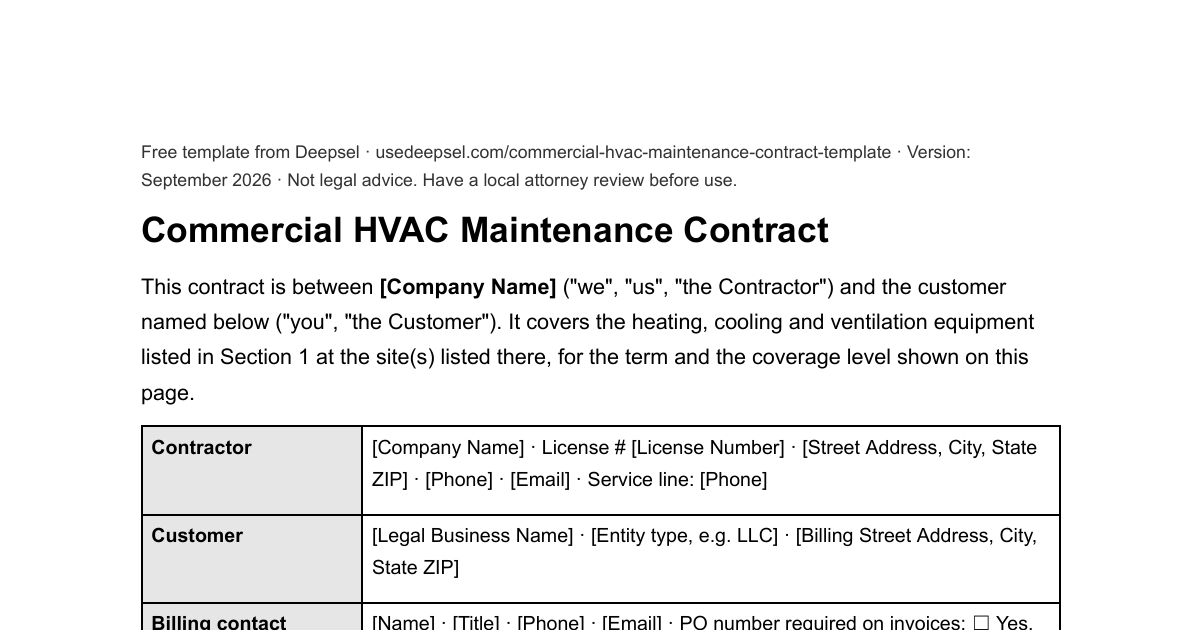
This is a free commercial HVAC maintenance contract template, the document some contractors call a preventive maintenance agreement or a PM contract, for shops that maintain rooftop units, split systems and air handlers for businesses, property managers and building owners. I rewrote my residential template for commercial work: a site-by-site equipment schedule, three coverage levels, a quarterly task list, response targets in place of "priority service", net-30 invoicing with a purchase-order line, an annual price adjustment, and insurance terms. Fifteen pages, plain English.
Get it three ways: make your own copy in Google Docs (one click, opens in your Drive), download the Word version (.docx), or download the PDF. You can also read it in Google Docs first without copying anything. Need the residential version instead? That's the HVAC maintenance agreement template. Want to compare the free templates before you pick one? I reviewed eight of them in the best free HVAC maintenance agreement templates.
Two kinds of people search for this page: contractors who want paper for their first commercial accounts, and building owners or property managers whose lease or insurer told them to get a maintenance contract in place. The template is written from the contractor's side, because that's who I build software for. If you manage a building, it shows what a fair contract from a contractor contains, and the pricing section tells you what a rooftop unit costs to maintain.
What should a commercial HVAC maintenance contract include?
A commercial HVAC maintenance contract should list every covered unit by site and serial, state the coverage level (scheduled maintenance only, or repairs included), set the visit cadence and the task list, define response targets and contract rates for breakdown calls, set invoicing terms and an annual price adjustment, and cover insurance, site access, exclusions, renewal and cancellation. Each clause below says what changed from the residential agreement and why.
A site-by-site equipment schedule, with tonnage, filters and belts
Section 1 is two tables. Sites first: address, access hours, how you get onto the roof, who to call. Then units: site, unit tag, type, make, model, serial, tons, filter sizes and quantities, belt sizes, notes. The unit tag column (RTU-1, AHU-2) does more daily work than the serial, because that's what is painted on the unit and printed on the roof plan. Roof access gets its own column because a tech who arrives at a locked hatch has wasted the trip, and Section 3.4 bills a return trip when that happens on a confirmed date.
Coverage level: scheduled maintenance only, or repairs included
This decides who carries the repair risk, and the generic templates leave it to a phone call. Universal Services, a New York City commercial contractor, draws the line in its 2026 guide: in a full-coverage contract "the contractor assumes the risk," while a preventive-maintenance contract "covers only scheduled visits at a fixed fee; repairs and replacements are billed separately, so you carry that risk."1 Page 1 offers three levels. A is preventive maintenance only, with repairs at the contract rates in Appendix A. B adds repair labor. C adds parts. B and C both require the Appendix C inspection and exclude compressors, heat exchangers and coils unless you write them in, because those are the parts that turn a fixed fee into a loss on a fifteen-year-old unit. A is the default, and for a one-to-four-truck shop I'd keep it there for the first year of every new account.
Visit cadence and a task list per visit
Quarterly is the common commercial cadence. Smart Service's pricing guide says so in five words, "quarterly visit programs are common for commercial,"2 and Allied Air's June 2026 guide puts it in equipment terms: a standard rooftop unit needs "a basic inspection and filter change every 60 to 90 days (quarterly)" plus a hands-on tune-up twice a year.3 Twice a year is the floor for everything else.4 So page 1 lets you check two or four visits a year and a separate filter cadence, and Section 3.2 is a task table marking which tasks happen at every visit, at the spring startup, at the fall startup, or once a year.
The task list names ANSI/ASHRAE/ACCA Standard 180 as its minimum. The Department of Energy's Better Buildings program describes Standard 180 as establishing "minimum HVAC inspection and maintenance requirements that preserve a system's ability to achieve acceptable thermal comfort, energy efficiency, and indoor air quality in new and existing commercial buildings."5 The 2018 edition is current.6 A task list tied to a published standard is easier to defend in a dispute than "a tune-up."
A written service report per unit, per visit
Section 3.3 promises a report per unit within two business days (tasks done, readings, photos, a repair quote at contract rates) and an annual equipment condition summary. The report is what the property manager is buying, and often what their lease demands. A Nevada lease guide describes the standard clause: it "requires the tenant to secure a preventive maintenance contract with a licensed, landlord-approved HVAC contractor, requiring quarterly filter swaps and inspections."7 That's why Section 2.4 has the customer confirm they have authority under their lease and asks whether the landlord needs the reports.
Response targets instead of "priority service"
Residential plans promise priority. Commercial customers ask "how fast." Section 4.2 answers with a business-hours target (a technician on site within one business day for a no-cooling, no-heating or water-leak call, scheduled ahead of customers without a contract) and an after-hours callback within two hours, with dispatch at the after-hours rate. The same paragraph says these are scheduling commitments, and that a guaranteed response time with service credits is a separate line with its own price in Appendix A. Section 4.4 gives the site contact an on-the-spot approval limit, because the person on the roof at 4 pm usually can't reach the person who pays the invoices.
Net-30 invoicing, PO numbers and late charges
Smart Service's invoicing guide states the norms in three sentences: "Net 15 is the default for residential. Net 30 is standard for commercial. Late fees of 1.5 percent per month are the industry norm and enforceable in most states."8 Section 6 is built on them: net 30 from the invoice date, your PO number on every invoice if you give one, a late charge of 1.5 percent a month or the legal maximum, whichever is less, and a pause on visits at 60 days past due after a written 10-day notice. Next Era Legal's guidance for contractors adds a suspension right, a cure period before termination, and interest and lien rights on net-30 accounts,9 and all of those are in. Section 6.4 is an autopay option with the consent sentence.
An annual price adjustment
Pipeline's 2026 pricing guide reports material costs up 12 to 18 percent across 2024 to 2026 and insurance premiums up 8 to 15 percent a year.10 A contract that renews at the same price for five years is how that margin disappears. Section 6.5 adjusts the fee on each anniversary by the 12-month change in CPI-U, with a floor of 3 percent and a cap of 6 percent, stated in the renewal notice 45 days ahead; Appendix A has a fixed-percent option instead. One word to watch when a customer sends their own paper: "the lesser of" and "the greater of" CPI and a fixed percent flip who carries inflation.
Term, renewal, and New York's certified-mail rule
Section 9: twelve months, auto-renews unless either side gives 30 days' notice, with a written renewal notice from you at least 45 days before the end of the term. Consumer auto-renewal laws mostly don't reach business customers. New York's does. General Obligations Law section 5-903 covers any contract "for service, maintenance or repair to or for any real or personal property" with an automatic renewal longer than a month, and it counts firms and corporations as persons. The contractor must give written notice "served personally or by certified mail" at least 15 and not more than 30 days before the customer's deadline to cancel, or the renewal is unenforceable against the customer.11 With a 30-day cancellation deadline, that means a certified letter between 45 and 60 days before the term ends. Appendix B spells it out. Either side can also cancel for convenience with 30 days' notice, with visits already performed re-priced at the single-visit rate and the rest of any prepaid fee refunded.
Insurance, certificate of insurance and mutual indemnity
Section 8 fills in general liability limits (the example is $1 million per occurrence and $2 million aggregate), promises a certificate of insurance on request, and offers to add the customer or their landlord as an additional insured, with any carrier fee quoted first. Limits are moving: one 2025 insurance guide reports the standard "has shifted from $1 million per occurrence/$2 million aggregate to $2 million per occurrence/$4 million aggregate for many commercial projects,"12 and general contractors now routinely ask for additional-insured status by endorsement.13 The indemnity is mutual and limited to each side's own negligence. Liability is capped at twelve months of fees, with carve-outs for bodily injury and negligence, and neither side is liable for lost business or spoiled inventory. Property managers' own vendor agreements often demand far more, so Appendix B's "pay a lawyer for an hour" list includes reading theirs before you sign.
Access, safety, exclusions and refrigerant records
Section 5 makes the customer responsible for safe roof access that meets OSHA rules, keys or an escort, and clear mechanical rooms, and lets the tech document and skip a unit that can't be reached safely. Section 7 lists what's out: refrigerant beyond two pounds per unit per year, major components under level A, controls programming, code upgrades, unlisted units, pre-existing problems photographed at the first visit, and crane rental. One item is new since I wrote the residential template. EPA's 2024 Emissions Reduction and Reclamation rule extends leak-repair and record-keeping duties to appliances holding 15 pounds or more of HFC refrigerant, from January 1, 2026.14 Many rooftop units sit over that line, so Section 1 asks for each unit's refrigerant charge and Section 7 has every pound added recorded on the service report.
How much does a commercial HVAC maintenance contract cost?
Most commercial HVAC maintenance contracts cost $500 to $1,500 per rooftop unit per year, with twice-yearly plans at the low end and quarterly plans at the high end. Whole-building contracts run $1,000 to $10,000 or more a year depending on unit count, and commercial repair labor bills at $110 to $190 an hour. The public benchmarks I found while checking Appendix A:
| Source | Benchmark | Notes |
|---|---|---|
| Dalton Heating and Cooling, Rochester NY15 | $350 to $700 per rooftop unit per year (two visits); $650 to $1,300 (quarterly); $175 to $350 for a single visit without a contract | The clearest per-unit pricing published by a contractor; filters often billed separately |
| ENTOUCH Controls16 | $500 to $1,500 per rooftop unit per year | Split systems similar; chillers $2,000 and up |
| Smart Service pricing guide2 | Light commercial $500 to $2,000 per unit per year; heavy commercial $1,000 to $10,000+ per contract | Range driven by unit size, roof access, refrigerant type and visit frequency |
| Harold Brothers Mechanical17 | Annual contract $1,000 to $10,000+ | Several visits a year, often quarterly, with priority service and reporting |
| Oxmaint 2026 benchmarks18 | Labor-only contracts $0.08 to $0.14 per square foot per year; full coverage $0.20 to $0.35 | The facility-side view, for when a property manager quotes you a per-square-foot budget |
| Pipeline 2026 pricing guide10 | Commercial labor $110 to $190 per hour; service call fees $89 to $149; after-hours $125 to $400 | Sets the contract rates in Appendix A |
Appendix A ships with example prices inside those bands: $450 a year for two visits and $850 for four on a packaged unit up to 7.5 tons, rising by tonnage band, plus filter, belt and labor lines, with contract labor at $125 an hour in business hours and $190 after. Replace every number. Then run the check that decides whether the contract makes money: cost out one quarterly visit honestly, roof access and drive and filters and report writing included, and multiply by four. If the fee barely covers that, the contract is a marketing cost that pays through repair work, and you should know that on the day you sign it.
Net-30, COI and escalation: what changes from a residential agreement
The residential template and this one share a spine: equipment listed by serial, scope limited to listed units, a written visit count, plain renewal and cancellation terms. Ten things change.
| Clause | Residential agreement | Commercial contract |
|---|---|---|
| Parties | Company and homeowner | Company and a business, with separate billing and site contacts, PO number and tax-exempt certificate |
| Equipment schedule | One table, up to four systems, filter sizes and UV bulb | Sites table plus units table with unit tags, tonnage, filter counts, belts and roof access |
| Coverage | Tune-ups plus a repair discount | Three levels: maintenance only, plus repair labor, or full coverage after an inspection |
| Visits | Two a year in season windows; three logged booking offers, then the visit expires | Two or four a year plus a filter cadence; task table tied to Standard 180; return-trip charge for no access |
| Breakdowns | "Priority service," defined as a place in line | Response targets in business hours and after hours; approval limits for the site contact |
| Payment | Monthly card on file by default | Net 30 by check or ACH by default; autopay optional; 1.5 percent monthly late charge |
| Price changes | Only at renewal, after notice | Annual CPI-U adjustment with a floor and a cap, or a fixed percent |
| Renewal notice | 30 days, email or text | 45 days, written; certified mail in New York under GOL 5-903 |
| Insurance and liability | Liability insurance mentioned; cap at one year's payments | Stated GL limits, COI and additional insured on request, mutual indemnity, no consequential damages either way |
| State-law focus | Consumer auto-renewal laws; Florida's service warranty statute | New York's business auto-renewal notice rule, lien rights and preliminary notices, sales tax on commercial work, EPA refrigerant records. Florida's statute covers "consumer product" only, so commercial units are generally outside it19 |
After it's signed: running the program
A commercial contract creates the same three recurring jobs a residential one does, with bigger numbers attached: get every unit's visits scheduled in each window, invoice on time and chase what's late, and keep a per-unit record of visits owed versus delivered and refrigerant added. Start with the free maintenance agreement tracking spreadsheet, one row per agreement, and read how to track HVAC maintenance agreements for the reasoning behind each column. For commercial accounts, add a column for the unit tag and one for refrigerant added, and you have the ledger Sections 3.3 and 7 promise.
Where Deepsel fits, honestly: it's built for membership programs, meaning residential and light-commercial agreements billed to a card on file or invoiced on a schedule, with the visit ledger, the season booking reminders and the failed-payment follow-up handled for you. A restaurant with five rooftop units on a quarterly plan fits that shape. A distribution center with forty units and a facilities team is a different job, and a maintenance management system is the better tool for it. If your commercial book looks like the first case, the trial is on the pricing page, and it works beside Jobber or Housecall Pro rather than replacing them. The other trade templates in this set: septic, landscaping, plumbing and electrical.
14-day free trial. No credit card required.Frequently asked questions
What is the difference between a preventive maintenance contract and a full-service contract?
A preventive maintenance contract sells scheduled visits for a fixed annual fee; repairs are quoted and billed separately, so the customer carries the repair risk. A full-service (full-coverage) contract includes repair labor, and sometimes parts, in the fee, so the contractor carries that risk and prices it by the age and condition of each unit. The template defaults to preventive maintenance only (level A) and makes the two levels above it conditional on the Appendix C inspection.
How often should commercial HVAC be serviced?
Twice a year is the floor: a cooling startup in spring and a heating startup in fall. Rooftop units, restaurants, retail and any building with long run hours usually get quarterly visits, and filters get changed every 30 to 90 days depending on the space. Page 1 of the template lets you check two or four visits a year plus a separate filter cadence, and the Section 3.2 task table says which tasks happen at which visit.
Can a tenant sign a commercial HVAC maintenance contract?
Usually, yes. Many triple-net leases make the tenant responsible for HVAC maintenance, and some require the tenant to hold a preventive maintenance contract with a landlord-approved contractor. Section 2.4 has the customer confirm they have authority under their lease and asks whether the landlord needs copies of the service reports. Section 10.1 covers what happens when the tenant changes or the property sells.
Is there a Google Docs, Word or PDF version?
All three, and none of them asks for an email. The Google Docs link makes a copy in your own Drive in one click, the .docx opens in Word, and the PDF prints as is. The tables (sites, units, task list, prices, inspection) carry over in every format. The residential version is on the HVAC maintenance agreement template page.
Sources
- Universal Services HVAC (New York City), "Commercial HVAC Maintenance Agreement: What It Covers, What It Costs, and How to Choose One (2026 Guide)" - full-coverage vs preventive-maintenance definitions. universalservicescrp.com, June 1, 2026, read September 5, 2026.
- Smart Service, "How Much to Charge for HVAC Service Agreements" - "Light commercial: $500-$2,000/year per unit... Quarterly visit programs are common for commercial. Heavy commercial: $1,000-$10,000+/year per contract." smartservice.com, updated June 15, 2026, read September 5, 2026.
- Allied Air Heating and Cooling, "How Often Should Commercial Air Conditioning Units Be Serviced?" - rooftop unit inspection and filter change every 60 to 90 days plus a mechanical tune-up twice a year; cadence table by building type. alliedairheat.com, June 30, 2026, read September 5, 2026.
- Meyer and Depew, "How Often Should Commercial HVAC Systems Be Serviced?" - "at least twice a year... rooftop units, older systems, and high-occupancy spaces may benefit from quarterly maintenance." meyer-depew.com, read September 5, 2026.
- U.S. Department of Energy, Better Buildings Solution Center, "ANSI/ASHRAE/ACCA Standard 180: Standard Practice for Inspection and Maintenance of Commercial Building HVAC Systems." betterbuildingssolutioncenter.energy.gov, published August 15, 2022, read September 5, 2026.
- ANSI Webstore, "ANSI/ASHRAE/ACCA Standard 180-2018" - the current edition, following the 2008 and 2012 editions. webstore.ansi.org, read September 5, 2026.
- Landager, "Nevada Commercial Maintenance: NNN Leases & HVAC Burdens" - "A standard clause requires the tenant to secure a preventive maintenance contract with a licensed, landlord-approved HVAC contractor, requiring quarterly filter swaps and inspections." landager.com, read September 5, 2026. Corroborated by The Severn Group, "Who Takes Care of HVAC Maintenance on a Commercial Lease?" (four ways leases allocate HVAC maintenance), theseverngroup.com, read September 5, 2026.
- Smart Service, "Elements HVAC Invoices Need" - "Net 15 is the default for residential. Net 30 is standard for commercial. Late fees of 1.5 percent per month are the industry norm and enforceable in most states." smartservice.com, updated June 15, 2026, read September 5, 2026.
- Next Era Legal, "HVAC Maintenance Contracts: Build Recurring Revenue" - "Your payment terms should include a specific late fee, the right to suspend service after a defined number of days past due, and the right to terminate the agreement after a specified cure period. For commercial accounts using net 30 terms, include the right to charge interest on past-due balances" and lien rights. nexteralegal.com, read September 5, 2026.
- Pipeline, "2026 HVAC Pricing Guide: Costs and Markup Explained" - "Hourly labor is $85-$150 residential and $110-$190 commercial"; "Material cost rose 12-18% across 2024-2026. Insurance premiums are up 8-15% year over year." pipelineon.com, June 5, 2026, read September 5, 2026.
- New York General Obligations Law section 5-903, "Automatic renewal provision of contract for service, maintenance or repair unenforceable by contractor unless notice thereof given to recipient of services." nysenate.gov, text verified September 5, 2026 (statute last amended 2014).
- 1-800-Insurance, "General Liability Insurance for HVAC Contractors (2026)" - "The standard coverage has shifted from $1 million per occurrence/$2 million aggregate to $2 million per occurrence/$4 million aggregate for many commercial projects in 2025-2026." 1800insurance.com, October 10, 2025, read September 5, 2026.
- Grit Insurance, "HVAC Contractor Insurance: Coverage, Cost, and What Actually Matters in 2026" - "Most general contractors now require HVAC subs to carry completed operations and name the GC as additional insured via ISO endorsement CG 20 37." gritinsurance.com, read September 5, 2026.
- U.S. EPA, "Regulatory Actions for Managing HFC Use and Reuse" - the 2024 Emissions Reduction and Reclamation rule established "leak repair requirements for appliances with a refrigerant charge size of 15 pounds or more that contain an HFC or certain HFC substitutes (see 40 CFR 84.106)," effective January 1, 2026. epa.gov, read September 5, 2026.
- Dalton Heating and Cooling, "Commercial HVAC Maintenance Rochester NY" - "a twice-yearly agreement typically runs $350 to $700 per rooftop unit per year, and a quarterly agreement $650 to $1,300 per unit. A single visit without an agreement is usually $175 to $350 per unit." daltonheatingandcooling.com, read September 5, 2026.
- ENTOUCH Controls, "Commercial HVAC Maintenance Costs: What to Expect and How to Budget" - "Rooftop units (RTUs) are common and cost-efficient to maintain, typically $500-$1,500 annually per unit." entouchcontrols.com, September 3, 2025, read September 5, 2026.
- Harold Brothers Mechanical Contractors, "How Much Does Commercial HVAC Preventative Maintenance Cost?" - "Annual Commercial HVAC Maintenance Contract: $1,000 to $10,000+." haroldbros.com, read September 5, 2026.
- Oxmaint, "Commercial HVAC Maintenance Cost in 2026: What Facility Teams Actually Pay" - full-coverage contracts $0.20 to $0.35 per square foot per year; labor-only $0.08 to $0.14. oxmaint.com, read September 5, 2026.
- Florida Statutes 634.401 (definitions, service warranty associations) - "'Consumer product' means tangible property primarily used for personal, family, or household purposes"; "service warranty" is defined as a promise to repair, replace or maintain a consumer product. leg.state.fl.us, 2024 statutes, read September 5, 2026.