Septic maintenance agreement template (county-compliant, free Google Docs, Word and PDF)
- Free. No signup and no email asked; the links below go straight to the file.
- Deepsel is our product. It runs maintenance agreements for HVAC, plumbing and electrical shops, and the last section says how that applies to a septic company.
- Not legal advice. Have a local attorney read the template before you use it, and check it against your county's own form.
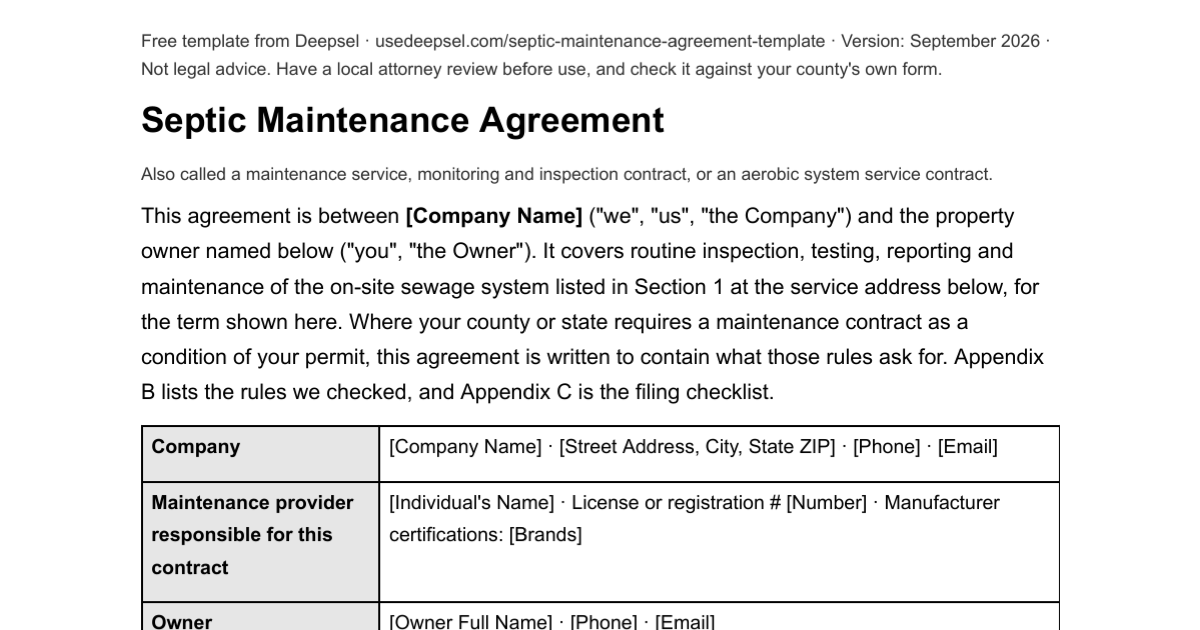
This is a free septic maintenance agreement template (the document Texas calls a maintenance contract, Minnesota counties call a maintenance service, monitoring and inspection contract, and Arkansas calls an aerobic service contract) written to contain what state and county rules require. It has a component schedule for the tank, aerator, panel, chlorinator and field, an inspection count you set to your state's rule, reporting duties to the permitting authority, alarm response times, pumping terms, the 30-day notice that most rules require when a contract ends, state notes for 11 states, and a one-page filing checklist. Eighteen pages, plain English.
Get it three ways: make your own copy in Google Docs (one click, opens in your Drive), download the Word version (.docx), or download the PDF. You can also read it in Google Docs first without copying anything. It's the septic edition of my HVAC maintenance agreement template, with the visit, payment and renewal clauses rewritten for a system the county is watching.
If you're a homeowner who just got a letter from the county saying your aerobic system needs a maintenance contract, here's the one paragraph you need. Call a licensed maintenance provider (Texas lists them by county; other states list certified operators or service providers) and ask for three things: how many inspections a year your permit requires, whether they file the reports with the county for you, and what pumping costs on top. Then hand them this template, or compare it with theirs. The rest of this page is for the septic company writing the contract.
Which states and counties require a septic maintenance contract?
Aerobic treatment units and other mechanical systems need a maintenance contract by state rule in Texas, Iowa, Arkansas and Louisiana, and by county permit or system type in Wisconsin, Minnesota, Virginia, Ohio, Maryland and North Carolina. Conventional tank-and-drainfield systems generally don't, though counties may still require pumping on a schedule. Here's what I verified against the rules and county pages, in September 2026.
| State (rule) | Which systems | Initial term | Inspections per year | Who files what |
|---|---|---|---|---|
| Texas (30 TAC 285.7 and Table XII; HSC 366.0515) | Secondary (aerobic) treatment, drip, surface application, non-standard treatment. Not conventional systems. | Two-year initial service policy from first use, filed before approval for use | Report at least every four months (three a year); twice a year with electronic monitoring; some counties require quarterly | Provider files each report within 14 days; owner files each new contract 30 days before the old one expires; provider gives 30 days notice when service stops |
| Iowa (567 IAC 69.14) | Aerobic treatment units | Contract before installation, for the life of the system | At least twice a year, six months apart | Manufacturer-certified technician does the work; contract available to the county |
| Wisconsin (SPS 383.52; county forms) | Any system whose management plan needs evaluation, monitoring or maintenance at intervals of 12 months or less | As long as the system is used | Per the management plan | Counties run the program; Bayfield County records a notarized agreement (pump within 3 years, then every 3 years) that binds future owners |
| Minnesota (Minn. R. 7082.0100, 7082.0600) | Type IV and Type V systems and mid-sized systems, under a county operating permit | Renewable operating permit | Per the management plan and permit | Owner attaches the signed service-provider contract to the permit; monitoring report due before the permit expires (Aitkin County's form is three pages) |
| Virginia (12VAC5-613-140, -150) | Alternative onsite sewage systems | Operator relationship for the life of the system | First visit within 180 days of the permit, then every 12 months (up to 1,000 gpd); quarterly or monthly above that | Operator keeps a log; owner keeps the log and O&M manual on the property |
| Ohio (OAC 3701-29-19) | Systems with O&M conditions on the operation permit | Per operation permit | Per permit and manufacturer | A service contract substitutes for the board of health inspection; provider must report non-renewals; records to the board within 60 days |
| Maryland (COMAR 26.04.02; MDE BAT rules) | Best Available Technology (nitrogen-removing) units | Two-year O&M contract and warranty included with every unit sold | At least once a year after that, by a certified service provider (Anne Arundel County) | Owner keeps the unit under a certified provider for the life of the system |
| Louisiana (LDH Onsite Wastewater Program) | Individual sewage treatment systems | Installer provides the contract with the installation | Per manufacturer endorsement | Owner maintains the system for as long as they occupy the home; provider must hold the manufacturer's endorsement |
| Arkansas (ADH Alternative Systems Manual) | Aerobic treatment plants | Valid service contract at all times | Per manufacturer and ADH | Owner pays for maintenance, testing and records; distributors report non-renewals to ADH |
| North Carolina (15A NCAC 18A .1961) | Type IV, V and VI systems | Management entity contract | Per the rule's Table V for the system type | Certified subsurface system operator; health department tracks compliance |
| Oklahoma (DEQ rules, per OSU Extension) | Aerobic treatment systems | Installer maintains free for two years after installation | Per manufacturer after that | Owner is responsible once the two years end; check the county for a contract rule |
Two things stand out from reading the rules side by side. Texas writes the contents of the contract into the rule: what's covered, a response time for owner complaints, the licensed provider's name (an individual, since TCEQ stopped registering companies), the frequency of maintenance, testing and reporting, who maintains the disinfection unit, and the provider's address and phone.1, 2 Each one is a labeled field or a numbered clause in the template. And almost every rule cares about the lapse more than the signing: Texas wants 30 days notice from the provider and a replacement contract within 30 days,1 Ohio wants the board of health told when a contract isn't renewed,10 and Arkansas has distributors report owners who don't renew.13 That's why the template's renewal notice goes out 45 days ahead, not the 30 the HVAC version uses.
What should a septic maintenance agreement include?
A septic maintenance agreement should identify the system component by component, set the inspection count to the rule that applies, list what each inspection covers, say who files reports with the permitting authority and by when, give a response time for alarms, price pumping separately, spell out the owner's duties, and state what happens to the county filing when the contract ends. Each clause below exists because a rule or a county form asks for it.
A component schedule, down to the aerator
Section 1 is two tables: system type and dispersal method with checkboxes, then eight component rows (trash tank, aerobic unit, aerator, control panel and alarm, pump tank and floats, disinfection, effluent filter, field or spray heads) with make, model, serial or size, location and condition at the first visit. A contract attached to a specific aerator is a contract nobody argues about when the aerator fails. Page 1 also carries the permitting authority, the permit number and its expiry, because in Minnesota and Ohio the permit is the thing being renewed and the contract rides along with it.7, 10
The inspection count is a fill-in
Section 3.1 reads "each term includes [3] routine inspections, about [four] months apart" and then makes you write in what your permitting authority requires and the reporting window. I didn't hard-code three because the right number is three in Texas, four in some Texas counties, two in Iowa and one in Virginia.1, 4, 9 Section 3.2 is the inspection checklist itself, assembled from the TCEQ minimums and Aitkin County's own contract form: sludge and scum depth, aerator and diffusers, chlorinator tablets and residual, pump, floats and alarm test, elapsed-time meter readings, spray head coverage or drip filter flush, effluent filter, and the manufacturer's checklist for the model.2, 8
Reports: to the owner and to the county, on a clock
Section 3.4 commits the company to a written report after each visit, a copy to the owner within 14 days, the same report filed with the permitting authority in the same window where required, and the weather-resistant tag on the system that TCEQ requires, marked at each visit.1 Section 3.5 covers the awkward part: if a required repair isn't done in 30 days, the next report has to say so. Better to write that down at signing than to argue about it in front of a county inspector.
Alarms and complaints with a response time
Section 4 gives a response time in business days (Texas requires the contract to specify one), says whether alarm visits are included or billed, and tells the owner what to do when the panel screams: silence it, don't unplug it, cut water use, call. A silenced and ignored alarm is how a $150 float becomes a failed spray field.
Pumping is separate, and logged
Section 5 keeps pumping out of the inspection price, which is how every contract I read prices it, and sets the trigger (about a third of the tank in sludge and scum, or the county's interval, whichever comes first). Wisconsin counties write the interval into a recorded agreement: Bayfield County requires pumping within three years of installation and every three years after, unless an inspection finds less than a third of the tank filled.6 Appendix C has the pumping log, with gallons, hauler and receipt number, so the record exists when the county asks.
Owner duties, in plain words
Section 6 is the list every provider recites and nobody writes down: keep power on, keep vehicles off the field, keep lids reachable, use calcium hypochlorite tablets rated for wastewater and never pool tablets (TCEQ's warning about trichlor tablets releasing an explosive gas in the chlorinator is worth repeating to every customer2), no wipes or grease, respond to alarms, keep the reports, and tell the company before selling.
Payment, renewal, and notice to the county when it ends
Section 7 defaults to annual or multi-year billing (the norm in this trade, and counties like a contract that outlasts the permit year) with a monthly card-on-file option and the consent sentence auto-renewal laws expect. Failed payments get two retries and a text each time, and the company promises never to let a required inspection lapse without telling the owner the date it was due. Section 8 is where the septic version differs most from the HVAC one: renewal notice 45 days ahead, 30 days notice from either side to cancel, and Section 8.4, which commits the company to notify the permitting authority and the manufacturer at least 30 days before service stops, whoever cancelled, and reminds the owner they have 30 days to file a replacement.1
How much does a septic maintenance contract cost?
Aerobic system maintenance contracts run about $300 to $500 a year for the three required inspections and the reporting, and conventional system contracts $150 to $350, with pumping billed separately at roughly $300 to $600 per tank.16, 17 Appendix A of the template ships with example plans you replace with your own:
| What you get | Basic | Standard | Premium |
|---|---|---|---|
| Routine inspections per year | As the rule requires | As the rule requires | As the rule requires |
| Reports filed with the permitting authority | Included | Included | Included |
| Alarm visits, business hours | $95 per visit | Included | Included |
| Chlorine tablets | Owner supplies | Included | Included |
| Small parts per term | Quoted | Quoted | Included up to $200 |
| Example price per year | $325 | $425 | $550 |
| Or per month, card on file | $29 | $38 | $48 |
| Two-year term, paid at signing | $600 | $790 | $1,020 |
Calibration. Texas Septic Guide's 2026 breakdown puts aerobic contracts at $300 to $350, $350 to $450 and $450 to $600 across three tiers, all with the three TCEQ inspections, and warns that anything well under $250 a year is cutting a corner.16 One Harris County provider lists aerobic contracts from $375 a year with four quarterly inspections and county reporting, $675 for two years and $975 for three.3 Pumping: Angi's 2026 figure is $292 to $564, average $428; a second guide says $300 to $600 for a 1,000 to 1,500 gallon tank, most people paying about $400.17, 18
The math that matters: divide the contract price by the inspection count. Three inspections at $325 is $108 a visit before the report, the filing, the drive and the tablets. If that only covers the visit, the contract is a compliance service sold at cost and the margin comes from pumping, parts and repairs. Fine business, as long as you know you're in it. Prepaid two- and three-year terms are where septic differs from HVAC: the county wants continuous coverage and the owner wants to stop thinking about it. Check Appendix B before you sell one, since some states treat prepaid service contracts as regulated products.
The filing checklist
Appendix C is the page the office works from. One row per filing event: copy of the signed contract to the permitting authority (who does it, by when), each inspection report within the window, the operating permit renewal with the report attached, the 45-day renewal notice, the renewed contract filed 30 days before the old one expires, the 30-day notice if the agreement ends, the owner's replacement contract within 30 days, and what happens on a sale (Aitkin County, for one, doesn't transfer operating permits to a new owner; they apply for their own8). Below it sit a pumping log and an inspection log with the fields counties ask for: date, technician, chlorine residual or lamp hours, sludge depth, the date the report was filed, and repairs recommended.
Every one of those dates is a promise to a regulator, and the person tracking them is usually also answering the phones and dispatching the pump truck. A missed report is a violation for the owner and a mark against the provider's license.
After it's signed: tracking inspections and renewals
The template starts a compliance relationship. It doesn't run one. With 50 contracts on the books a septic company is tracking 150 inspection dates, 150 report deadlines, 50 renewal notices and 50 county filings a year, plus pumping intervals. Start with the free maintenance agreement tracking spreadsheet: one row per agreement, equipment columns, dates for each visit owed, booked and done, and formulas for visits remaining and days to renewal. It was built for HVAC tune-ups, and a septic inspection is the same object: a visit you were paid for that has to happen by a date. The reasoning behind each column is in how to track maintenance agreements.
Deepsel, the product this site sells, is built for HVAC, plumbing and electrical shops running maintenance memberships; it isn't a septic compliance tool and I won't pretend the report-filing step is in it. What is in it is the part of this job that's identical across trades: the ledger of visits owed versus delivered, card-on-file renewals with retries and a text when a card fails, season reminders that get the visit booked, and a warning before a paid visit expires. The multi-trade page explains where it fits. A septic company with a few hundred contracts and an office of one will recognize every problem on it.
Both free. No email asked.Other trades: the commercial HVAC contract, landscaping, plumbing and electrical versions share the same master clauses, and the roundup compares the free HVAC templates side by side.
Frequently asked questions
Does a homeowner need a septic maintenance contract?
It depends on the system and the state. In Texas, Iowa, Arkansas and Louisiana an aerobic treatment unit needs one by state rule; in Wisconsin, Minnesota, Ohio, Virginia, Maryland and North Carolina the requirement comes through the county permit or the system type. A plain septic tank with a gravity drainfield usually needs no contract anywhere, though a county can still require pumping on a schedule. Your permit paperwork says which one you have.
What happens if the maintenance contract lapses?
The provider usually has to tell the county. Texas requires the maintenance provider to notify the permitting authority and the manufacturer at least 30 days before service stops, and the owner then has 30 days to file a new contract. Ohio service providers must notify the board of health when a contract is not renewed, and Arkansas distributors report owners who fail to renew. After that it is a permit violation, with fines set locally. The template's 45-day renewal notice exists so this never happens by accident.
How often is an aerobic septic system inspected?
Three times a year in Texas (a report to the permitting authority at least every four months, or twice a year with electronic monitoring; some counties require quarterly). Twice a year at six-month intervals in Iowa. Once a year in Virginia for systems under 1,000 gallons a day, and once a year for Maryland BAT units. Elsewhere the number is in the operating permit or the manufacturer's service schedule. Section 3.1 of the template has a fill-in for it.
Can I write my own septic maintenance agreement?
Yes, as long as it contains what your state and county require, and this template was built to contain those items: what is covered, the response time for complaints, the named licensed provider, the inspection and reporting frequency, who maintains the disinfection unit, and the provider's contact details. Some counties insist on their own form; attach it rather than fighting it. Have a local attorney read Appendix B against your state before you sell the first one.
Sources
- 30 Texas Administrative Code §285.7 (Maintenance Requirements) and §285.91(12), Table XII (OSSF Maintenance Contracts, Affidavit, and Testing/Reporting Requirements) - initial two-year service policy; contract contents (d)(1)(A)-(F); contract copy to the permitting authority 30 days before expiration; 30-day notice on discontinuation and 30 days to file a new contract; reports within 14 days; two tests a year with electronic monitoring. Chapter text: 30 TAC Chapter 285 (PDF), read September 5, 2026.
- Texas Commission on Environmental Quality, "Maintenance of On-Site Sewage Facilities (Septic Systems)" - provider must be a licensed individual ("TCEQ no longer registers OSSF maintenance companies"); tag the system; "Submit a report to the permitting authority and owner at least once every four months"; the five items a contract must specify; warning against swimming pool chlorine tablets. tceq.texas.gov, read September 5, 2026. Statute: Texas Health and Safety Code §366.0515, justia.com, 2023 codes, read September 5, 2026.
- Harris County Septic (Enviro-Pal, Inc.), "Harris County Septic System Requirements & TCEQ OSSF Regulations" - a provider's page: "Harris County requires your licensed provider to inspect the system four times per year"; reports within 14 days; "Aerobic system contracts start at $375/year (2-year: $675, 3-year: $975)." harriscountyseptic.com, read September 5, 2026.
- Iowa Administrative Code r. 567-69.14(6) - "A maintenance contract is required for the life of the system... Aerobic treatment units shall be inspected for proper operation at least twice a year at six-month intervals by the certified technician." law.cornell.edu, read September 5, 2026.
- Wisconsin Administrative Code SPS 383.52(1)(c) - owner "shall maintain a maintenance contract with a POWTS maintainer... as long as the POWTS is utilized" where the management plan involves evaluating, monitoring or maintaining any part "at an interval of 12 months or less." docs.legis.wisconsin.gov, read September 5, 2026.
- Bayfield County, Wisconsin, "Private Sewage System Maintenance Agreement" (revised July 2020) - pumping "within three (3) years of the date of installation and at least once every three (3) years thereafter unless... less than one-third (1/3) of the volume occupied by sludge and scum"; notarized; "binding upon... all current and future owners." bayfieldcounty.wi.gov, read September 5, 2026.
- Minnesota Rules 7082.0100 subp. 3 item K (operating permits for systems under 7080.2350, 7080.2400 and chapter 7081) and 7082.0600 (management plans and operating permit contents). revisor.mn.gov, read September 5, 2026.
- Aitkin County, Minnesota, "Maintenance Service, Monitoring and Inspection Contract for Subsurface Sewage Treatment System Operating Permit" (3 pages; inspection checklist; "This contract may be renewed 30 days from the ending date"), co.aitkin.mn.us; and a 2025-2026 Aitkin County SSTS operating permit record showing the attached signed contract and the requirement to submit monitoring results before the permit's expiration date. Aitkin County also states operating permits do not transfer to new property owners. Read September 5, 2026.
- Virginia Administrative Code 12VAC5-613-140 (owner responsibilities: have the AOSS operated and maintained by an operator, keep the log and O&M manual on the property) and 12VAC5-613-150, Table 4 (up to 1,000 GPD: initial visit within 180 days of the operation permit, then every 12 months). law.lis.virginia.gov, read September 5, 2026.
- Ohio Administrative Code 3701-29-19(C)-(D) - O&M may be demonstrated by "securing a service contract"; "Service providers shall notify the board of health when service contracts are not renewed"; records to the board of health within sixty days of an O&M inspection. codes.ohio.gov, read September 5, 2026.
- Maryland Department of the Environment, "BAT Septics Reform" - "all BAT systems sold in the State include both a two-year operation and maintenance contract and a two-year warranty" (effective November 24, 2016), mde.maryland.gov; Anne Arundel County Health Department, BAT requirements - "operate and maintain the BAT for the life of the system through a certified service provider... at a minimum of once per year," aahealth.org. Both read September 5, 2026.
- Louisiana Department of Health, Onsite Wastewater Program - "Your installer should provide you with a maintenance contract as part of your initial installation and homeowners are required to maintain their systems in perpetuity"; choose a provider with the manufacturer's endorsement. ldh.la.gov, read September 5, 2026.
- Arkansas Department of Health, Alternative Systems Manual (Rule 007.04.93-005) - "Owners of aerobic treatment plants must maintain a valid service contract with a certified individual or company"; distributors "provide and maintain periodic reports to the Arkansas Department of Health on individuals failing to renew service contracts." law.cornell.edu, read September 5, 2026.
- Mecklenburg County (NC) Public Health, "Public Management Entity Program" - "A Public Management Entity is required to perform maintenance for Type IV, Type V, and Type VI systems," per 15A NCAC 18A .1961 and its Table V; entity must be a certified Subsurface System Operator. health.mecknc.gov, read September 5, 2026.
- Oklahoma State University Extension, "Basic Septic System Rules for Oklahoma" - "Oklahoma rules require the installer to provide a free, two-year maintenance period" for aerobic treatment systems; owner responsible for operation after that. extension.okstate.edu, read September 5, 2026.
- Texas Septic Guide, "Septic Maintenance Contracts in Texas: Cost, Requirements & What's Included (2026)" - "$150-$350 for conventional systems and $300-$500 for aerobic systems"; tier bands $300-$350, $350-$450, $450-$600; pumping "$235-$400 for a 1,000-gallon tank, billed separately"; "If a contract is significantly below $250 per year for an aerobic system, ask what's being cut." texassepticguide.com, read September 5, 2026.
- Angi, "How Much Does It Cost to Pump a Septic Tank? [2026 Data]" - "The average cost to pump a septic tank is $428, with most people paying between $292 and $564." angi.com, read September 5, 2026.
- The Septic Guide, "Septic Tank Pumping Cost 2026" - "$300 to $600 for a standard 1,000 to 1,500 gallon tank, with most homeowners paying around $400"; regional and tank-size tables. theseptic.guide, read September 5, 2026.