HVAC tune-up checklist: the 21 points that count, with a free two-page report card
- Free. No signup and no email asked; the links below go straight to the file.
- Deepsel is our product. It tracks whether the visits owed under a maintenance agreement actually happened, and the last section says so.
- This is a maintenance inspection list. It doesn't replace the manufacturer's service instructions, local code or safety training, and the combustion and refrigerant items belong to trained, certified techs.
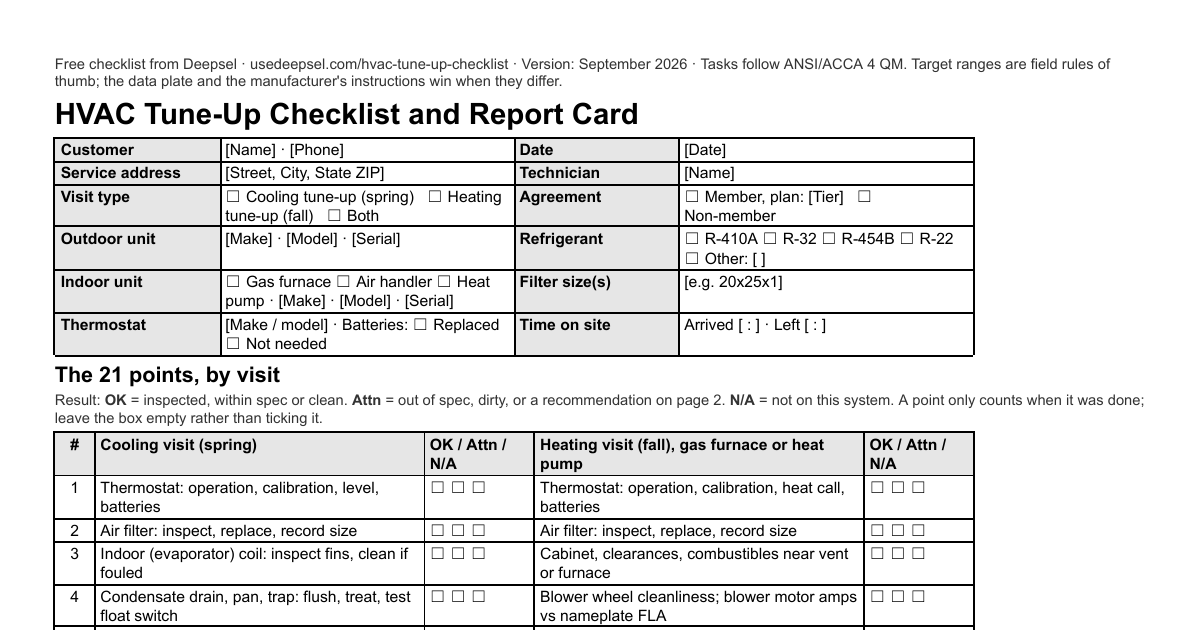
An HVAC tune-up checklist is the list of inspection, cleaning and measurement tasks a technician completes on a seasonal maintenance visit. The version below has 21 points for the cooling visit and 21 for the heating visit, and every point produces a reading, a photo or a cleaned part. It comes with the target numbers and a free two-page report card the tech leaves with the customer.
Get the report card three ways: make your own copy in Google Docs (one click, opens in your Drive, add your logo), download the Word version (.docx), or download the PDF. You can read it in Google Docs first without copying anything. Page one is the 21-point list for both seasons with OK / Attn / N/A boxes. Page two is the readings table, condition grades and a recommendations block that makes the tech write the reading next to the price.
I built it because the checklists that rank for this search are either a franchise blog post with "lubricate moving parts" on it, or a PDF behind a form that wants your company name and business email before it opens.22 Neither one has a target number on it. A checklist without targets is a list of things to glance at, and glancing is how a $79 visit turns into a $13,000 quote (there's a thread about exactly that further down).
What does an HVAC tune-up include?
An HVAC tune-up includes a thermostat and filter check, cleaning of the indoor and outdoor coils and the condensate drain, electrical testing of the capacitor, contactor and connections, motor amp draws against the nameplate, an airflow measurement (static pressure and temperature split), and a refrigerant charge check by line temperatures. The heating visit adds the heat exchanger, burners, igniter, flame sensor, gas pressure, venting, safeties and a combustion analysis.
That's the short version. The long version is ANSI/ACCA 4 QM, the industry's maintenance standard for houses, which describes itself as "minimum requirements for the inspection, by appropriately licensed HVAC contractors, of residential HVAC equipment."1 Its gas furnace checklist alone has 34 tasks, lettered a through hh. The condensing unit has 15, the evaporator coil 12, and an air-to-air heat pump gets four more. I read the 2013 edition, which is the one you can find free online; ACCA sells a 2019 revision, and the ACCA homeowner tool that goes with it was refreshed in November 2024.2 The tables below compress those tasks into 21 per season and attach a target to each one. Where a range is a field rule of thumb rather than a manufacturer number, I say so.
Cooling tune-up (spring), 21 points
| # | Point | What the tech checks, and the target | What goes on the report |
|---|---|---|---|
| 1 | Thermostat | Calls for cooling, reads the room correctly, mounted level, batteries fresh | Make and model, batteries replaced or not |
| 2 | Air filter | Inspect and replace; a loaded filter can add a quarter inch of static on its own6 | Filter size, replaced or not |
| 3 | Indoor coil | Fins visibly clean, straight and open; clean if fouled (ACCA 5.7 i)1 | Cleaned or not, photo if dirty |
| 4 | Condensate drain, pan, trap | Flush, treat for growth, test the float or overflow switch (ACCA 5.7 c to f)1 | Flushed, switch tested |
| 5 | Blower wheel and motor | Wheel clean, motor amps under nameplate FLA (ACCA 5.9)1 | Blower amps / FLA |
| 6 | Static pressure | Total external static, return plus supply; "you would like to see it be 0.5″ or less," and 0.8″ or more points to a duct or filter problem6 | TESP in inches WC vs rated |
| 7 | Temperature split | Return dry bulb and wet bulb, supply dry bulb; "between 16 and 22 degrees" in typical conditions, and it moves with indoor humidity3, 4 | Return DB/WB, supply DB, split |
| 8 | Refrigerant charge check | Line temperatures first; subcooling on a TXV system "between 8 and 14 degrees," superheat on a fixed orifice from the charging chart; gauges only if the numbers say so3 | Suction and liquid line temps, SH or SC |
| 9 | Refrigerant lines | Insulation intact, no oil stains at joints (ACCA 5.7 j, k)1 | OK or repair noted |
| 10 | Outdoor coil | Wash from the inside out, straighten fins, clear the base pan (ACCA 5.8 o)1 | Cleaned, photo before and after |
| 11 | Condenser fan motor | Amps under FLA, blade balanced, minimal shaft endplay (ACCA 5.8 n)1 | Fan amps / FLA |
| 12 | Compressor | Running amps under nameplate RLA (ACCA 5.8 j)1 | Compressor amps / RLA |
| 13 | Run capacitor(s) | Microfarads under load vs rating; "most capacitors allow for a 6%+/- tolerance"5 | Rated µF / measured µF |
| 14 | Contactor | Pitting, burned contacts, coil, voltage drop across the contacts (ACCA 5.8 f)1 | OK or replace, with the reason |
| 15 | Electrical connections | Tightened, no heat discoloration, wire size matches the load (ACCA 5.8 h)1 | OK |
| 16 | Disconnect and fuse or breaker | Right size, not bypassed, case intact (ACCA 5.8 c)1 | OK |
| 17 | Line voltage | Measured against the nameplate range (ACCA 5.8 e)1 | Volts |
| 18 | Control board and low voltage | 24 V present, no hot spots or burn marks (ACCA 5.8 g)1 | OK |
| 19 | Cabinet and pad | Panels on, clearance kept, pad level, no nests or debris (ACCA 5.8 a, b)1 | OK |
| 20 | Visible ductwork | Disconnected runs, leaks, crushed flex, missing insulation11 | OK or photo |
| 21 | Final run test | Full cooling cycle, disconnect back in, readings explained to the customer23 | Time on site, customer signature |
Point 21 is on the list because of a tech in the r/HVAC checklist thread, who ended his own list with: "Finally verify the unit is running before walking away. You'd be surprised how many call backs we've had over disconnects being left out."23 The order matters too. A homeowner in May 2026 described a tech who read the charge, added refrigerant, and then washed the outdoor coil; the top reply called that "distressing," and a second tech spelled out the rule: "airflow before charge."32 Points 2 through 7 come before point 8 for that reason.
Heating tune-up (fall), 21 points
| # | Point | What the tech checks, and the target | What goes on the report |
|---|---|---|---|
| 1 | Thermostat | Calls for heat, calibration, batteries | Make and model |
| 2 | Air filter | Inspect and replace, record the size | Filter size |
| 3 | Cabinet and clearances | Combustion and service clearance kept; nothing combustible near the vent (ACCA 5.4 a, b, hh)1 | OK |
| 4 | Blower wheel and motor | Wheel clean, amps under FLA (ACCA 5.4 m)1 | Blower amps / FLA |
| 5 | Static pressure | TESP against the data tag; same 0.5″ rule of thumb6, 9 | TESP in inches WC |
| 6 | Temperature rise | Supply minus return, measured out of line of sight of the heat exchanger, inside the nameplate range ("50-80° or 45-75°"); high rise means low airflow, low rise means too much7 | Return, supply, rise, nameplate range |
| 7 | Heat exchanger | Visual or camera inspection for cracks, rust and bulges, and flame disturbance when the blower starts (ACCA 5.4 q)1 | Photo |
| 8 | Burners | Inspect, clean, fire and check the flame pattern (ACCA 5.4 r, y)1 | Cleaned or not |
| 9 | Igniter | Hot surface igniter checked for cracks and resistance; spark igniter gap to spec (ACCA 5.4 t, z)1 | Ohms, or OK |
| 10 | Flame sensor | Clean, then read microamps: "between 1 and 10 microamps, preferably between 2 and 6"8 | µA before and after cleaning |
| 11 | Inducer motor | Amps, bearing noise, pressure switch hose and port clear (ACCA 5.4 p)1 | Inducer amps |
| 12 | Gas pressure | Inlet and manifold against the data plate; natural gas manifold "usually between 3.2 and 3.8″ WC," propane "10.5 to 11.5″ WC"8 | Inlet and manifold in inches WC |
| 13 | Combustion analysis | CO air-free "below 100 PPM is the recommended target"; at "400 PPM or above, you are required to shut down the furnace"8 | CO air-free, O2, stable or rising |
| 14 | Venting | Slope, support, termination, rust, condensate, blockage (ACCA 5.4 ee to gg)1 | OK or photo |
| 15 | Combustion air | Correct for the appliance type and the space it sits in (ACCA 5.4 bb)1 | OK |
| 16 | Safeties | High limit, rollout switches, pressure switch, door switch all tested20 | Tested |
| 17 | Condensate | Trap and drain on condensing furnaces; outdoor drain ports on heat pumps (ACCA 5.4 n, 5.8-HP d)1 | Cleared |
| 18 | Electrical | Connections, disconnect, grounding, line voltage against the nameplate (ACCA 5.4 c to g)1 | Volts |
| 19 | Control board and low voltage | 24 V between thermostat and board, no burn marks9 | OK |
| 20 | Heat pump extras | Reversing valve, defrost cycle, auxiliary heat strips and their amps (ACCA 5.8-HP a to c)1 | Strip amps / rating |
| 21 | Final run test | Full heat call, ignition sequence, blower on and off delays, ambient CO in the living space, readings explained | Ambient CO, time on site, signature |
Two of the heating points need a certified hand. Anyone who opens the refrigerant circuit on the cooling side must hold EPA Section 608 certification; the EPA's rule is that "technicians who maintain, service, repair, or dispose of equipment that could release refrigerants into the atmosphere must be certified."10 And the combustion analysis on point 13 is the one item where the reading can end the visit. ACCA's standard says the contractor "shall shut off the equipment and advise the occupant and/or owner, in writing, of the unsafe condition."1 The report card has a box for that.
What is a 21-point tune-up, and which points are padding?
The number on a tune-up ad is the count of tasks the company chose to print, and nothing standardizes it. Service Champions sells a "21-Point 'WOW!' Air Conditioner Tune-Up" for $88 against a $149 regular price.12 NRS in Las Vegas publishes 20 points.31 A shop in St. George, Utah offers a 21-point inspection for $19.13 ACCA's standard, which none of them are counting from, has 34 tasks for a gas furnace and 27 for a split-system condenser and coil.1 So 21 is a marketing convention, and the way to read one is to sort the points into three piles.
Points that produce a number. Temperature split, static pressure, capacitor microfarads, amp draws, line voltage, temperature rise, flame sensor microamps, gas pressure, CO. A tech can't fake these without writing a fake number, and a fake number is checkable next year.
Points that produce a cleaned part or a photo. Coils, drain, blower wheel, burners, flame sensor, heat exchanger. You can see before and after.
Points that produce a checkbox. Service Champions' list is a fair example of a real list with padding mixed in: "Test and inspect contactor for burned and pitted contacts" and "Measure the supply & return temperature differential" are real, while "Inspect safety devices for proper operation," "Test service valves for proper operation" and "Clean existing air filter (as needed)" are three points for what a competent tech does in passing.12 The franchise version of the same list has "Lubricate all moving parts" on it, which on a modern system with sealed bearings means nothing, and ACCA only allows it "if recommended by OEM."19, 1 When a Lowe's tune-up flyer, priced under $9 according to the comments, got posted to r/HVAC, the top comment, at 218 upvotes, was: "Make sure they lubricant the thermostat!"24
My rule for the report card: a point counts if it leaves a reading, a photo or a part behind. Both 21-point lists above pass that test, and the "What goes on the report" column is what the tech is supposed to write.
How much does an HVAC tune-up cost in 2026?
A single-visit tune-up costs $65 to $200 in the consumer guides and $19 to $149 on the contractor pages I checked. The guides disagree with each other by a wide margin, and the contractor prices split into two groups: the ones that cover the visit and the ones that don't.
| Source | Price | Note |
|---|---|---|
| This Old House16 | $65 to $200, average $133 | Updated March 2026 |
| Fixr17 | $150 to $350, average $275 | Updated January 2026; service contracts $150 to $500 a year |
| Carrier18 | $75 to $200 | Cites This Old House |
| Five Star, St. George UT13 | $19 first visit, normally $49 | "The $19 doesn't cover our cost" |
| Service Champions12 | $88, regular $149 | 21 points plus a water heater inspection |
| Wrangler AC, San Antonio14 | $89 to $149 | Prices updated May 2026, two visits a year recommended |
| Smart Climate Solutions15 | $149 | Priced "without the pressure to push for extra repairs" |
| r/HVAC tech's own shop23 | $204 a year, two visits | Full strip-and-clean of the outdoor unit included |
The line techs draw is $100. "Any tune up under $100 is a sales pitch," one wrote in a thread comparing Home Depot's $14 to $35 specials with a maintenance contract.28 Another did the arithmetic on a $29 promo: "A legit tune up you spend about an hour on the system, and for $29 thats less than most guys make hourly. And what a guy makes hourly is much different than what a guy costs hourly."29 A contractor's general manager put a number on that cost: a technician earning $25 to $40 an hour, plus travel and overhead, means "a one-hour service call actually costs a company $75-$150 just to break even."15 Five Star says it out loud on its own offer page: "Loss-leader. We offer a deep discount to new customers because we know if we do good work, you'll call us next time something breaks."13
If you're a shop pricing your own tune-up, the honest floor is your loaded hour plus the drive. If you're a homeowner reading this, the $19 visit isn't a scam by definition, and the next section is how to tell.
The $79 tune-up that finds a $13,000 problem
A homeowner posted to r/hvacadvice in February 2026. The furnace had been making a high-pitched hum for a minute before the flames lit. A tech arrived for a scheduled $125 tune-up, "immediately scares my wife and tells her its a big problem," called in a second person, and the two of them condemned the heat exchanger and left a $13,000 replacement quote.25 The top reply, at 159 upvotes: "I would call 2-3 other companies and make them get you pictures of the heat exchanger, that high pitched wine is more than likely just the inducer motor." Another reply pointed out that a company that believed the heat exchanger was cracked would have locked the furnace out, and these two hadn't.
That pattern shows up in the same subreddit every season. "I'm apprehensive that it's a $79 invitation to find problems that may or may not actually exist, only to end up with a 4-figure bill," wrote a homeowner in March 2026, and an HVAC pro answered in the same thread: "We're losing money on the 79.00 tune up. But we'll leave with a profit after replacing your capacitors, contactors, telling you your fan is about to fail, telling you that your system is low on refrigerant and needs a leak check/repair etc."26 A $49 heat pump tune-up in September 2025 turned out to have covered the cooling side only; one reply put it plainly: "The only dishonest part is calling it a tuneup. Just call it routine maintenance and inspection."27
Techs hate this more than homeowners do, because it's their name on the invoice. "How is one to be expected to bring in profit on tune ups without upselling or selling them a capacitor because theirs tests 'weak'? Genuine question. I genuinely can't feel good about doing work like that," one asked in r/HVAC.30 Another described his own rule: "I very rarely upsell anything unless it's out of spec. I know for a fact I catch a lot of issues early before something fails."28
"Out of spec" is the whole answer, and it only works if the spec is on paper next to the reading. A capacitor rated 45 µF that measures 40.1 µF is 11 percent low against a 6 percent tolerance, and that sentence is a recommendation a homeowner can check with a second opinion. "Capacitor weak" is a guess. The report card's recommendations block has a column for the reading and a column for the price, and the tech fills the first one before the second. A second-generation furnace contractor runs his visits the same way: "Document everything in writing. Pressures, temps, amp draws, CO numbers, and a photo of the heat exchanger. You get a copy."20 ACCA's own education manager makes the shop's case for it: detailed documentation "can reduce liability exposure by providing evidence of diligent service."21
What the tech writes down, and why the readings matter
Page two of the report card is a readings table with a target column, a "before" column and an "after" column. Here is what each reading is for and what an out-of-range number usually means.
| Reading | Target | If it's off |
|---|---|---|
| Temperature split (cooling) | About 16 to 22°F; lower when the return air is humid3, 4 | Low split with high humidity is normal. Low split with dry air is airflow or charge; check static first |
| Total external static pressure | Rated on the data tag; 0.5″ WC or less is typical, 0.8″ or more is a problem6 | Loaded filter, dirty coil or wheel, undersized return, crushed flex |
| Subcooling (TXV) | Data plate value; "10°, +/- 3°" if there is none3 | Low: undercharge or restriction. High: overcharge or a dirty condenser. Clean the condenser before you believe either |
| Superheat (fixed orifice) | From the charging chart for the indoor wet bulb and outdoor dry bulb; "target superheat is a MOVING target"3 | Same as above, and never adjusted without the chart |
| Capacitor microfarads | Within 6 percent of the rating5 | Out of tolerance: replace, and write both numbers on the report |
| Motor amps | Under the nameplate FLA (fan, blower) or RLA (compressor)1 | Over: bearings, dirty wheel, wrong capacitor, low voltage |
| Temperature rise (heating) | Inside the nameplate range, e.g. 45 to 75°F7 | High: not enough airflow, furnace will trip on limit. Low: too much airflow, condensation risk in the exchanger |
| Flame sensor | 1 to 10 µA, best 2 to 68 | Low: clean the rod and re-read; still low, replace |
| Manifold gas pressure | Data plate; natural gas about 3.5″ WC, propane 10 to 11″ WC8 | Off: adjust the valve, or call the gas supplier if inlet pressure is short |
| Flue CO, air-free | Under 100 ppm and stable; 400 ppm or more means shut down8 | Rising CO through the cycle is the sign of a problem, even under 100 |
The readings pay off in year two. Genry Garcia, writing at HVAC School, calls the fixed 20-degree split "a lazy rule of thumb" because the right split "depends on the temperature and water vapor content of the air entering the evaporator coil," so a single reading can mislead.4 Last year's reading on the same unit in similar weather can't. A capacitor that measured 44 last spring and 41 this spring is a recommendation with a trend behind it. That's why the report card has one copy for the customer and one for the file, and why the file needs to be findable per unit, which is the last section of this page.
Promotional tune-up vs a visit under a maintenance agreement
The checklist is identical. What differs is what surrounds it.
| Promotional tune-up | Visit under a maintenance agreement | |
|---|---|---|
| Price | $19 to $149, one visit | $150 to $500 a year for two visits17 |
| Time on site | Should be an hour; often 15 minutes | One to two hours per system19 |
| Filter | Inspected; replaced if the customer has one | Size on file, brought on the truck |
| Last visit's readings | Unknown | On file, compared |
| Repairs | Standard price | Member discount, usually 10 to 15 percent |
| Next visit | Whoever mails the next flyer | Owed, dated, and tracked by the shop |
The last row is the one that goes wrong. A homeowner with a two-visit agreement whose fall visit never got booked paid for a tune-up that didn't happen, and no checklist catches that, because the checklist lives on the visit and the problem lives between visits. The r/hvacadvice heat pump thread above is that failure from the customer's side: he thought he'd been serviced through spring and had been serviced through summer.27
For the deep technical version of each side, use the AC maintenance checklist and the furnace maintenance checklist. Heat pumps get both sides on one visit; the heat pump maintenance checklist covers the reversing valve and defrost items point 20 only touches. The full-year HVAC maintenance checklist is the whole program, spring and fall, and the HVAC inspection checklist is the look-only version for a home sale or a new customer's first visit. All of them are on the free HVAC checklists page.
The checklist proves the work. The ledger proves the visit happened.
A signed report card proves one visit on one unit. It doesn't tell the office which of 120 members still has a fall visit owed, or that Mrs. Alvarez's plan year ends in 40 days with a paid tune-up undelivered. That's a second record, one row per agreement: plan, equipment and filter sizes, visit one and visit two with booked and done dates, renewal date. The free maintenance agreement tracking spreadsheet is that record in Google Sheets, and it has the same equipment and filter columns as the report card header. The contract that makes the visit owed in the first place is the free HVAC maintenance agreement template, whose Section 3.3 is a shorter version of the list on this page. The reasoning behind both is in how to track HVAC maintenance agreements.
Past about 80 agreements, keeping that ledger by hand is where visits start slipping. Deepsel keeps it beside Jobber or Housecall Pro: it holds visits owed against visits delivered per covered unit, sends the season booking texts, charges the renewal to the card on file, and warns you before a paid visit expires. The tune-up itself still happens on the report card above. Deepsel is the reason the report card gets filled out twice a year instead of once.
14-day free trial. No credit card required.Frequently asked questions
What is a 21-point HVAC tune-up?
A marketing package, with a real inspection inside it if the shop is honest. The number is the count of tasks the company chose to print; Service Champions counts 21, NRS in Las Vegas counts 20, and ACCA's residential maintenance standard lists 34 tasks for a gas furnace alone. Judge a tune-up by how many of its points produce a written reading, a photo or a cleaned part, and ask for the report card before you book.
How much does an HVAC tune-up cost in 2026?
Published guides put a single-visit tune-up at $65 to $200 (This Old House, average $133) or $150 to $350 (Fixr, average $275). Contractor pages I checked in 2026 ran from a $19 first-visit special to $149 at full price. Techs on Reddit draw the line at $100: below it, the company is losing money on the visit and expects to make it back on repairs. A two-visit maintenance agreement runs $150 to $500 a year.
Is an HVAC tune-up worth it?
Yes, when it produces numbers. A tune-up that records temperature split, static pressure, capacitor microfarads, amp draws and, on a furnace, temperature rise, gas pressure and flue CO gives you a baseline to compare against next year. A tune-up that ends with a verbal 'everything looks good' or a $2,000 recommendation with no reading behind it was a sales visit, and the price you paid was the admission fee.
How long should an HVAC tune-up take?
About an hour per system per season for a real one. Aire Serv tells its customers to expect one to two hours. Five Star in Utah says 60 to 90 minutes. A second-generation furnace contractor budgets about 90 minutes for a fall furnace visit with combustion analysis. A tech who is in and out in 15 minutes did the filter, looked at the outdoor unit and left; the readings on the report card take longer than that to collect.
What's the difference between a tune-up and a maintenance visit?
Same work, different packaging. A tune-up is sold one visit at a time, usually at a promotional price, to a customer the shop may never see again. A maintenance visit is one of the two visits owed under a maintenance agreement, so it comes with a record of the last visit, the filter sizes already on file, and a renewal date. The checklist doesn't change. What changes is that somebody is tracking whether the visit happened.
Should a tune-up include adding refrigerant?
No. A system that needs refrigerant has a leak, and adding gas without finding it is a repair sold as maintenance. Only an EPA Section 608 certified technician may open the refrigerant circuit at all. The charge check on a tune-up is a measurement (line temperatures, superheat or subcooling) taken after the coils are clean, because a dirty condenser reads like low charge. Airflow first, then charge.
Sources
- Air Conditioning Contractors of America, ANSI/ACCA 4 QM-2013, "Maintenance of Residential HVAC Systems" - scope: "minimum requirements for the inspection, by appropriately licensed HVAC contractors, of residential HVAC equipment"; Checklist 5.4 Gas Furnace (tasks a to hh), 5.7 Evaporator Coil (a to l), 5.8 Condensing Unit (a to o) and 5.8-HP heat pump tasks; section 3.3.7: "the contractor shall shut off the equipment and advise the occupant and/or owner, in writing, of the unsafe condition." transductiontechnologies.com (PDF mirror of the 2013 edition), read September 5, 2026. The current edition is ANSI/ACCA 4 QM-2019, sold by ACCA.
- ACCA, "Residential Quality Maintenance Checklist" - homeowner tool for evaluating contractor maintenance programs against ANSI/ACCA 4 QM; file QM-Checklist-2024.pdf, "Last Updated: November 27, 2024." acca.org, read September 5, 2026.
- Bryan Orr, HVAC School, "The '5 Pillars' of Residential A/C Refrigerant Circuit Diagnosis" - "The air temperature split during typical conditions will be between 16 and 22 degrees' difference from the return to the supply"; "Typical ranges for subcooling are between 8 and 14 degrees on a TXV system"; "10°, +/- 3° at the condenser outlet is an acceptable rule of thumb." hvacrschool.com, July 24, 2019, read September 5, 2026. Superheat as "a MOVING target": Orr, "How to Set a Charge by Superheat," hvacrschool.com.
- Genry Garcia, HVAC School, "20° ΔT (Delta T), A Lazy Rule of Thumb" - the supply air temperature "depends on the temperature and water vapor content of the air entering the evaporator coil. It does not depend on how many years of experience the person that you are asking has." hvacrschool.com, April 5, 2019, read September 5, 2026.
- Bryan Orr, HVAC School, "Testing Run Capacitors the Smart (and Easy) Way" - "Most capacitors allow for a 6%+/- tolerance"; under-load formula "Start Winding Amps X 2,652 ÷ Capacitor Voltage = Microfarads." hvacrschool.com, March 4, 2017, read September 5, 2026.
- Bryan Orr, HVAC School, "Static Pressure, Manometers, and Magnehelics" - "Total external static pressure is return plus supply, positive plus negative, and in general, you would like to see it be 0.5″ or less"; 0.8″ or higher indicates a problem on most newer residential systems. hvacrschool.com, April 12, 2024, read September 5, 2026. Filter pressure drop example (0.26″ WC from one filter): Orr, "Air Filter Static Pressure Drop," hvacrschool.com.
- Bryan Orr, HVAC School, "Furnace Air Temperature Rise" - "Every gas furnace data plate/tag has a specification for the temperature rise through that furnace. It is shown in a range like 50-80° or 45-75°"; high rise means insufficient airflow and limit cycling, low rise means excess airflow and condensation risk. hvacrschool.com, December 26, 2022, read September 5, 2026.
- Bryan Orr, HVAC School, "Gas Furnaces - What a Tech Needs to Know" - "In general, 400 PPM is the maximum allowable concentration of CO air free in the flue. If you have 400 PPM or above, you are required to shut down the furnace"; "Below 100 PPM is the recommended CO air free target"; flame sensor "between 1 and 10 microamps, preferably between 2 and 6"; manifold pressure "usually between 3.2 and 3.8″ WC," LP "10.5-11.5″ WC." hvacrschool.com, March 3, 2023, read September 5, 2026.
- Michael Housh and Bryan Orr, HVAC School, "Gas Furnace Maintenance Procedure" - 22-step procedure; "should be 24v of electrical potential between the thermostat and circuit board"; static pressure "less than the maximum specification listed on the data tag." hvacrschool.com, December 22, 2022, read September 5, 2026.
- US EPA, "Section 608 Technician Certification Requirements" - "Technicians who maintain, service, repair, or dispose of equipment that could release refrigerants into the atmosphere must be certified." epa.gov, last updated July 15, 2026, read September 5, 2026.
- ENERGY STAR, "Maintenance Checklist" - contractor tasks including "Tighten all electrical connections," "Check and inspect the condensate drain," "Clean evaporator and condenser air conditioning coils," and "Check all gas (or oil) connections, gas pressure, burner combustion and heat exchanger." energystar.gov, read September 5, 2026.
- Service Champions, "Air Conditioner Maintenance and Tune-Up" - "21-Point 'WOW!' Air Conditioner Tune-Up including a FREE Water Heater Safety Inspection for Only $88 (reg $149)," with all 21 points listed. servicechampions.net, read September 5, 2026.
- Five Star Heating & Air, "$19 AC Tune-Up St. George" - "$19 (normally $49) for first-time customers"; "Loss-leader. We offer a deep discount to new customers because we know if we do good work, you'll call us next time something breaks"; "The $19 doesn't cover our cost"; "60-90 minutes for most homes." fivestarut.com, read September 5, 2026.
- Wrangler AC, "AC Tune-Up San Antonio" - "AC tune-ups in San Antonio run $89 to $149, and we recommend two visits a year"; "Prices updated May 2026." wranglerac.com, read September 5, 2026.
- Bill Scott, Smart Climate Solutions, "The Truth Behind Those Tempting HVAC Tune-Up Specials" - "a one-hour service call actually costs a company $75-$150 just to break even"; "we price our standard tune-up at $149 because that allows us to perform all necessary services thoroughly without the pressure to push for extra repairs." mysmartclimatesolutions.com, June 5, 2025, read September 5, 2026.
- Alexis Carthan, This Old House, "How Much Does an AC Tune-Up Cost? (2026 Guide)" - "Air conditioning (AC) tune-ups typically cost $65-$200," average $133. thisoldhouse.com, updated March 27, 2026, read September 5, 2026.
- Dan Simms, Fixr, "How Much Does HVAC Maintenance Cost in 2026?" - "An annual tune-up costs an average of $275," range $150 to $350; "An HVAC service contract costs between $150 and $500 per year." fixr.com, updated January 30, 2026, read September 5, 2026.
- Carrier, "AC and HVAC Tune-Up Guide: Checklist, Costs & More" - "On average, an air conditioner tune-up in 2026 costs between $75 and $200." carrier.com, read September 5, 2026.
- Aire Serv, "HVAC Tune-up Checklist: What Does It Include?" - checklist including "Lubricate all moving parts"; "seasonal HVAC maintenance appointments take 1 to 2 hours." aireserv.com, published July 30, 2026, read September 5, 2026.
- Jason Stom, Clear the Air, "Furnace Tune-Up Checklist" - "A real fall furnace tune-up takes about 90 minutes"; "Document everything in writing. Pressures, temps, amp draws, CO numbers, and a photo of the heat exchanger. You get a copy." cleartheairac.com, October 15, 2024, updated May 9, 2026, read September 5, 2026.
- Matt Akins, ACCA HVAC Blog, "Elevating HVAC Maintenance with Systematic Checklists" - documentation "can reduce liability exposure by providing evidence of diligent service." hvac-blog.acca.org, April 18, 2024, read September 5, 2026.
- Cameron Brown, ServiceTitan, "Free HVAC Tune-Up Checklist | PDF" - download form requires first name, last name, company, business email and industry. servicetitan.com, December 20, 2024, read September 5, 2026.
- r/HVAC, "What is your AC tune up checklist?" - AustinHVAC419: "Finally verify the unit is running before walking away. You'd be surprised how many call backs we've had over disconnects being left out"; OkFail3716's full strip-and-clean list priced at "204 for a year membership 2 tune ups"; EJ25Junkie, 32 upvotes: "1. Talk to customer. 2. Condemn system. 3 Sell new system." reddit.com, April 13, 2023, read September 5, 2026.
- r/HVAC, "Lowe's tune-up special LOW PRICE" - top comment, 218 upvotes: "Make sure they lubricant the thermostat!"; "You're basically paying for a salesman to come to your house." reddit.com, November 24, 2023, read September 5, 2026.
- r/hvacadvice, "Called for a Tune Up, got a $13,000 quote" - $125 tune-up, tech "immediately scares my wife and tells her its a big problem"; top reply, 159 upvotes: "make them get you pictures of the heat exchanger, that high pitched wine is more than likely just the inducer motor." reddit.com, February 2, 2026, read September 5, 2026.
- r/hvacadvice, "AC/Heating Tune Ups - Worth It?" - "I'm apprehensive that it's a $79 invitation to find problems that may or may not actually exist, only to end up with a 4-figure bill"; itdoesntmatta69: "We're losing money on the 79.00 tune up. But we'll leave with a profit after replacing your capacitors, contactors..." reddit.com, March 31, 2026, read September 5, 2026.
- r/hvacadvice, "AITA? Should a tune-up include both sides of a heat pump?" - $49 tune-up covered cooling only; 1991gts: "The only dishonest part is calling it a tuneup. Just call it routine maintenance and inspection." reddit.com, September 22, 2025, read September 5, 2026.
- r/hvacadvice, "HVAC tune up versus Preventative maintenance contracts?" - BuzzyScruggs94: "Any tune up under $100 is a sales pitch"; ALonelyWelcomeMat: "I very rarely upsell anything unless it's out of spec. I know for a fact I catch a lot of issues early before something fails." reddit.com, September 15, 2024, read September 5, 2026.
- r/HVAC, thread on a $29 Home Depot tune-up promo - ALonelyWelcomeMat: "A legit tune up you spend about an hour on the system, and for $29 thats less than most guys make hourly. And what a guy makes hourly is much different than what a guy costs hourly." reddit.com, September 30, 2025, read September 5, 2026.
- r/HVAC, "Is it really that hard to find a solid company nowadays?" - Soloralphlauren: "How is one to be expected to bring in profit on tune ups without upselling or selling them a capacitor because theirs tests 'weak'? Genuine question. I genuinely can't feel good about doing work like that." reddit.com, August 21, 2024, read September 5, 2026.
- NRS Heating & Air, Las Vegas, "20 Point Air Conditioning Tune Up Checklist" - 20 numbered points from "Check the Outdoor Refrigerant Lines" to "Measure the Temperature Split." nrs.vegas, read September 5, 2026.
- r/hvacadvice, "HVAC Tune Ups - Expectations?" - tech "added some then sprayed the unit with a hose"; MadDabber89: "The fact that he added refrigerant before cleaning the outdoor coil is distressing"; SecularAdventure: "In HVAC, there a rule called ABC; airflow before charge." reddit.com, May 11, 2026, read September 5, 2026.