Free HVAC maintenance agreement template (service contract): Google Docs, Word and PDF
- Free. No signup and no email asked; the links below go straight to the file.
- Deepsel is our product. It runs the agreements this template creates, and the last section says so.
- Not legal advice. Have a local attorney read the template before you use it, especially Appendix B.
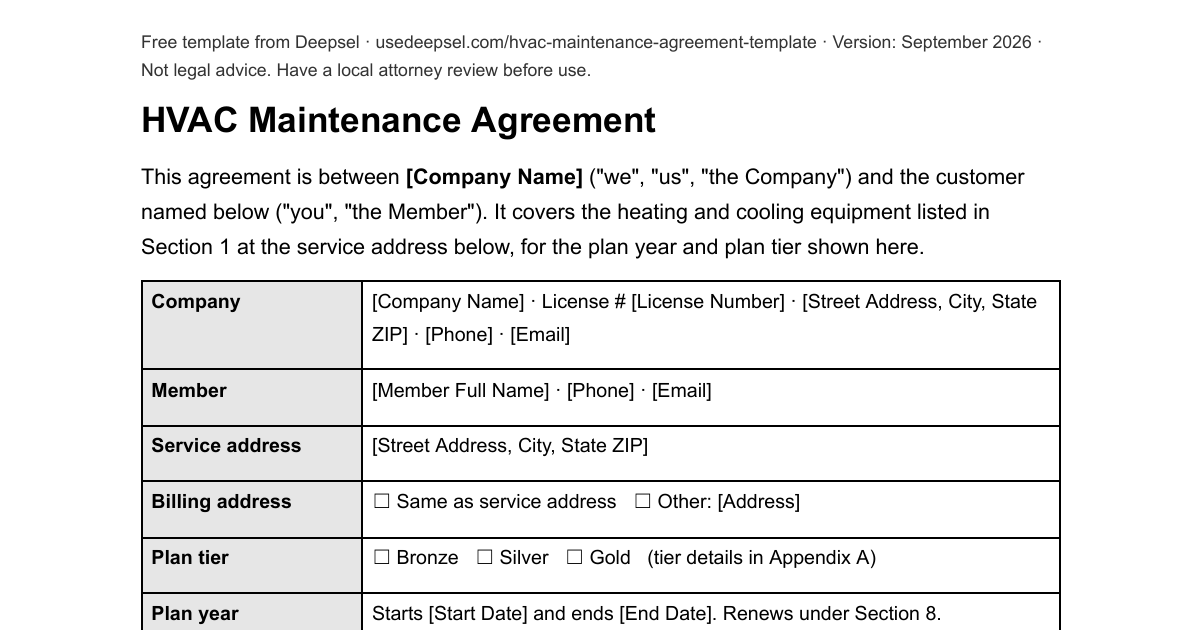
This is a free HVAC maintenance agreement template (the same document some shops call a service contract, service plan or membership) written for shops with one to four trucks. It has the pieces the free generic templates leave out: a covered-equipment table with filter sizes, per-system scope, a visit-expiry rule that is fair to both sides, card-on-file consent, a 30-day renewal notice, and a state-law appendix. Ten pages, plain English.
Get it three ways: make your own copy in Google Docs (one click, opens in your Drive), download the Word version (.docx), or download the PDF. You can also read it in Google Docs first without copying anything. Want to compare it with the other free templates before you pick one? I reviewed eight of them, mine included, in the best free HVAC maintenance agreement templates.
No form, no follow-up email. I built this because the free templates that rank for this search are either independent-contractor forms with "HVAC" pasted in, or two-page checkbox sheets attached to a software pitch. Neither one says what happens when a customer has two systems and a plan for one, or when a paid tune-up never gets booked. Those two gaps generate most of the disputes I read about while researching maintenance programs, so the template answers both in writing.
What should be included in an HVAC maintenance agreement?
An HVAC maintenance agreement should list the covered equipment by serial number, state how many visits are included and when, say who books them, define the repair discount and priority service, set the price and billing method with card-on-file consent, and spell out renewal, cancellation and refunds. Each clause below prevents a specific argument I found in complaint records and contractor forums.
Covered equipment schedule, with filter sizes
Section 1 is a table: unit number, type, make, model, serial, location, filter sizes and UV bulb type, four rows. An agreement is attached to equipment, not to a house, and the serial is what makes that true on paper. The filter column is there for the tech. If sizes are on file, the truck arrives with the right filter; if not, someone calls the customer to go read the label. A contractor on r/hvacadvice put the whole design rule in one line when a new owner asked how to write his first agreement: "list all equipment covered by serial number or unit number."1
Scope: only the systems listed
Section 2 says the benefits apply only to the listed systems, and gives a per-system price for adding more. Multi-system homes are the classic dispute. In a thread about service agreements on r/HVAC, the top-voted advice was blunt: "If they have multiple systems, make sure they know the benefits only apply to the system in the contract. People really seem to have a hard time figuring that one out."2 The template makes the customer initial a table instead of remembering a conversation.
Visits owed, and who books them
Section 3 sets the visit count (two per system by default), the season windows, a checklist of what a visit includes, and then the part every other template skips: booking responsibility, stated both ways. The company promises at least three logged booking offers per season by text or email. The member can book at any time without waiting. "We'll call you" is the promise that breaks first. A CSR in the same r/HVAC thread called it "a trap": when the phones fill with breakdown calls, "you're not getting to everyone."2 Putting the member's booking link in the contract shares the job.
When a paid visit expires
Section 4 is the clause I'd defend hardest. A paid visit expires at year end only if the company made those three documented offers and the customer still didn't book. Fewer than three offers, and the visit carries over 60 days. Compare that with the standard office line in complaint responses, "unused services are not refundable after expiration when they were available but not scheduled,"3 which is fair if the shop tried and unfair if it didn't. One BBB complaint against a plan billed for years reads: "Only one tune-up was ever performed (in 2021). No services were performed from 2022 to 2025."4 The three-offer log is what lets a shop prove it isn't that shop.
Repair discount, and no surprise clawback
Section 5 sets the discount (10 percent in the example, 15 on higher tiers), lists what it doesn't apply to, and settles the clawback question. Discounts already given stay given, with one exception: cancel within 90 days of a discounted repair and the shop may add that one discount back, up to a cap. The alternative, which I've seen in complaint files, is a cancellation where "prior savings applied" get netted against the refund until "a negative total remains."5 That's a customer who tells the story for years.
Priority service, defined honestly
Section 6 defines priority as a place in line ahead of non-members, "not a guaranteed response time," and says out loud that during a heat wave the shop may still be booked out for days. Every plan promises priority; almost none define it. The undefined version is what the angry calls in July are about.
Payment: monthly card on file by default
Section 7 defaults to monthly card-on-file billing with an annual option, includes the consent sentence auto-renewal laws expect, and writes the failed-payment path into the contract: two retries over 14 days, a text or email each time, benefits pause after 30 days, and never a silent cancellation. The renewal math behind the default is the biggest number on this page: manual annual renewals convert at 40 to 50 percent, card-on-file plans at 80 percent or better.6 Top operators on monthly billing clear 90 to 95.7
Term, renewal and cancellation
Section 8: one plan year, auto-renews, renewal notice at least 30 days out stating the price and how to cancel, price increases only after notice, cancellation by email or text with written confirmation in five business days, no cancellation fee, and a plain refund rule for annual plans (unperformed visits refunded at a stated per-visit amount). Section 8.6 points at the state notes. This is the section the free templates get most wrong: eForms has no renewal clause at all, and ServiceTitan's checkbox form has one line.
Exclusions, liability and general terms
Sections 9 through 11 cover what isn't included (repair parts, refrigerant beyond the check, duct work, code upgrades, pre-existing problems documented at the first visit), a 30-day workmanship warranty, a liability limit that excludes the shop's own negligence, what happens when the customer sells the house, and a disputes clause that starts with a 15-day fix-it window. One template in the top ten disclaims liability "including but not limited to property damage, personal injury, or death." I didn't copy that. A clause a judge would strike is worse than no clause.
How much should an HVAC maintenance plan cost?
Most residential HVAC maintenance plans cost $150 to $300 per system per year for the standard two-visit tier, with monthly billing at roughly a twelfth of that.8 Consumer guides put the same band in front of homeowners, so pricing inside it meets expectations.9 Appendix A of the template ships with example tiers you replace with your own:
| Benefit | Bronze | Silver | Gold |
|---|---|---|---|
| Visits per system per year | 2 | 2 | 2 |
| Repair discount | 10% | 15% | 15% |
| Diagnostic fee | Standard | Waived, business hours | Waived, all hours |
| Standard 1-inch filters | Member provides | Included | Included |
| Example price per system per year | $179 | $249 | $329 |
| Or per month, card on file | $16 | $22 | $29 |
| Each additional system | $129 | $179 | $229 |
Two public comparisons for calibration. Relay's template guide uses $179, $269 and $429 a year for its three tiers, and LeadDuo's runs $149 to $449 per unit.10, 11 My middle tier sits under both on purpose; a one-to-four-truck shop wins on trust and speed, not on being the priciest club in town.
Now the math that decides whether the plan makes money. Divide the annual price by the visits in it. A $249 Silver plan with two visits is $124.50 per visit. Load a visit honestly: an hour and a half of tech time, drive time, the filter, dispatch, the truck. If that lands at $110, the visit clears $14.50 and the plan is a marketing cost that pays off through the repair leads it finds and the renewal it keeps. That's a fine business, as long as you know that's the business. Relay's guide runs the same exercise and lands near "$134 of delivered cost per visit" on a $269 plan, which is break-even.10 The additional-system price is where the margin lives, because the second unit adds twenty minutes to a visit the truck already made.
How many should you have? The trade benchmark is about 250 agreements per $1 million of service revenue.12 A two-truck shop doing $700,000 is healthy at 150 to 200. Past that, the program stops being a side task for whoever answers the phones, which is where the last section of this page comes in.
Maintenance agreement, service contract, service plan, comfort club: same document
They're all this document. Contractors say "maintenance agreement" and "service agreement"; the legal-template sites say "HVAC service contract"; software vendors say "service plan" or "membership"; a few shops brand theirs a comfort club. The clauses don't change with the name. What does change is the reader's expectation. "Contract" reads as legal to a homeowner, "plan" reads as a subscription, and "membership" reads as a club with perks. The template is titled "HVAC Maintenance Agreement" and you can retitle it in one edit.
One naming trap: a "preventive maintenance agreement" for a commercial building is a different animal, with multi-site equipment schedules, net-30 invoicing and response-time promises. This template is the residential one. Use the commercial variant for rooftop units and property managers.
Auto-renewal language and state law
An auto-renewing plan billed to a card on file needs four things in most states that regulate it: clear disclosure of the renewal terms before signup, the customer's affirmative consent to the recurring charge, a reminder before renewal, and a cancellation path as easy as signup. Sections 7 and 8 of the template are written to those four. Appendix B tells you which states to check first.
The states. A June 2026 article by SmartAC with Next Era Legal lists California, New York, Massachusetts, Minnesota and Virginia as states that recently updated their auto-renewal laws, and notes that enforcement now focuses on unclear disclosures, hard cancellations and surprise charges.13 A separate 50-state guide adds Colorado, whose one-step online cancel rule took effect in February 2026 with penalties up to $20,000 per violation, and notes Minnesota's limit on the save offers you can show someone who's cancelling.14 Other states have older statutes. The federal FTC rule that would have covered all of this was vacated in July 2025, so the state list is the one that matters.13
Florida is different, and it bites prepaid annual plans specifically. Florida's service warranty statute treats a maintenance service contract as a regulated "service warranty" if it's written for a year or longer, or gives a parts-and-labor discount over 20 percent, or includes indemnification. Regulated means a license and financial requirements under Chapter 634.15 That's why a Florida contractor on r/ProHVACR wrote: "I can't even do a maintenance contract that is a full year. Has to be a day short of a year. Or I would have to escrow."16 The template's page-1 End Date and Section 5 discount are the two fields a Florida shop sets with that in mind.
Does a lawyer have to be involved? That question opens the r/hvacadvice thread I quoted earlier, from an owner doing handshake maintenance who wanted to write it down. The answer he got was "No lawyers needed, just keep the agreement very simple and clear."1 I agree with the spirit and I'd add one hour. Pay a local attorney to read Appendix B against your state before you bill the first card. It costs $200 to $400 and it's the only line item in this whole program that I'd call non-optional in California, New York or Florida.
After it's signed: running the program
The template starts a program. It doesn't run one. Once you have 40 or 50 signed agreements, three jobs repeat forever: charge the renewals and chase the failed payments, get every member's spring and fall visits booked, and keep a ledger of visits owed versus delivered so nobody's prepaid tune-up expires in silence. Section 4 of the template is a promise to keep that ledger, and Section 7 is a promise to chase every failed card. Both promises need a system behind them.
Start with the free maintenance agreement tracking spreadsheet: one row per agreement, the same equipment and filter columns as Section 1, both visits, and formulas for visits remaining and days to renewal. The agreement is the contract; the sheet is the ledger. The reasoning behind every column is in how to track HVAC maintenance agreements. Run with discipline, the sheet holds to about 80 to 100 agreements.
Above that, the renewal number decides it. Moving from asking for renewals to charging a card on file is the 40 to 50 percent versus 80 to 95 percent swing from earlier,6, 7 and at 200 agreements on a $249 plan that swing is worth more than $15,000 a year. That's the job Deepsel does. It keeps the ledger from Section 1 and Section 4, charges the card on the schedule in Section 7 with retries and a text on failure, sends the season booking links Section 3.4 promises, and warns you before a paid visit expires. It works beside Jobber or Housecall Pro rather than replacing them: import your customer list on Starter, or sync jobs both ways with Jobber on Pro. Pricing is flat and public on the pricing page.
14-day free trial. No credit card required.Frequently asked questions
What is the $5,000 rule for HVAC?
It's a repair-or-replace rule of thumb for homeowners, not an agreement term. Multiply the system's age in years by the repair quote. Over $5,000, replacement usually makes more sense; under it, repair. A 12-year-old unit with a $500 repair scores $6,000, so the rule points to replacing (CBS News walks through that example, source 17 below). Members ask about it at the kitchen table, so the tune-up report in Section 3.3 is a good place to show the math.
Can I legally write my own maintenance contract?
Yes. A maintenance agreement is an ordinary service contract, and nothing requires a lawyer to draft it. Two things do need a local check: automatic renewal rules if you bill a card on file (California, New York, Massachusetts, Minnesota, Virginia and Colorado have updated theirs), and Florida's service warranty statute, which regulates plans of a year or longer or with a repair discount over 20 percent. Appendix B in the template lists both, and an hour of attorney time covers them.
Are maintenance agreements worth it for contractors?
Yes, when the visits get delivered and the renewals get collected. Trade benchmarks put a healthy program at about 250 agreements per $1 million of service revenue, and the visits fill the spring and fall weeks when breakdown calls dry up. The margin per agreement is thin, so the money is in renewal rate: manual renewals convert at 40 to 50 percent, card-on-file plans at 80 percent or better.
Is there a Word, Excel or Google Docs version?
Google Docs and Word, yes: use the one-click copy link for Docs or download the .docx. Both hold the full text, tables and appendices. There is no Excel version of the agreement, because a contract belongs in a document. The Excel-shaped part of running a program is the ledger of who is due and what is owed, and that is a separate free download, the maintenance agreement tracking spreadsheet.
Sources
- r/hvacadvice, "Service Contract/Maintenance agreement?'s" - owner asks "Does a lawyer have to be involved?"; replies "No lawyers needed, just keep the agreement very simple and clear" and "list all equipment covered by serial number or unit number." reddit.com, November 13, 2025, read September 5, 2026.
- r/HVAC, "service agreement" - "If they have multiple systems, make sure they know the benefits only apply to the system in the contract. People really seem to have a hard time figuring that one out" and, from a CSR, "'We Will Call You For Tune Ups' is a trap." reddit.com, December 18, 2023, read September 5, 2026.
- Better Business Bureau complaint file, Conditioned Air (Naples, FL), business response - "unused services are not refundable after expiration when they were available but not scheduled." bbb.org, May 4, 2026.
- Better Business Bureau complaint file, Aire One Heating & Cooling KW - "Only one tune-up was ever performed (in 2021). No services were performed from 2022-2025." bbb.org, October 6, 2025.
- Better Business Bureau complaint file, Harrington Air Conditioning (Pinellas Park, FL) - plan cost $575.00, cancellation fee 25%, "prior savings applied" netted against the refund until "a negative total remains." bbb.org, February 25, 2024.
- Smart Service, "How Much to Charge for HVAC Service Agreements" - "Monthly auto-pay or annual auto-renew with explicit opt-out language drives 80%+ renewal rates. Manual annual renewal processes drop to 40-50%." smartservice.com, retrieved June 2026.
- Pipeline, "Contractor membership program" - "top operators clear 90-95% on monthly auto-billed plans vs 75-80% on annual renewals." pipelineon.com, June 2026.
- Smart Service, same article - "Residential basic plans: $150-$300/year. The standard two-visit residential tune-up tier. Most businesses price this $175-$250." Corroborated by Profitability Partners, "priced at $150 to $250 per year," profitabilitypartners.io, June 2026.
- Angi, "How Much Does HVAC Maintenance Cost? [2026 Data]" - service contracts "range between $150 and $300 per year." angi.com, updated July 9, 2026.
- Relay, "HVAC Service Contract Template: Build Plans That Hold Margin" - tiers at $179, $24/month or $269, and $39/month or $429 per year; "A $269 annual plan with two visits in it has to cover roughly $134 of delivered cost per visit." relayfi.com, May 20, 2026, read September 5, 2026.
- LeadDuo, "HVAC Maintenance Agreement Template (2026)" - "Most residential HVAC maintenance agreements are priced at $149-$449 per unit per year depending on tier." leadduo.io, read September 5, 2026.
- FieldEdge, "HVAC service agreement programs" - "Target '250 service agreements per $1 million in service revenue.'" fieldedge.com, retrieved August 2026.
- SmartAC with Eric Proos, Next Era Legal, "Auto-Renewal in HVAC Maintenance Contracts" - states that updated their auto-renewal laws: California, New York, Massachusetts, Minnesota, Virginia; the FTC's 2024 rule "was vacated by a federal appeals court in July 2025." smartac.com, June 30, 2026, read September 5, 2026.
- Churnkey, "US state automatic renewal laws" - Colorado SB25-145 one-step online cancel effective February 2026, penalties to $20,000 per violation; Minnesota limits save offers; Virginia's easy-cancel rule from July 1, 2026. churnkey.co, read September 5, 2026.
- Florida Statutes 634.401 (definitions, service warranty associations) - "Service warranty" includes a "maintenance service contract equal to or greater than 1 year in length or which does not meet the exemption in paragraph (a)"; the exemption covers "maintenance service contracts written for less than 1 year which do not contain provisions for indemnification and which do not provide a discount to the consumer for any combination of parts and labor in excess of 20 percent." flsenate.gov, 2024 statutes, read September 5, 2026.
- r/ProHVACR, "Labor Warranty" thread, comment by a Florida contractor - "I can't even do a maintenance contract that is a full year. Has to be a day short of a year. Or I would have to escrow." reddit.com, May 15, 2025, read September 5, 2026.
- CBS News, "What is the $5,000 rule for HVAC systems?" - age times repair cost; "Multiplying 12 by 500 gives you $6,000." cbsnews.com, June 24, 2026.