Free lawn care and landscaping contract template: a simple mowing contract and a full maintenance agreement, in Google Docs, Word and PDF
- Free. The files come by email.
- Deepsel is our product. It's free estimate, invoice and scheduling software for home-service contractors, landscaping included, and the section before the FAQ says where it does and doesn't fit a lawn route.
- Not legal advice. Have a local attorney read the template before you use it, especially Appendix B.
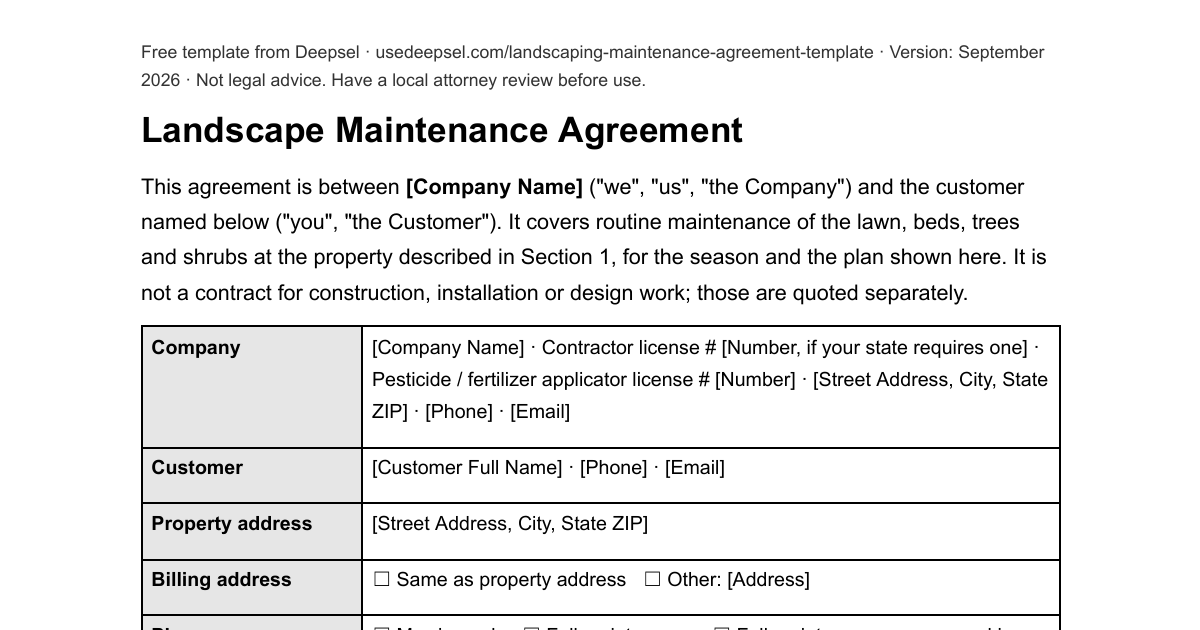
This is a free lawn care and landscaping contract template for lawn and landscape companies running one to four crews, and it comes in two sizes. A mowing-only customer gets the simple lawn mowing contract: season dates, how often you come, a per-cut, monthly or season price, the rain rule, priced add-ons and a 7-day way out. A customer on a full plan gets the landscaping maintenance agreement (some call it a landscape maintenance contract or a landscaping service agreement), built around a seasonal scope table instead of a paragraph of promises. That one also settles the four things generic contracts skip: what a rained-out week costs, whether the crew gets paid when the gate is locked, what happens to a plant that dies, and how the plan renews each spring. Plain English, with a snow and ice appendix.
Get it three ways: make your own copy in Google Docs (opens in your Drive), download the Word version (.docx), or download the PDF. Pick a format, enter your email and I'll send the links. It's the landscaping version of my HVAC maintenance agreement template, and the same clauses that hold up for tune-ups hold up for mowing routes.
Both contracts are in the same file. The mowing contract is Appendix D, two pages you can print and use on their own, and the rest of the file is the full agreement. I wrote the long version first, because when I started, the top result for "landscaping maintenance agreement" was the California Landscape Contractors Association's Form 104, an attorney-reviewed form last revised in June 2025 that does two things well (it auto-renews for an equal term on 30 days notice, and it charges 18 percent a year on late payments) and then leaves you alone with three pages of legalese and no guidance.1 Below it sat the independent-contractor forms with "landscaping" pasted into the blanks. None of them said what a rain week costs.
What should a lawn care contract include?
A lawn care contract should name the property and the areas you cut, give the first and last cut of the season, say how often you come, and pick one way to charge: per cut, monthly or a season price. Then it settles what a rained-out or drought week costs, lists the add-ons with prices, says who's licensed to put down fertilizer and weed control, and says how prices change and how either side gets out. Appendix D puts all of that on two pages. A mowing contract needs a few lines the full maintenance agreement doesn't, and handles others more simply, so here's each one.
Per cut, monthly or a season price
This line decides most of the others. Take the template's quarter-acre example: about 28 cuts from mid-April to mid-November, at $50 a cut.
| How you charge | What the customer sees | The example, worked | Who carries a wet or dry year |
|---|---|---|---|
| Per cut | A bill after each cut, or one a month for that month's cuts | $50 × the cuts done; all 28 = $1,400 | You. No cut, no charge. |
| Monthly | The same charge each month of the season | $1,400 ÷ 8 months = $175 a month, April to November | Shared. The price assumes 2 weather skips; each one past that is a $50 credit. |
| Season, paid up front | One payment in spring | $1,400 less 5% = $1,330 | Mostly the customer. Cancel early and the cuts not done come back at $50 each, less the discount. |
Per cut is the easiest sell to a new customer and the hardest to run. Every rained-out week is revenue gone, and a 28-cut season is 28 bills unless you batch them monthly. Monthly pricing levels your cash flow, and a dry July still pays the crew. That's why the full agreement defaults to it. The catch is that monthly only holds up if the contract says what happens when weather takes more than two visits; leave that out and you'll argue about it in September. A season price paid up front is the cleanest of the three, and the 5% off is what the customer gets for carrying the risk.
In Deepsel, the weekly mow is a recurring job series on every plan, Free included, and you can bill the series per visit, with an invoice made from each finished cut. Monthly charges to a card on file are the service plans module on Pro. It bills every month of the year, so a season price goes in as 12 equal payments rather than 8. If you'd rather bill by hand, the free landscaping invoice template covers the per-cut bill.
When the season starts and ends
Write dates, not "spring to fall." The template uses on or about April 15 for the first cut and November 15 for the last, with a box for the other way to do it: start when the grass reaches 3 inches and stop when it stops growing, with both dates sent by text. Dates matter most on a monthly plan, because they fix how many payments there are. They also settle the first cut of the year. Grass that has grown past 6 inches takes longer, so Appendix D bills that first cut at 1.5 times the visit price, the same rule as Section 3.3 of the full agreement.
Skipped cuts in rain and drought
Rain moves the cut to the next dry working day. A whole lost week is skipped, with no double cut. On a per-cut contract that's the end of it, since a cut you didn't make isn't billed. On a monthly or prepaid contract the price assumes two weather skips a season, and each skip past two is credited at the per-cut price on the last bill. Drought runs the other way: Appendix D lets you drop to every 14 days when the grass stops growing, with a text first. Customer skips work the same way on every option. Tell the crew by 5 pm the day before and the visit is skipped free (up to two a season on a monthly or prepaid price); a locked gate or a dog in the yard with no warning is billed as done.
Leaf cleanup and other add-ons
A mowing contract covers mowing. Spring cleanup, fall leaves, hedge trimming, aeration and the overgrown first cut are add-ons, priced in the contract or quoted before you do them, so a $150 leaf visit isn't a surprise on a $50-a-week customer's bill. Leaves are the add-on that starts the most arguments, because customers think of the fall cleanup as the last few mowing visits. The landscaping estimate template is a good way to send those prices before October. On the full agreement, the add-ons are rows in the Section 3 scope table instead.
Fertilizer and weed control: who's licensed
Weed control is a pesticide application, and the EPA notes that many states require every commercial applicator to be certified, not only those using restricted-use products.20 Some states license fertilizer too: Florida requires a state certification before you put any fertilizer on a residential lawn for pay.19 So the contract names who applies products and under which license number, or ticks "not offered: we mow only." If you subcontract the rounds, put the subcontractor's number in. What each state asks for is in lawn care business license requirements by state, and Maryland's version is worked through in Maryland pesticide business license.
Price changes and cancellation
The price holds for the season. A new price for next season goes out in writing by February 1 and only applies if the customer stays. Either side can end a mowing contract with 7 days notice by text or email, which is shorter than the full agreement's 30 days because there's less to wind down. The customer pays for the cuts done. A prepaid season gets a refund for the cuts not made, at the per-cut price, minus the discount, within 30 days. Ticking "continues next season" turns it into a renewing plan, so if you bill a card on file, read Appendix B on automatic renewal laws first.
What should a landscaping maintenance agreement include?
A landscaping maintenance agreement covers a full plan, not only the mowing. It should describe the property and what's marked on it, list every service with its season window and frequency, state the rain and skipped-visit rule, say who pays for a plant that dies, set the price and the monthly billing method with card-on-file consent, and spell out how the plan renews each season and how either side cancels. Each clause below answers an argument I found in contractor forums and company terms.
A property schedule, not an equipment list
Section 1 is a table: turf area and grass type, beds and mulch, shrubs and small trees, irrigation zones, gate codes, dogs, and a row I'd call the most valuable one in the file: "mark these before the first visit." Invisible fence wire, low-voltage lighting, drip lines, septic lids. Items not marked are excluded from damage claims, which is fair because a crew can't avoid what it can't see. One company's terms list 30-odd things it won't cover, from bird baths to trampolines, and end with "any item hidden in the landscape and not clearly marked."2 A marking row at signup gets the same protection with less reading.
The seasonal scope table
Section 3 is the contract. Ten rows: spring cleanup, the weekly mowing visit (mow, trim, edge every second visit, blow), bed care, shrub trimming, the fertilization program, mulch, irrigation startup and winterization, aeration, fall leaf removal, and snow. Every row has a window, a frequency and a checkbox for "Included" or "Add-on at $X." The customer initials a table instead of remembering a conversation. CLCA's form does a version of this with an Exhibit A where both sides initial fertilization, pest control and lawn renovation as in or out,1 and it's the best idea in that document, so I kept it and added dates.
The rain and skip-visit rule
Section 4 is the clause I'd defend hardest. A rained-out day moves to the next dry day. A whole lost week is skipped, with no double cut and no double charge. The season price assumes two weather skips; beyond that the customer gets a per-visit credit or make-up visits. And when the crew can't get in (locked gate, dog out, cars on the lawn), the visit is billed as done unless the customer told you by 5 pm the day before, with two free customer skips a season.
That last rule is industry standard and almost never written down. When a renter asked r/landscaping whether they should pay for a mowing day lost to a roofing crew, the top answer with 126 upvotes was: "They still had to make the drive and bring everything to do the job. It's on you to inform them they would not be able to do the job this week and schedule it for another time. You should pay."3 And when an owner asked how to handle customers who cancel week after week, one commenter's whole answer was "Include two cancellations per year (bake those into the price)."4 Section 4.4 does exactly that.
Plants: maintained, not guaranteed
Section 5 says it in one line: we maintain your plants; we do not guarantee them. Weather, disease, grubs, salt, drainage and a customer who never waters are not the crew's fault. Plants you install under a separate quote get a one-season warranty if they were watered as instructed, which matches what established companies offer (one Midwest firm's Michigan terms warrant installed plants for a year, excluding annuals and transplants).5 Damage the crew causes to the house, the hardscape or marked items is yours to fix, reported within seven days.
Monthly billing on a card, with a failed-payment path
Section 7 splits the season price into 8 monthly payments (or 12 equal ones all year), charged to a card or bank account on file, with the consent sentence automatic renewal laws expect, an invoice option due in 10 days, and a discount for paying the season up front. It also writes down what happens when a charge fails: two retries over 14 days, a text each time, service pauses after 30 days, and never a silent stop. The forum consensus has moved the same way. The top advice in that cancellations thread was "Make a subscription model that auto bills each month for 4 weekly cuts for $100 (or whatever you choose), or offer 'as needed' cuts for $32."4 Two prices, one of them on autopay, and the a-la-carte one visibly higher.
Per-season renewal with notice
Section 8 renews the agreement each season, the way the route needs it to. By February 1 the customer gets next season's price and start date; silence by March 1 keeps their spot; a price increase applies only after the notice; and either side can cancel any time with 30 days notice, no fee. Compare CLCA's "automatically renew for another equal term unless notice… at least thirty (30) days prior"1 and a common company version, "unless either party serves written notice… by January 1st, this contract shall automatically renew," with an 8 percent annual increase baked in.5 Both work. Mine adds the notice with the number in it, because the states that regulate auto-renewal now expect one, and because a customer who was told the price in February doesn't argue about it in April.
How much should a lawn care or landscaping contract cost?
For a standard quarter-acre lot in 2026, a weekly mowing visit runs $45 to $90 and most quarter-acre lots land at $50 to $55 per visit; full-service maintenance runs $100 to $410 a month depending on what's bundled.6, 9 Appendix A of the template ships with three example plans built from the benchmarks below. Replace them with your own numbers.
| Service (quarter-acre lot unless noted) | 2026 benchmark | Source |
|---|---|---|
| Weekly mowing visit (mow, trim, edge, blow) | $45 to $90; quarter-acre lots $50 to $55 | Housecall Pro, July 20266 |
| Mowing by lot size | Up to 1/4 acre $41 to $61; 1/2 to 1 acre $59 to $114; 1 to 2 acres $99 to $264 | LawnStarter, September 20267 |
| Monthly-only service, per visit | 50 to 80 percent more than the weekly rate | GreenPal, 20268 |
| Full-service lawn care, per month | $100 to $410 | GreenPal, 20269 |
| Fertilization, per application | $50 to $150 (3 to 4 rounds a year); $67 to $405 by lawn size | Today's Homeowner; LawnStarter10, 11 |
| Spring or fall cleanup | $150 to $300; average job $174 | Today's Homeowner; LawnStarter, July 202610, 12 |
| Sprinkler winterization | $59 to $144; $50 to $75 for 1 to 2 zones | LawnStarter, December 202513 |
| Snow removal | $30 to $75 per visit; seasonal $350 to $600 | Housecall Pro, March 202614 |
Now the math that decides whether a plan makes money. Divide the season price by the visits in it. The template's mowing-only example is $1,400 for the season, billed at $175 a month for eight months, on about 28 visits: $50 a visit. Load a visit honestly: two people for 25 minutes, drive time between stops, fuel, the mower's hourly cost, dump fees if you haul. If that lands at $38, the mow clears $12 and the plan is a route-density play. The margin lives in the add-on rows (a $175 spring cleanup, four $70 fertilization rounds, two $150 leaf visits) and in how many stops share a street. The full-maintenance example is $2,600 a season, $325 a month, and it's the plan you want most customers on, because every add-on row is already sold.
One number to watch in the benchmarks: monthly-only mowing costs 50 to 80 percent more per visit than weekly, because tall grass takes longer.8 Section 4.3 of the template handles the opposite case, drought, by moving to every 14 days and using the visit for bed care instead of cutting grass that isn't growing.
Seasonal scope: what changes between April and November
A lawn route is ten different jobs spread across eight months, and the contract should read like the calendar does. This is the Section 3 table with the example dates filled in for a northern climate; move the windows for yours.
| Service | Window | How often | Mowing only | Full maintenance |
|---|---|---|---|---|
| Spring cleanup (winter debris, cut back perennials, re-edge beds, first mow) | March 15 to April 30 | 1 visit | Add-on | Included |
| Mowing visit (mow, string-trim, edge every 2nd visit, blow) | April 15 to November 15 | Every 7 days, about 28 visits; every 14 in drought | Included | Included |
| Bed care (weeding, spent blooms, light shaping) | Growing season | Every 2nd mowing visit | Add-on | Included |
| Shrub and hedge trimming, under 8 ft | June and September | 2 visits | Add-on | Included |
| Fertilization and weed control | Early spring, late spring, summer, fall | 4 rounds | Add-on | Included |
| Mulch top-dress, 2 inches | April to May | 1 visit | Add-on per yard | Add-on per yard |
| Irrigation startup, mid-season check, winterization | April, July, October | 3 visits | Add-on | Included |
| Core aeration, with overseeding | September to October | 1 visit | Add-on | Add-on |
| Fall cleanup and leaf removal, final cut | October 15 to December 1 | 2 visits | Add-on | Included |
| Snow and ice (Appendix C) | December 1 to March 31 | Per 2-inch trigger | Not offered | Add-on or "Full + snow" plan |
Snow gets its own appendix because it's a different contract wearing the same signature. Appendix C sets the trigger depth (2 inches in the example), the areas cleared, a finish target after the snow stops, per-push or seasonal pricing with a cap on included pushes, what ice control costs, and what isn't covered (roofs, refreeze after the crew leaves, slip-and-fall once the property has been treated). The last line says the trade out loud: a quiet winter and the seasonal price stays; a brutal one and the extra pushes are billed. Written in September, it saves a phone call in March.
Appendix C assumes the snow customer is already a summer customer. If you sell snow on its own, or to commercial lots, the standalone snow removal contract template fits better, and snow removal pricing works out the per-push and seasonal numbers before you fill in the price row.
Pricing the rows that aren't mowing: lawn care pricing works out a price per application for the fertilization and weed control rounds as well as the season price for mowing, and irrigation pricing covers the service call, the hourly rate and per-zone work. The irrigation row's spring start-up and fall blowout are step by step in the sprinkler blowout and start-up checklist. In Maryland, putting down the weed control and fertilizer rounds yourself takes state licenses on top of this contract; they're in Maryland pesticide business license: what it covers and your first 30 days.
After it's signed: billing and renewals without chasing
The template starts a program. Running it is three jobs that repeat for as long as the plan exists: charge the monthly payments and chase the failed cards, send the renewal notices in February and log who answered, and keep a count of visits delivered versus visits the season price promised, so a wet year's credits are right and a customer who cancels in July gets the right refund. Section 4 and Section 8 are promises to keep that count.
Start without buying anything. Sign the agreement, run the shop on Deepsel Free (scheduling and dispatch, quotes, invoicing, card payments, and customer and equipment records, with 30 estimates and 30 invoices a month for your whole team), and keep the plan book in the free maintenance agreement tracking spreadsheet beside it. It was built for HVAC tune-ups, but the columns are the same problem: one row per customer, plan and tier, start and renewal dates, payment method, and visit counts with formulas for what's still owed and how many days until renewal. Rename "visit 1" and "visit 2" to "cleanup" and "leaf removal," or count mowing visits in the notes column. The property schedule in Section 1 goes on the customer's record in Deepsel, so the gate code and the marked items are typed once. The reasoning behind every column of the sheet is in how to track HVAC maintenance agreements. A sheet holds a small book fine.
You outgrow the pair when the shop sends more than 30 estimates or 30 invoices a month, or the hand-work starts eating the office's week. Here's the honest part. Deepsel is free estimate, invoice and scheduling software for home-service contractors, landscaping included: scheduling, quotes, invoicing and card payments at one price with no per-user charge, replacing Jobber or Housecall Pro. The weekly mow is not a plan visit: the mowing weeks run as a recurring job series, set once on the job, on every Deepsel plan, Free included. The plan visits are the seasonal rows in Section 3, the spring cleanup, the fertilization rounds and the fall leaf visits, plus the snow add-on. Those run in the service plans module on Pro at $29 a month with unlimited estimates and invoices: it keeps the ledger of visits owed against delivered that Section 4 promises, charges the card on file every month from the day the plan starts (a customer who pays outside the app instead gets an email with the amount and due date before each period and a past-due notice if it's late, and you record the payment), retries a failed card, updates a reissued one, emails the customer and flags the office when it still fails, sends the Section 8 renewal notice with the price in it, sends a reminder by email when a covered visit comes due, on wording and a schedule you approve, and warns you and the customer before a paid visit expires. Renewals someone has to ask for convert at 40 to 50 percent, while card-on-file plans renew at 80 percent or better,15, 16 and the module does that charging itself. The sheet's customers import in one upload, and each plan is set up once in the module. Deepsel has no route optimization. Import your customer list from Jobber or Housecall Pro. Pricing is public on the pricing page; the free plan covers the scheduling and invoicing, and the plan billing is on Pro. Other trades: commercial HVAC, septic, plumbing and electrical versions of the same master file, a pool service agreement template for weekly pool routes, and a review of seven free HVAC maintenance contract templates if you want to see what the generic forms leave out.
Free up to 30 estimates and 30 invoices a month, then $29 a month for your whole team. No credit card required.Frequently asked questions
Is there a simple lawn care contract in the template?
Yes. Appendix D is a short lawn mowing agreement that stands on its own: property, season dates, how often, a per-cut, monthly or season price, the rain and skip rule, priced add-ons, who applies fertilizer and weed control, price changes and a 7-day cancellation. Use it for a mowing-only customer and keep the full agreement for customers on a seasonal plan with cleanups, fertilization and irrigation.
Should I bill landscaping customers monthly or per visit?
Monthly, for anything on a route. A season price split into 8 or 12 equal card-on-file payments gives you level cash flow, one charge to run instead of 28 invoices, and a customer who has already decided to keep you. Per-visit billing keeps every week open to a cancellation, which is the complaint that fills lawn-care forums every July. The template defaults to monthly on a card, with an invoice option and a discount for paying the season up front.
What happens if it rains on the mowing day?
The visit moves to the next dry working day. If the whole week is lost, that visit is skipped, and there is no double cut and no double charge. The season price in the template assumes up to two weather skips; if a wet year forces more, the customer gets a per-visit credit on the last invoice or the same number of visits added at the end of the season. Writing the number down is what stops the argument in September.
Can a landscaping contract renew automatically each season?
Yes, and most professional contracts do. The California Landscape Contractors Association form renews for an equal term unless the customer gives 30 days notice, and many companies renew unless they hear otherwise by January 1. The template sends a renewal notice by February 1 with next season's price and start date, keeps the customer's spot if nothing is heard by March 1, and lets either side cancel with 30 days notice. If you bill a card on file, check your state's automatic renewal law first; Appendix B lists the ones I know about.
Do I need a lawyer to write a landscaping maintenance contract?
Not to write it. A maintenance agreement is an ordinary service contract. Pay for one hour of local review before you bill cards on file in a state with an automatic renewal law, before you take on commercial properties or an HOA, and before your first winter of snow and ice work, where slip-and-fall exposure changes the insurance question. In California, check whether a plan over $1,000 per term needs a full home improvement contract, which is what the CLCA form warns about.
Sources
- California Landscape Contractors Association, Form 104 "Landscape Maintenance Agreement" (rev. 6/25, © 2025 CLCA) - "This Agreement shall automatically renew for another equal term unless notice of the Contracting Party's intent not to renew is given… at least thirty (30) days prior to the end of the term"; "Past due payments shall bear interest at the rate of 1 1/2 percent per month (18% per annum)"; header note that a homeowner contract over $1,000 in a single term needs a full home improvement contract; Exhibit A initials for fertilization, pest and weed control, lawn renovation. clca.org; the CLCA legal contracts page lists Form 104 as "Reviewed December, 2025." Both read September 5, 2026.
- Team Turf Landscapes, "Landscape Maintenance Terms of Service" - "There will be no credits or refunds offered as a result of rained out days"; no credits for inaccessible yards; damage exclusions ending "any item hidden in the landscape and not clearly marked"; 30-day cancellation. teamturflandscapes.com, read September 5, 2026.
- r/landscaping, "Lawn services- do you charge when you can't mow?" - top comment (126 points): "They still had to make the drive and bring everything to do the job. It's on you to inform them… You should pay." reddit.com, September 9, 2023, read September 5, 2026.
- r/landscaping, thread on customers who repeatedly cancel (original post since deleted by its author; comments live) - "Make a subscription model that auto bills each month for 4 weekly cuts for $100 (or whatever you choose), or offer 'as needed' cuts for $32" (145 points) and "Include two cancellations per year (bake those into the price)" (38 points). reddit.com, July 19, 2025, read September 5, 2026.
- Priority Landscape & Maintenance, "Michigan Landscape Maintenance Terms" - "Unless either party serves written notice with the intent to terminate the contract by January 1st, this contract shall automatically renew. Pricing will increase eight percent (8%) annually"; one-year warranty on installed plants excluding annuals and transplants; rainfall delay clause. prioritylandscape.net, read September 5, 2026.
- Housecall Pro, "How Much to Charge For Lawn Mowing: 2026 Price Guide" - "$45-$90 per visit for standard residential properties… Most 1/4-acre lots land closer to $50-$55 per visit." housecallpro.com, updated July 24, 2026, read September 5, 2026.
- LawnStarter, "How Much Does Lawn Mowing Cost in 2026?" - "$43 and $70 per visit"; by size: up to 1/4 acre $41 to $61, 1/2 to 1 acre $59 to $114, 1 to 2 acres $99 to $264. lawnstarter.com, updated September 3, 2026, read September 5, 2026.
- GreenPal, "Lawn Mowing Cost: Average Prices by Size and Region (2026)" - "$30-$85 per visit, with a national average around $50"; "A monthly mow often runs 50-80% higher than the weekly rate." yourgreenpal.com, read September 5, 2026.
- GreenPal, "How Much Does Full-Service Lawn Care Cost in 2026?" - "$100 to $410 per month"; fertilization "usually 4 to 6 per year." yourgreenpal.com, read September 5, 2026.
- Today's Homeowner, "How Much Does Lawn Care Cost? (2026)" - fertilization "$50-$150 per treatment (3-4 times per year)"; "Spring/Fall Lawn Cleanup (leaf & debris removal): $150-$300"; full-service "$150-$200 per month." todayshomeowner.com, read September 5, 2026.
- LawnStarter, "How Much Does Lawn Fertilization Cost in 2026?" - "$67 to $405 for the average-size lawn"; "$0.02 to $0.08 per square foot." lawnstarter.com, updated December 27, 2025, read September 5, 2026.
- LawnStarter, "How Much Does Yard Cleanup Cost in 2026?" - "The average cost for a yard cleanup is $174"; range $25 to $451. lawnstarter.com, updated July 13, 2026, read September 5, 2026.
- LawnStarter, "How Much Does it Cost to Winterize a Sprinkler System in 2026?" - "$59 and $144"; 1 to 2 zones $50 to $75. lawnstarter.com, updated December 27, 2025, read September 5, 2026.
- Housecall Pro, "Snow Removal Price Guide 2026" - "$30 and $75 per visit, while seasonal contracts typically range from $350 to $600." housecallpro.com, updated March 12, 2026, read September 5, 2026.
- Smart Service, "How Much to Charge for HVAC Service Agreements" - "Monthly auto-pay or annual auto-renew with explicit opt-out language drives 80%+ renewal rates. Manual annual renewal processes drop to 40-50%." smartservice.com, retrieved June 2026.
- Pipeline, "Contractor membership program" - "top operators clear 90-95% on monthly auto-billed plans vs 75-80% on annual renewals." pipelineon.com, June 2026.
- New York State Department of Health, "Neighbor Notification Law Fact Sheet" - counties that opt in require neighbors to be told "24 to 48 hours in advance of a pesticide application"; fertilizers alone are not subject to notification. health.ny.gov, read September 5, 2026. Used in Appendix B.
- Ohio Admin. Code 901:5-11-09, "Notification requirements for lawn pesticide applicators" - written product information to the customer at or before application; "Lawn posting signs must remain in place for twenty-four hours following lawn application." law.cornell.edu, read September 5, 2026. Used in Appendix B.
- Florida Department of Agriculture and Consumer Services, "Pest Control Licensing and Certification" - "All commercial fertilizer applicators must be certified by FDACS to make any type of fertilizer application to… the turf or ornamental area of any residential property," after Green Industry Best Management Practices training. fdacs.gov, read September 5, 2026. Used above and in Appendix B.
- U.S. Environmental Protection Agency, "How to Get Certified as a Pesticide Applicator" - "State, territorial, and tribal authorities certify applicators"; "many states require all commercial applicators, not only those using RUPs, to be certified." epa.gov, read November 10, 2026.