Handyman invoice template: free Excel, Word and PDF, with three sample invoices
- Free. The files come by email.
- Deepsel is our product: free estimate, invoice and scheduling software for contractors, with scheduling, quotes, invoicing, card and bank payments and a price book. The section before the FAQ says how it connects to this template.
- Not legal or tax advice. Sales tax and license rules differ by state; check yours before you rely on any line here.
A handyman invoice lists who did the work and where, each task or block of hours with its price, materials at your cost plus markup, any minimum charge or trip fee, sales tax on the lines your state taxes, deposits already paid, and the balance due. This template has a row for each, plus a License # row, an On site row for the times you arrived and left, and a Change orders row. Pages 2 to 4 are filled-in samples with the arithmetic shown: an hourly visit with a $150 minimum, a landlord's punch list priced per task, and a deck repair with materials at cost plus 20%, a trip fee, a deposit and a signed change order.
Get it five ways: make your own copy in Google Sheets (opens in your Drive) or download the Excel version (.xlsx), both with the totals worked out by formula; or, to type into or print, make a copy in Google Docs, download the Word version (.docx) or the PDF. Pick a format, enter your email and I'll send the links. Quoting the job first? The handyman estimate template is the other half, and the handyman price list has the prices these samples use.
Before building it I read the free handyman templates that rank for this search. Staxen's is the most thought through: a minimum charge field, materials listed at cost plus a stated markup, and a five-task sample that comes to $743.45, with no sales tax line.1 InvoBee's is a filled-in $483.50 service call with "Materials billed at cost" in the notes and no tax charged.2 Housecall Pro's Google Sheet lets you set a tax percentage on each line,3 and ilove-invoice.com is an online generator with discount, tax and shipping fields.4 None of the four pages shows a deposit line or a change order, and only Staxen mentions a license limit, for one state.
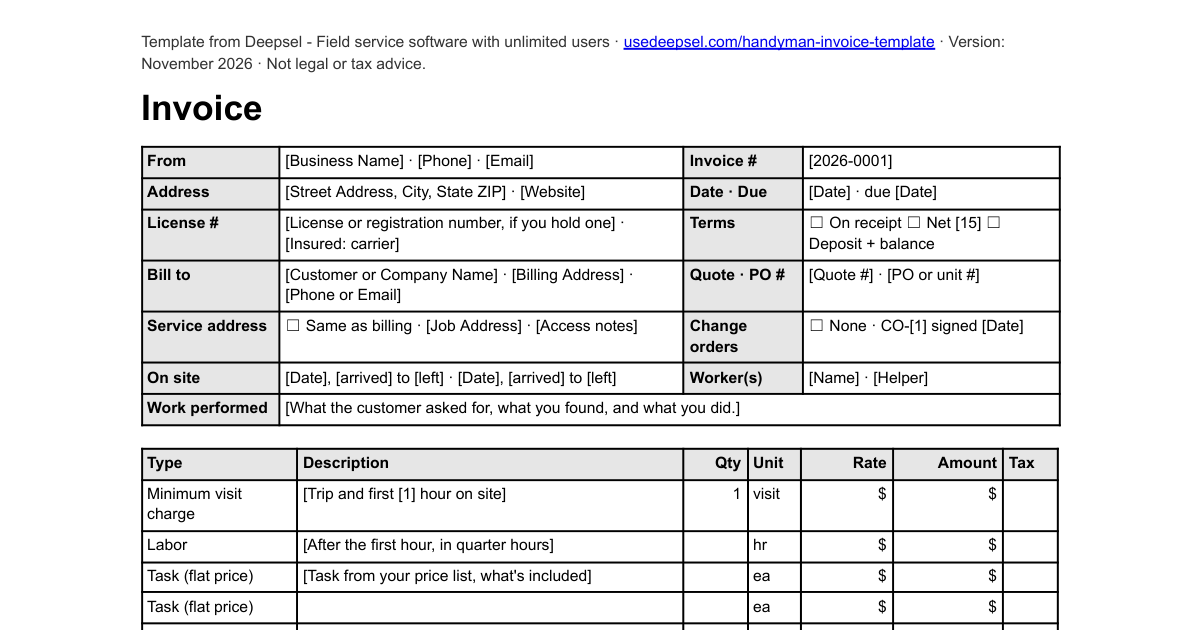
What should a handyman invoice include?
Top to bottom, these are the lines. The template has a row or a column for every one.
- Your business name, phone, email and address
- Your license or registration number if you hold one, or your insurance carrier if you don't
- An invoice number, the invoice date, the due date and the terms
- Who pays (bill to) and where you worked (service address), with the unit number for rentals
- The days and times you were on site
- One line per task, block of hours or material, with quantity, rate and amount
- The minimum charge or trip fee, when the visit has one
- Change orders, each on its own lines with its number and date
- Subtotal, sales tax on the taxable lines, total, deposits and payments received, and the balance due
- How to pay, the late fee if the customer agreed to one, and how long you guarantee the work
Your license or registration number
Few states name the invoice outright, but some come close. New Jersey tells home improvement contractors to display their registration number "on all business documents," along with ads, business cards and trucks.5 Minnesota wants the license number on business cards, contracts, "notices and statements relating to the filing of mechanics liens" and all advertising.6 If your state has no handyman license and your jobs stay under its dollar line (the table is further down), print "Insured" and your carrier on that row. Someone deciding whether to pay a stranger's bill likes to see one or the other.
Bill-to and service address
Landlords and property managers send a lot of handyman work, and they pay from an office for a unit somewhere else. Put the unit on the service address and the PO or unit number in the reference box. Their bookkeeper can then match your invoice to the job without calling you.
Time on site
Billing by the hour, or charging a minimum that covers the first hour? Write down when you arrived and when you left. "9:10 to 10:45" answers "how was that an hour and a half?" before anyone asks it.
Parts the customer bought
When the customer bought the faucet or the blinds, list the part at $0 and mark it customer-supplied. The guarantee line can then say "labor only," and nobody argues in a month about who stands behind the part.
Three sample handyman invoices, with the arithmetic
Pages 2 to 4 of the template are these three jobs, and the spreadsheet has each one on its own tab. They use the numbers from our handyman price list: $85 an hour, a $150 minimum that covers the trip and the first hour, 20% on materials and a $600 day rate. I set each one in a different state on purpose, because the sales tax line works differently in each. Names and prices are made up.
Sample 1: an hourly visit with a minimum charge (Texas)
Pat called about three small things: a sticking bedroom door, two broken cabinet hinges and a loose stair handrail. You were there from 9:10 to 10:45, an hour and 35 minutes.
| Type | Description | Qty | Rate | Amount | Tax |
|---|---|---|---|---|---|
| Minimum visit charge | Trip and first hour on site | 1 | $150.00 | $150.00 | N |
| Labor | After the first hour: 35 min, billed as 0.75 hr | 0.75 hr | $85.00 | $63.75 | N |
| Material | Soft-close cabinet hinges (cost $4.48 + 20%) | 2 | $5.38 | $10.76 | Y |
| Material | Handrail brackets (cost $6.97 + 20%) | 2 | $8.36 | $16.72 | Y |
| Material | 3 in. door hinge screws (cost $3.98 + 20%) | 1 pack | $4.78 | $4.78 | Y |
| Subtotal | $246.01 | ||||
| Sales tax | 8.25% on $32.26 (the lines marked Y) | $2.66 | |||
| Total | Paid by card on site, November 3 | $248.67 |
- The minimum covers the trip and the first hour: $150.00.
- The other 35 minutes round up to 0.75 hours, since you bill in quarter hours: 0.75 × $85 = $63.75.
- Each material is your cost times 1.20, rounded to the cent: $4.48 × 1.20 = $5.38 a hinge. The three material lines come to $32.26.
- Tax goes on the materials only: 8.25% × $32.26 = $2.66.
- Total: $150.00 + $63.75 + $32.26 + $2.66 = $248.67.
Why only the materials? Texas says "Labor to repair, remodel, or restore residential real property is not taxable." When you bill the materials separately, you collect sales tax "on the amount you charge for the materials," and your charge "must be at least as much as you paid for them."7 The state rate is 6.25 percent, and local taxes can add up to 2 percent, for 8.25 percent at most.8 Bill one lump sum instead and you pay the tax when you buy the materials and charge the customer none. Had the visit taken 40 minutes, the invoice would be $150.00 + $32.26 + $2.66 = $184.92. The minimum stays put, and the materials still go on top.
Sample 2: a punch list priced per task (New York)
A property manager sends the move-out list for a rental unit. You price each item from your price list, materials included, and finish six of the seven in a day and a half.
| Type | Description | Qty | Rate | Amount | Tax |
|---|---|---|---|---|---|
| Task | 1. Hallway drywall patch, up to 2 ft × 2 ft, primed | 1 | $285.00 | $285.00 | Y |
| Task | 2. Remove old caulk, recaulk tub and surround | 1 | $190.00 | $190.00 | Y |
| Task | 3. Replace weatherstripping, unit entry door | 1 | $150.00 | $150.00 | Y |
| Task | 4. Install owner-supplied blinds, per window | 4 | $40.00 | $160.00 | Y |
| Task | 5. Replace entry deadbolt, owner-supplied | 1 | $150.00 | $150.00 | Y |
| Task | 6. Hang three bathroom shelves, owner-supplied | 1 | $150.00 | $150.00 | Y |
| Subtotal | $1,085.00 | ||||
| Sales tax | 8% (Albany County) on $1,085.00 | $86.80 | |||
| Balance due | Net 15, due November 14, 2026 | $1,171.80 |
Six tasks add up to $1,085.00 (the blinds are 4 × $40 = $160). New York taxes the whole bill: "All charges for materials and labor that you bill to your customer for any repair, maintenance, or installation project, including any expenses or other markups, are taxable."9 Albany County's combined rate is 8 percent,10 so the tax is $86.80 and the total $1,171.80. Work that counts as a capital improvement isn't taxed in New York, so check before you add tax to a bigger remodel.9
The seventh item, a slow kitchen drain, goes in the notes as "not in scope; recommend a plumber" instead of on a line. The minimum doesn't come into it, since the list is far over $150. On a visit to hang one blind at $40, though, the spreadsheet's "Brought up to the minimum" row adds $110, and the visit still costs $150.
Sample 3: materials at cost plus markup, a trip fee, a deposit and a change order (Virginia)
A deck repair 28 miles from the shop: 14 rotted boards, three stair treads and one railing section. You quoted it on October 12 and took a $450 deposit on October 14 to buy the lumber. Under the boards you found a rotted stretch of rim joist, so you stopped, priced it, and the owners signed change order 1 before you fixed it.
| Type | Description | Qty | Rate | Amount | Tax |
|---|---|---|---|---|---|
| Labor | Deck, stairs and railing, day rate | 2 days | $600.00 | $1,200.00 | N |
| Material | 5/4 × 6 × 12 ft treated deck boards (cost $13.98 + 20%) | 14 | $16.78 | $234.92 | N |
| Material | 2 × 6 × 8 ft treated, stair treads (cost $9.47 + 20%) | 6 | $11.36 | $68.16 | N |
| Material | 2 × 4 × 8 ft treated, rails and balusters (cost $5.98 + 20%) | 8 | $7.18 | $57.44 | N |
| Material | 4 × 4 × 8 ft treated rail posts (cost $14.97 + 20%) | 2 | $17.96 | $35.92 | N |
| Material | Deck screws, 5 lb box (cost $42.98 + 20%) | 1 | $51.58 | $51.58 | N |
| Disposal | Old boards to the landfill, fee at cost | 1 | $45.00 | $45.00 | N |
| Trip fee | Outside 20-mile service area, per work day | 2 | $50.00 | $100.00 | N |
| Change order | CO-1, signed October 21: sister rim joist section, labor | 3 hr | $85.00 | $255.00 | N |
| Change order | CO-1: 2 × 10 × 8 ft treated (cost $18.97 + 20%) | 2 | $22.76 | $45.52 | N |
| Change order | CO-1: joist hangers, structural screws (cost $24.50 + 20%) | 1 lot | $29.40 | $29.40 | N |
| Total | Quote $1,793.02 + change order 1 $329.92; no sales tax | $2,122.94 | |||
| Less deposit | Received October 14 | −$450.00 | |||
| Balance due | Net 15, due November 7, 2026 | $1,672.94 |
- Labor at the day rate: 2 × $600 = $1,200.00.
- Materials at cost plus 20%: a deck board that cost $13.98 becomes $16.78, and 14 of them are $234.92. The five material lines total $448.02, which the $450 deposit covered.
- The landfill fee passes through at cost, $45.00. The trip fee for working outside your 20-mile area is $50 for each of the two days, $100.00.
- The quoted job comes to $1,793.02.
- Change order 1 is 3 hours at $85 ($255.00), two 2×10s at $22.76 ($45.52) and the hangers and screws at $29.40: $329.92.
- Total $2,122.94, less the $450.00 deposit: $1,672.94 due.
There's no tax line. Virginia says a person who contracts to repair real estate and furnishes the materials "shall be deemed to have purchased such tangible personal property for use or consumption."11 You pay the tax at the lumber yard and charge the customer none, so your cost already includes it and the markup goes on top.
The total matters for a second reason. In Virginia, work where "the total value referred to in a single contract or project is over $1,000" needs a contractor license, and Class C runs from there to under $30,000.12 This job is over the line, so the license number goes on the invoice. The Virginia handyman license page goes through the classes and the specialties a handyman usually needs.
Minimum charge, trip fee and markup on the invoice
The minimum charge
The owners we counted for the price list put their minimum at a median of $150. There are two ways to show it. Sample 1 bills it as a line, "trip and first hour on site," and adds labor after that. Or price every task and let the minimum top up a small visit, which is what the spreadsheet's "Brought up to the minimum" row does. Whichever you use, say it when the customer books. An invoice is a bad place to announce a minimum for the first time.
The trip fee
A trip fee covers the visits your minimum doesn't: jobs outside your area, estimate visits, the customer who cancels at the door. Put it on its own line with the reason, like Sample 3's "outside 20-mile service area, per work day," so it doesn't read as padding.
Materials markup: show it or fold it in?
Owners disagree, sometimes loudly. When a homeowner asked r/handyman whether she could see her handyman's receipts, the top reply (179 points) was "I don't give clients my receipts, you don't get a receipt from Walmart showing what they paid for that bag of potatoes." Another owner gave the reason for the markup: it pays for "time spent collecting them, storing them, transporting them, travel time etc."13 Others keep it off the paper entirely: "I flat out tell my customers 'I don't upcharge my materials' I just figure the upcharge and travel time into my labor cost. Never had a complaint."14
The template works either way. The samples print "(cost $4.48 + 20%)" on each material line so you can follow the arithmetic; delete it before you send if you'd rather the customer saw only the price. In the spreadsheet your cost sits in column I, outside the print area, and column J shows the rate at your markup. The difference between markup and margin is on the contractor markup page.
Sales tax: is handyman labor taxable?
It depends on the state. The three samples cover three common answers:
| State and work | Labor | Materials | On the invoice |
|---|---|---|---|
| Texas, repair of a home | Not taxed | Taxed when billed separately | Tax on the material lines only. Repair of commercial property is taxed on the whole charge.7 |
| New York, repair, maintenance or installation | Taxed | Taxed | Tax on every line. Capital improvements aren't taxed.9 |
| Virginia, work on real estate | Not taxed | You pay tax when you buy them | No tax line.11 |
So the template taxes by line. Mark each line Y or N and enter your rate once; the taxable subtotal adds only the Y lines. The top-up to your minimum has its own Y/N box, because in a state like New York it's taxed like the rest of the visit. Ask your state's revenue department or your accountant before the first invoice goes out.
Deposits: how much, and how they show on the invoice
Plenty of handymen skip deposits on small jobs. On bigger ones the usual reason is materials. "I do a %50 deposit on anything requiring materials over 200 bucks," one owner wrote in an April thread on deposits; another puts a material deposit in the contract, due "NO LESS THAN seven (7) business days prior to scheduled start date."15
Check your state before you copy either. Some set limits:
- California: on a home improvement contract, the down payment can't exceed "one thousand dollars ($1,000) or 10 percent of the contract amount, whichever amount is less," and you can't take payment ahead of the work done or material delivered.16 A 50% deposit is out there.
- Massachusetts: no more than the greater of one-third of the contract price or the cost of special-order materials.17
- Maryland: no more than one-third of the contract price at or before signing.18
- Florida: no cap, but taking more than 10 percent on residential work means applying for permits within 30 days and starting within 90 days after they're issued.19
On paper, send the deposit as its own invoice when you take it, so the customer has a receipt. The final invoice then lists the whole job at full price and subtracts the deposit below the total, like Sample 3's "Less deposit, received October 14." The customer sees what the job cost and what's left to pay, and your books match theirs.
Change orders: price it and get it signed before the work
"When the customer changes their mind, you turn to a clean sheet of paper. It's called a change order," as one r/handyman reply put it (89 points).20 The same goes for anything you find behind a wall. The order matters: stop, price it, get the customer's signature, then do the work. A text that says "approved" beats a nod in the driveway.
Each change order gets a number, a date, what's added or removed, and a price. On the invoice, put its lines under the quoted work with the number on each one, as Sample 3 does. The total then reads as quote plus changes, and every line points to a signed paper. The change order template has the form and the hidden damage clause for your quotes, and the punch list template covers the final walkthrough before the last invoice.
There's one more reason to keep changes on paper: they can carry a job over a license line. Utah's exemption counts the job's value "including all changes or additions to the contracted or agreed upon work" toward its $7,000 limit.21
When handyman work needs a contractor license
The invoice total is where this shows up first. Most states let you take small jobs without a contractor license below a dollar line, and most of those lines count labor and materials on the whole project. Splitting a job into smaller invoices doesn't help: California, Florida and Arizona each say the exemption doesn't apply when a job is divided into smaller contracts to get under the limit.22, 23, 24 Ads matter too. California, Florida, Oregon and Washington take the exemption away from anyone who advertises as a contractor, and Arizona wants "not a licensed contractor" in your ads.
| State | No license or registration needed | What counts, and the conditions |
|---|---|---|
| California | Under $1,000 | Labor, materials and all other items on the project. No building permit needed, and you don't advertise as a contractor or employ anyone (the last condition since January 1, 2026).22 |
| Florida | Under $2,500 | "Casual, minor, or inconsequential" work; labor, materials and all other items; not part of a larger job; you don't advertise as a contractor.23 |
| Arizona | Under $1,000 | Labor and materials (plug-in appliances aside); no local building permit; not part of a larger job; ads say "not a licensed contractor."24 |
| Oregon | Under $1,000 | All your contracts on one structure or project; casual, minor or inconsequential work; you don't advertise as a contractor.25 |
| Washington | Under $500 | Casual, minor or inconsequential work. Above that, you need a contractor registration.26 |
| North Carolina | Under $40,000 | A general contractor license starts at $40,000 a project.27 |
| Virginia | $1,000 or less | Over $1,000 on a single contract or project needs a license; Class C goes to under $30,000. Virginia handyman license12 |
| Utah | Under $7,000 | Labor, materials and change orders. Electrical and plumbing systems, gas appliances and HVAC are excluded; over $3,000 you file an insurance affirmation. Utah handyman license21 |
| Minnesota | One special skill at any size, or up to $15,000 a year | Two or more skills need a residential license unless your yearly receipts stay at $15,000 or less and you hold a certificate of exemption. Minnesota handyman license28 |
| Massachusetts | Under $500 a project | Or part-time with under $5,000 in the past 12 months; otherwise a Home Improvement Contractor registration. MA HIC license29 |
| Connecticut | Up to $1,000 in 12 months | Jobs over $200 count toward it; above $1,000 a year you need a Home Improvement Contractor registration. CT home improvement license30 |
| New Jersey | No dollar line | Any home improvement business registers, part-time and side jobs included. NJ home improvement contractor license5 |
| Louisiana | Under $7,500 | From $7,500 on an existing home, a home improvement registration (up to $49,999) or a residential license. Louisiana contractor license31 |
A dollar line covers general repair work. The licensed trades sit outside it. Utah's exemption sends electrical and plumbing systems to licensed contractors and HVAC work to a licensed HVAC contractor, however small the job.21 Virginia requires a master tradesman license for electrical, plumbing and HVAC contractors.12 Minnesota and Massachusetts exempt electricians and plumbers from their residential rules because those trades are licensed on their own.28, 29 Before a ceiling fan or a toilet goes on your invoice, check what your state and city say about that work.
How to fill in the handyman invoice template
- Copy the Google Sheet or open the Excel file. Yellow cells are inputs and gray cells are formulas. The Sample 1, 2 and 3 tabs are the jobs above, and the Notes tab has the state rules.
- Fill in your business block, the license or insurance line, your minimum and your markup once, and save that as your master copy.
- For each job, enter the invoice number, the date, the terms in days (0 for due on receipt), who pays, the service address, your times on site and a sentence on what you did.
- Pick a Type for each line, describe it in words the customer recognizes, enter the quantity and rate, and mark Tax Y or N. For a material, type your cost in column I and copy the rate from column J.
- Enter your tax rate and any deposit or payment received. Balance due is what the customer owes.
The Google Docs, Word and PDF versions have the same layout without formulas, for typing or filling in by hand. Number invoices in one sequence, never reused and never skipped; year plus a counter (2026-0001) sorts by date. To fix a mistake, void the invoice and issue a new number rather than editing the copy the customer already has.
When the template stops being enough
A spreadsheet invoice is fine at five jobs a week. It starts costing you when you're retyping the same tasks from memory, chasing balances by text, and building a deposit invoice and a final invoice by hand for the same job.
That's what the free plan of Deepsel is for. The price book has a handyman starter list (Price book, then Add a trade, then Handyman) of 21 items at example prices you change: a $150 handyman visit, labor at $85 an hour, TV mounting at $195, a drywall patch at $285 and 17 more. You build the job from those items, create the invoice from the job and email it, and the customer pays from the link by card or from their bank account. You pay 3.3% + 30¢ on a card payment and 1%, capped at $15, on a bank payment. Each line has a Taxable switch, like the template's Y/N column. A quote can ask for a deposit the customer pays online, and the job's final invoice credits it. Signed change orders, which the customer signs online and which join the job's invoice, are on Pro, with progress billing.
Free covers 30 estimates and 30 invoices a month for your whole team, with no card to start. Pro is $29 a month ($290 a year) for unlimited estimates and invoices (pricing). What it won't do: apply your minimum by itself (add the handyman visit as a line), or install from the App Store or Google Play yet, since it runs in your phone's browser. QuickBooks sync is coming to Max but isn't out. The steps, with screenshots, are on invoicing for contractors. Still choosing? Eleven free handyman apps are compared on their free-plan limits and card fees, and field service software for small business covers the paid options.
Free up to 30 estimates and 30 invoices a month, then $29 a month for your whole team. No credit card required.Frequently asked questions
What should be on a handyman invoice?
Your business name and contact details, your license or registration number if you hold one, an invoice number and date, the due date and terms, who pays and where you worked, the days and times you were on site, one line per task, block of hours or material with quantity, rate and amount, any minimum charge or trip fee, change orders on their own lines, sales tax on the taxable lines, deposits received, the balance due, how to pay, and how long you guarantee the work.
Do handymen charge sales tax on labor?
It depends on the state. Texas doesn't tax labor to repair a home but taxes materials billed separately. New York taxes labor and materials alike on repair, maintenance and installation work. Virginia makes the contractor pay tax on materials when buying them, so the invoice carries no tax line. Mark each line Y or N in the template and check your state's rules before the first invoice goes out.
How do I put a minimum charge on a handyman invoice?
Two ways. Bill it as a line, such as "Minimum visit charge, trip and first hour on site, $150," and add labor for the time after that. Or price each task and add a line that tops a small visit up to the minimum, which the spreadsheet version does by formula. Either way, tell the customer the minimum when they book.
Should a handyman show the materials markup on the invoice?
You don't have to. Many owners show one price per material with the markup inside it, and some fold materials into the labor price. Texas does require that a separately billed materials charge be at least what you paid. The spreadsheet keeps your cost and markup in columns outside the print area, so the customer sees only the rate.
How much of a deposit can a handyman ask for?
Whatever you and the customer agree, unless your state sets a limit. California caps a home improvement down payment at $1,000 or 10 percent of the contract, whichever is less. Massachusetts and Maryland cap deposits at one-third of the contract, and Florida requires you to apply for permits and start work on a deadline once you take more than 10 percent on residential work. Bill the deposit on its own invoice and subtract it on the final one.
Is there a free handyman invoice template in Excel or Google Sheets?
Yes. The Excel file and the Google Sheets copy work out line totals, the top-up to your minimum charge, a taxable subtotal from the Y/N column, sales tax, deposits, the balance due and the due date. They include three filled-in sample tabs and a Notes tab. The Google Docs, Word and PDF versions have the same layout for typing or printing.
Sources
- Staxen, "Free handyman invoice template for small jobs" (updated October 15, 2026) - downloads in Word, Excel, PDF and CSV; fields for license, minimum charge, materials and markup and client-supplied parts; sample line items with "Cost $53.00 plus 15%" materials; "The sample below bills a five task visit that comes to $743.45"; no sales tax row in the sample. getstaxen.com, retrieved November 10, 2026.
- InvoBee, "Free Handyman Invoice Template" - sample lines "Labor: small repairs (hourly)," "Install ceiling fan / light fixture," "Drywall patch and paint (2 spots)," "Materials and supplies"; Total Due $483.50 with no tax; notes "Payment due on receipt. Materials billed at cost." invobee.com, retrieved November 10, 2026.
- Housecall Pro, "Handyman Invoice Template" - a Google Sheets template with Input Details, Invoice Details and Printable Invoice tabs; "Set the Tax % for each individual line item to ensure accurate billing." housecallpro.com, retrieved November 10, 2026.
- iLove Invoice, "Handyman Invoice Template Free Invoice Generator" - fields: invoice number, dates, bill from and to, Description / Qty / Unit Price / Amount, Discount (%), Tax (%), Shipping, notes. ilove-invoice.com, retrieved November 10, 2026.
- New Jersey Division of Consumer Affairs, Home Improvement Contractor Business FAQ - HICBs must "prominently display their registration number within their places of business, in all advertisements, on business cards, on their commercial vehicles and on all business documents"; the Act applies to any HICB "regardless of whether the home improvements are done on a full-time or part-time basis." njconsumeraffairs.gov, retrieved November 10, 2026.
- Minnesota Department of Labor and Industry, "Residential contractor FAQs" - "License numbers must be on all business cards, contracts, notices and statements relating to the filing of mechanics liens and all other advertising including websites." dli.mn.gov, retrieved November 10, 2026.
- Texas Comptroller of Public Accounts, "Real Property Repair and Remodeling" (publication 94-116) - "Labor to repair, remodel, or restore residential real property is not taxable"; "the total amount charged for remodeling, repairing, or restoring nonresidential real property is taxable"; under a lump-sum contract "you pay tax on all your supplies, materials, equipment, and taxable services when you buy them. You don't charge your customer tax"; under a separated contract "You then collect state sales tax, plus any local tax, from your customer on the amount you charge for the materials... Your charge for the materials must be at least as much as you paid for them." comptroller.texas.gov, retrieved November 10, 2026.
- Texas Comptroller of Public Accounts, "Sales and Use Tax" - "Texas imposes a 6.25 percent state sales and use tax... Local taxing jurisdictions... can also impose up to 2 percent sales and use tax for a maximum combined rate of 8.25 percent." comptroller.texas.gov, retrieved November 10, 2026.
- New York State Department of Taxation and Finance, "Contractors - Repair, Maintenance, and Installation Services to Real Property" (TB-ST-129) - "All charges for materials and labor that you bill to your customer for any repair, maintenance, or installation project, including any expenses or other markups, are taxable"; "capital improvement work is not taxable." tax.ny.gov, retrieved November 10, 2026.
- New York State Department of Taxation and Finance, Publication 718, "New York State Sales and Use Tax Rates by Jurisdiction," effective March 1, 2025 - Albany County, 8 percent. tax.ny.gov, retrieved November 10, 2026.
- Code of Virginia § 58.1-610 A - "Any person who contracts orally, in writing, or by purchase order, to perform construction, reconstruction, installation, repair, or any other service with respect to real estate or fixtures thereon, and in connection therewith to furnish tangible personal property, shall be deemed to have purchased such tangible personal property for use or consumption." law.lis.virginia.gov, retrieved November 10, 2026.
- Code of Virginia § 54.1-1100 - "'Class C contractors' perform or manage construction, removal, repair, or improvements when (i) the total value referred to in a single contract or project is over $1,000 but less than $30,000, or (ii) the total value of all such construction, removal, repair, or improvements undertaken by such person within any 12-month period is less than $250,000. The Board shall require a master tradesmen license as a condition of licensure for electrical, plumbing, and heating, ventilation, and air conditioning contractors." law.lis.virginia.gov, retrieved November 10, 2026.
- r/handyman thread asking whether a customer may see a handyman's receipts (June 19, 2025; the post was later deleted by its author, the comments remain) - top reply (179 points): "I don't give clients my receipts, you don't get a receipt from Walmart showing what they paid for that bag of potatoes." (reddit.com); another owner (56 points): "there is a pretty good markup for materials, which is for time spent collecting them, storing them, transporting them, travel time etc." (reddit.com), retrieved November 10, 2026.
- r/HandymanBusiness thread on customers asking for itemized breakdowns (December 30, 2025; post deleted by its author) - top reply: "I flat out tell my customers 'I don't upcharge my materials' I just figure the upcharge and travel time into my labor cost. Never had a complaint." reddit.com, retrieved November 10, 2026.
- r/handyman, "Do you charge deposits?" (April 14, 2026) - "I do a %50 deposit on anything requiring materials over 200 bucks. And it's non negotiable on things that cannot be returned." (reddit.com); "A non refundable material deposit of (Insert dollar amount here) is required NO LESS THAN seven (7) business days prior to scheduled start date for material procurement and delivery" (reddit.com), retrieved November 10, 2026.
- California Business and Professions Code § 7159.5 - (a)(3) "If a downpayment will be charged, the downpayment shall not exceed one thousand dollars ($1,000) or 10 percent of the contract amount, whichever amount is less"; (a)(5) "Except for a downpayment, the contractor shall neither request nor accept payment that exceeds the value of the work performed or material delivered." leginfo.legislature.ca.gov, retrieved November 10, 2026.
- Massachusetts General Laws chapter 142A, section 2 - "Any deposit required under the contract to be paid in advance of the commencement of work under said contract shall not exceed the greater of one-third of the total contract price or the actual cost of any materials or equipment of a special order or custom made nature." malegislature.gov, retrieved November 10, 2026.
- Maryland Code, Business Regulation § 8-617(b) - "A person may not receive a deposit of more than one-third of the home improvement contract price before or at the time of execution of the home improvement contract." mgaleg.maryland.gov, retrieved November 10, 2026.
- Florida Statutes § 489.126(2)(a) (2025) - a contractor who receives "more than 10 percent of the contract price for repair, restoration, improvement, or construction to residential real property" must apply for permits within 30 days and start the work within 90 days after the permits are issued. flsenate.gov, retrieved November 10, 2026.
- r/handyman, thread on a client changing paint colors after six hours of cutting in (September 30, 2025) - reply (89 points): "When the customer changes their mind, you turn to a clean sheet of paper. It's called a change order. Your efforts need to be compensated, even if it's a flat rate." reddit.com, retrieved November 10, 2026.
- Utah Code § 58-55-305(1)(h) - exempts work on a building "with a contracted or agreed value of less than $7,000, including both labor and materials, and including all changes or additions to the contracted or agreed upon work"; on those projects electrical and plumbing systems go to licensed contractors, gas appliances to certified persons, HVAC to a licensed HVAC contractor, and over $3,000 the person files "a one-time affirmation" of liability insurance. le.utah.gov, retrieved November 10, 2026.
- California Business and Professions Code § 7048 (amended by Stats. 2025, ch. 67, effective January 1, 2026) - (a) work where "the aggregate contract price for labor, materials, and all other items is less than one thousand dollars ($1,000)," of "casual, minor, or inconsequential nature," and that "does not require a building permit"; (b) not where a division of the operation is made "for the purpose of evasion"; (c) not for a person who advertises as a contractor or "Employs another person to perform, or assist in performing, the work." leginfo.legislature.ca.gov, retrieved November 10, 2026.
- Florida Statutes § 489.103(9) (2025) - "Any work or operation of a casual, minor, or inconsequential nature in which the aggregate contract price for labor, materials, and all other items is less than $2,500," except where it is part of a larger operation or split "for the purpose of evading this part," or done by "a person who advertises that he or she is a contractor." flsenate.gov, retrieved November 10, 2026.
- Arizona Revised Statutes § 32-1121(A)(14) - work where the aggregate contract price, "including labor, materials and all other items," is less than $1,000 (certain plug-in appliances excluded); not where it requires "a local building permit," is part of a larger operation or is divided "for the purpose of evasion," or where advertising doesn't include the words "not a licensed contractor." azleg.gov, retrieved November 10, 2026.
- Oregon Revised Statutes § 701.010(4) - "A person working on one structure or project, under one or more contracts, when the aggregate price of all of that person's contracts for labor, materials and all other items is less than $1,000 and such work is of a casual, minor or inconsequential nature. This subsection does not apply to a person who advertises..." oregonlegislature.gov, retrieved November 10, 2026.
- Revised Code of Washington § 18.27.090(9) - exempts work "the aggregate contract price of which for labor and materials and all other items is less than five hundred dollars," of "a casual, minor, or inconsequential nature," but not for a person who advertises as a contractor (app.leg.wa.gov); § 18.27.020(2)(a): unlawful to "perform any work as a contractor without being registered" (app.leg.wa.gov), retrieved November 10, 2026.
- North Carolina General Statutes § 87-1(a) - a "general contractor" is one who undertakes construction "where the cost of the undertaking is forty thousand dollars ($40,000) or more." ncleg.gov, retrieved November 10, 2026.
- Minnesota Statutes § 326B.805, subdivision 6 - exemptions include "(5) a person whose total gross annual receipts for performing specialty skills for which licensure would be required under this section do not exceed $15,000," with a certificate of exemption; "(7) a plumber, electrician, or other person whose profession is otherwise subject to statewide licensing"; and "(8) specialty contractors who provide only one special skill." revisor.mn.gov, retrieved November 10, 2026.
- Massachusetts General Laws chapter 142A, section 14 - not required to register: "electricians, plumbers... acting exclusively within the scope of the profession for which they are currently licensed"; a contractor on one project "where the aggregate contract price is less than five hundred dollars"; a part-time contractor who "has earned in gross revenues... less than five thousand dollars in the previous twelve-month period." malegislature.gov, retrieved November 10, 2026.
- Connecticut General Statutes § 20-419 - "'Contractor' does not include a person for whom the total price of all of such person's home improvement contracts with all of such person's customers does not exceed one thousand dollars during any period of twelve consecutive months"; home improvement is work where the total price "exceeds two hundred dollars." cga.ct.gov, retrieved November 10, 2026.
- Louisiana Revised Statutes 37:2150.1 - a contractor includes anyone doing "improvements or repairs to an existing residential structure for which the project value is seven thousand five hundred dollars or more"; a "home improvement contractor" takes projects of "at least seven thousand five hundred dollars but less than fifty thousand dollars"; a "residential contractor" includes "Any person bidding or performing home improvement for which the project value is seven thousand five hundred dollars or more." legis.la.gov, retrieved November 10, 2026.